

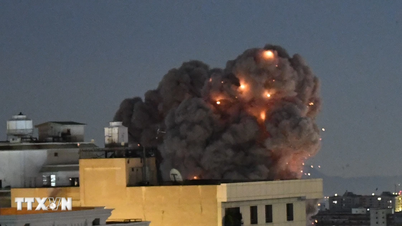
Despite repeated declarations from US President Donald Trump and his associates that the war was over, both sides continued to attack each other.
Over the past period, the two sides have held numerous rounds of diplomatic contacts, exchanging and proposing negotiation topics, but the peace talks remain deadlocked. To date, each side's proposed negotiation topics have been rejected by the other, and vice versa. Most recently, almost immediately after receiving Iran's response to the US proposal for negotiation topics, Donald Trump completely rejected Iran's response.
The fragile ceasefire and stalled peace talks between the US and Iran have many causes. Currently, both sides continue to attack each other, primarily due to Iran's control of the Strait of Hormuz and the US blockade of Iranian ports and the strait.
The Strait of Hormuz issue has now become the biggest challenge to the continuation of the ceasefire agreement and is also one of the central issues in the peace talks between the US and Iran. If the ceasefire is not maintained, the peace talks will not continue, and if the Strait of Hormuz issue is not resolved, the peace talks are unlikely to succeed.
The story surrounding the Strait of Hormuz has now become a test of the goodwill for peace talks on both sides, as well as the feasibility and prospects of a successful peace process aimed at ending the war.
Iran's control of the Strait of Hormuz is being used as a new and effective "weapon" in its conflict with the US, so it's understandable that the US is striving to neutralize this Iranian "weapon."
The biggest difference currently lies in each side's perspective: the US demands that Iran open the strait to free and safe passage for ships, while Iran demands that the US end its blockade of Iranian ports and the Strait of Hormuz, as well as recognize Iran's sovereignty over the strait.
Another reason is that both sides continue to impose stringent preconditions despite understanding that the chances of acceptance are very low. The US still demands that Iran completely end its nuclear and missile programs and cease supporting pro-Iranian armed forces in the region.
Meanwhile, Iran remains steadfast in its position that it has the right to pursue its nuclear and missile programs for peaceful purposes, while also demanding that the US end sanctions and provide war reparations.
In this context, peace talks have been unable to make substantive progress because neither side has offered a peace proposal that the other can accept without being seen as losing the war.
A ceasefire can always be broken, and peace talks remain stalled due to a lack of trust. Iran does not believe Donald Trump and his associates will abide by the agreement.
Conversely, Donald Trump remains very confident in America's military strength, always placing the US in a position of superiority, and continues to advocate for coercion and intimidation against Iran rather than equal peace talks.
In other words, the peace talks process lacks a solid foundation, and now is not the right time or context for it to progress smoothly.
Given that a ceasefire would benefit both sides, despite any potential rifts, both sides will maintain the truce. Peace talks will not completely collapse, but they are likely to remain deadlocked.
Source: https://hanoimoi.vn/ran-vo-ngung-chien-be-tac-hoa-dam-749465.html






























































































Comment (0)