

The Pragyan lunar rover took a remote photo of the Vikram lander after the pair of vehicles had completed half of their Chandrayaan-3 mission.
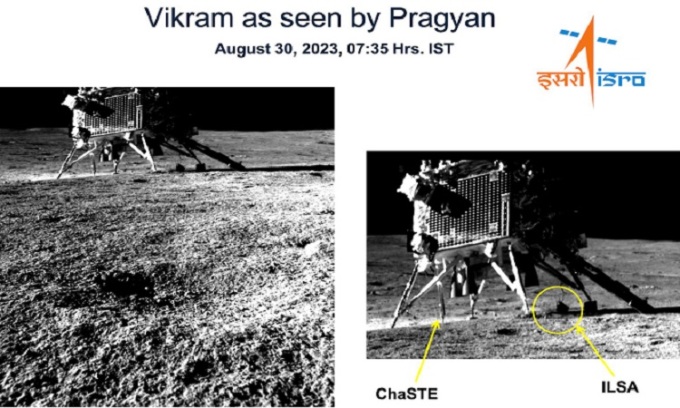
Vikram station in this photo taken by the Pragyan robot. Photo: ISRO
The Indian Space Research Organization (ISRO) shared two black-and-white images of the Chandrayaan-3 lander, showing the Vikram lander perched on the dusty surface of the Moon. The images were taken by the navigation camera on the Pragyan rover at 9:30 AM on August 30th (Hanoi time). One of the images is captioned to show two scientific sensors deployed by Vikram: the Chandra Surface Thermophysics Experiment (ChaSTE) and the Lunar Seismological Instrument (ILSA).
The Chandrayaan-3 mission landed on the Moon on August 23rd. A day later, the Pragyan rover separated from the lander. Both vehicles began scientific exploration. In the week since landing, the mission has sent back to Earth a series of photos and videos of Pragyan wandering across the lunar surface, leaving tire tracks on the ground. The photo shared by ISRO on August 30th is the first image of the lander taken from the rover's perspective.
The ChaSTE instrument on the mission garnered significant attention earlier this week for measuring the lunar surface temperature. This was the first measurement conducted by a sensor placed directly on the ground at the south pole, rather than from orbit. The instrument has a probe that drills 10 cm deep into the surface soil to understand how soil temperature changes with depth.
Measurements revealed a sudden temperature change in the surface soil. Eight centimeters below the surface, the soil froze at -10°C, while the surface was as hot as 60°C. The Moon's surface can become extremely hot during the day because, unlike Earth, the Moon is not protected by a thick atmosphere that can absorb heat from the Sun, balancing the difference between the amount of sunlight reaching the surface and the amount not.
Temperatures measured by the Vikram station remain relatively mild. Previous measurements from spacecraft orbiting the Moon showed temperatures could rise to 127 degrees Celsius during the day and drop to -173 degrees Celsius at night, especially around the equator, according to NASA. For that reason, missions to the Moon must take place at dawn, when the celestial body is warm enough for human activity but not too hot.
In a separate announcement, ISRO shared that Chandrayaan-3 found traces of sulfur in lunar soil. Sulfur had previously been found in small amounts in samples brought back to Earth during the Apollo missions in the 1970s. But scientists weren't sure how widespread this mineral was on the Moon. They believe the sulfur came from past tectonic activity, so understanding its abundance could help them better understand the Moon's history.
Chandrayaan-3 has now passed half of its planned lifespan. Neither the lander nor the rover is expected to survive the two-week lunar night. The solar-powered vehicle's battery pack is not powerful enough to sustain the systems as temperatures plummet and darkness envelops the lunar surface.
This was India's first successful lunar landing attempt, and also its first mission to land on the south pole. Previously, only the US, the Soviet Union, and China had sent spacecraft to the lunar surface. India itself had failed with the Chandrayaan-2 mission in 2019, when the lander crashed due to software malfunction, although the spacecraft continued to orbit and study the Moon.
An Khang (According to Space )
Source link



![[Image] Shipbuilders exposed to steel and record-breaking heat.](https://vphoto.vietnam.vn/thumb/1200x675/vietnam/resource/IMAGE/2026/06/04/1780545781745_ndo_br_img-5402-4683-jpg.webp)






















































![[Video] Sunset at Lap An Lagoon – Where the sun sets over the fishing nets](https://vphoto.vietnam.vn/thumb/1200x675/vietnam/resource/IMAGE/2026/05/31/1780192137701_beach-landscape-sea-water-nature-grass-745871-pxhere-com.jpeg)








































Comment (0)