

Nairobi, the capital city, boasts a vibrant technology industry with numerous startups and innovations. The city has also positioned itself as a technology hub in East Africa, earning the nickname "Silicone Prairies."
At Robot Cafe, the first cafe in East Africa to have robots serving customers, three robots join the human servers in delivering food to diners.
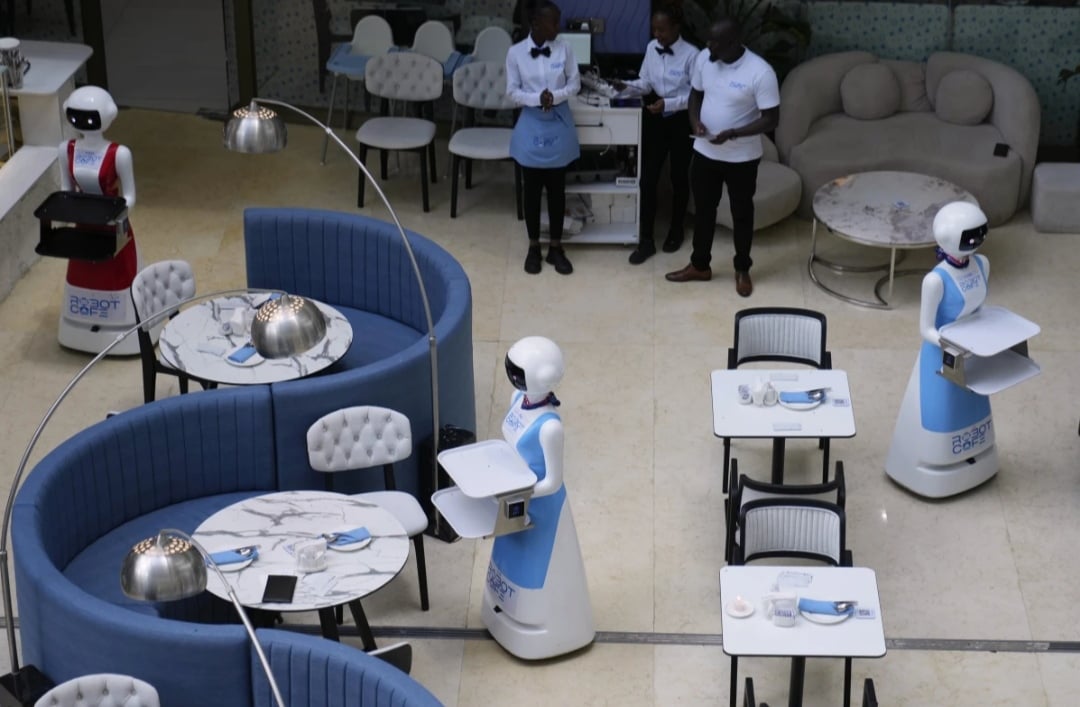
Robots work at the Robot Cafe in Nairobi, Kenya. Photo: AP
Restaurant owner Mohammed Abbas said he had experienced robot service in Asian and European countries and decided to invest in them.
He said importing robots was very expensive, but the investment paid off, as the restaurant was regularly crowded with customers curious to experience the robot service.
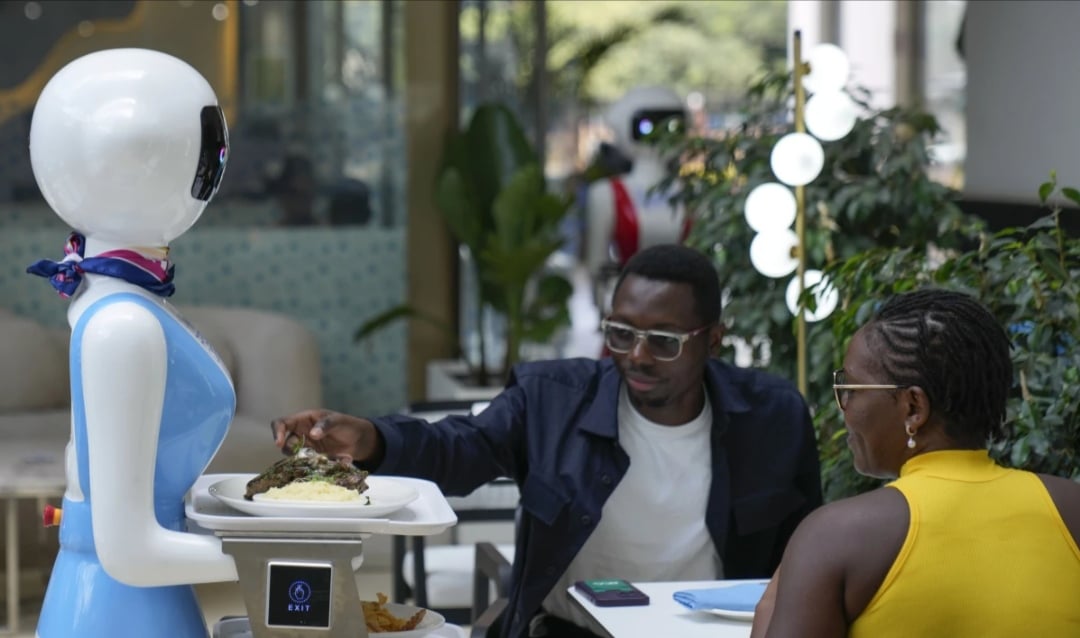
Robot Claire serves customers at Robot Cafe. Photo: AP
A customer named Packson Chege took a plate of fries from the robot's tray while his friend filmed the scene from across the table.
"This restaurant is very unique in our country, Kenya. I've never seen anything like it before, so I think it's a great idea from the owner," he said.
The three robots, named Claire, R24, and Nadia, are not programmed to engage in full conversation with customers, but they can say "Your food is ready" or "Welcome." The robots also require diners to press a button after taking food from the tray.
Waiters still play a crucial role in the restaurant's operations, as they take orders from customers who don't order online. Then, when the food is ready, the waitstaff place it on robotic trays.
This technology is predicted to transform the future workforce globally, particularly in Africa, which has a young population with an average age of 19.
But manager John Kariuki said robots cannot replace servers because they are not capable of providing all the services.
"Robots can't perform all the services in a restaurant without human intervention. In fact, we can't afford to buy robots because they're too expensive. So if you're still trying to save money, it's not cost-effective to choose to use robots," Kariuki explained.
Edith Ojwang, an expert in the hospitality industry, said there is still room for robotic and human services to coexist within the sector.
"The hospitality industry is very diverse. We have customers who prefer fully robotic and automated services, while we also have customers who prefer human service, so this isn't entirely a threat to human labor because of the diverse nature of the hospitality customer base," she said.
Ngoc Anh (according to AP)
Source: https://www.congluan.vn/robot-phuc-vu-gay-sot-o-kenya-post310232.html



































































![[Infographic] Vietnam's Economic Situation Report, Q1 2026: Strong Growth Momentum](https://vphoto.vietnam.vn/thumb/402x226/vietnam/resource/IMAGE/2026/04/04/1775298512042_tang-truong-kinh-te-viet-nam.jpeg)

![[Image] Close-up view of the 10-lane road connecting to Long Thanh Airport](https://vphoto.vietnam.vn/thumb/402x226/vietnam/resource/IMAGE/2026/04/04/1775291871988_ndo_br_1-resize-5690-jpg.webp)



























Comment (0)