

Originating from riverside villages
Like other rural areas, in Bac Ninh , spring arrives very early in the craft villages. While the city streets are still asleep, many villages are already brightly lit, beginning a new day of work. Spring originates from these very workshops – where the scent of freshly harvested rice, wood, earth, and fire blend together.
Along the banks of the Cau River, Tho Ha residential area (Van Ha ward) – an ancient land with a history spanning hundreds of years – begins its new day before 4 a.m. The craft of making spring roll wrappers has become the lifeblood of the village, a vibrant cultural heritage of the Kinh Bac region. On bamboo frames lining the pathways and in the village square, the ivory-white spring roll wrappers air-dry in the cool breeze, creating a simple yet warm spring scene.
 |
The rice paper sheets used for spring rolls in Tho Ha are dried under the gentle sunlight at the end of the year. |
Mr. Trinh Dang Khoa, who has been involved in the craft for over 40 years, said that to make a standard rice cake, every step must be precise, from selecting Khang Dan rice, soaking it in salt water according to a specific ratio, grinding the flour very finely, spreading the batter thinly and evenly, steaming it until cooked, and then drying it in the right sunlight. “Now with the help of machinery, productivity has increased many times, but the quality of the cakes must still be maintained as before,” Mr. Khoa said. Each day, his family makes about 1,000 trays, equivalent to about 7,000 rice cakes. During the Lunar New Year season, his family increases production by an additional 3,500 cakes to meet orders. Therefore, their income also increases significantly; on average, he and his wife earn a profit of about 700,000 to 800,000 VND per day.
According to Mr. Bui Cong Ly, a long-time skilled craftsman, the drying process is the "secret" of Tho Ha's rice cakes. "Drying them in the right amount of sunlight ensures they are chewy, and even after soaking in water, they remain firm and don't fall apart," he said. Now, thanks to electric dryers, people are more proactive and no longer have to rely on the weather and the land as before.
Thổ Hà has no rice paddies and is surrounded by rivers on three sides. When pottery production declined in the early 20th century, the people completely switched to making spring roll wrappers. Since then, this craft has sustained generations. Currently, the residential area has over 300 households engaged in this craft, employing more than 1,000 workers. Notably, on June 27, 2025, the craft of making spring roll wrappers in Thổ Hà was recognized by the Ministry of Culture, Sports and Tourism as a National Intangible Cultural Heritage – a milestone affirming the enduring value of the craft in the modern era.
Leaving Tho Ha, the spring atmosphere continues to spread to other craft villages. In Dong Ky craft village (Dong Nguyen ward), the sounds of chisels and machines blend with the lights of the woodworking workshops from morning till night. Altar tables, horizontal plaques, and couplets are completed in time for Tet, embodying meticulous craftsmanship and the belief in a prosperous new year. Similarly, in Phu Lang craft village (Phu Lang commune), pottery kilns burn brightly day and night. The eel-skin glaze is warm and rich, and the pottery shapes are simple yet refined. The artisans say that pottery is most beautiful when made at the end of the year – when earth, water, and fire blend perfectly.
Preserving traditional crafts in the modern lifestyle.
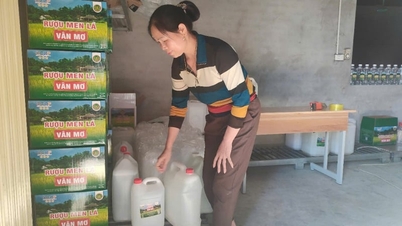
Bac Ninh is not just home to a few famous craft villages, but a land of hundreds of crafts, where each village carries its own story of resilience and adaptability. From Phu Lang pottery to Tho Ha rice paper for spring rolls, Van village wine... many production facilities have boldly innovated, built brands, and contributed to creating jobs and increasing income for the people. Towards the end of the year, the output of each facility can increase by 5-10% compared to the previous months.
 |
Ceramic vases are being produced for the Lunar New Year in Phu Lang craft village. |
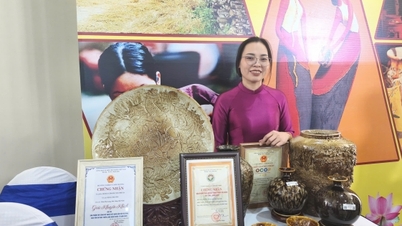
In Phu Lang village, Ngoc Pottery Workshop is a prime example of creativity within tradition. Certified for production and business since 2008, the workshop, spanning over 1,000 m², is scientifically planned and includes space for display and hands-on experience. Currently, the workshop produces approximately 1,000 works of art such as vases, flower pots, feng shui water fountains, teapots and cups, incense burners, health-promoting candles, and decorative garden murals using traditional eel-skin glaze.
Ms. Doan Minh Ngoc, the owner of the workshop, said that she and her husband are the fourth generation in the pottery trade. To keep up with the market, they created a line of "clean" glazes made from rice husk ash, firewood, lotus stems, and alluvial soil from the Cau River, which are environmentally friendly. Ngoc Pottery products won many prestigious awards in 2025 and are currently widely consumed domestically and exported to Thailand, South Korea, and other countries. "Preserving the craft is not just about preserving the old techniques, but about making the craft alive in today's life. To achieve this, each craftsman and artisan must dedicate all their efforts and cherish each of their products," Ms. Ngoc shared.
According to Ms. Nguyen Thi Tinh, Head of Phu Lang village, the craft village here (including Phu Lang, Thu Cong, and Doan Ket villages) has more than 200 households engaged in pottery making, with about 100 households in Phu Lang village alone. While previously they only produced traditional-style jars, pots, and earthenware containers, many young people who graduated from fine arts universities have now returned to the village, becoming artisans and creating high-value artistic products. Along with the efforts of the people, many conservation projects supported by the province and the Japan International Cooperation Agency (JICA) have helped Phu Lang preserve and promote its traditional pottery brand.
Beyond pottery, Bac Ninh's craft villages are divided into five main sectors, ranging from agricultural product processing and handicrafts to ornamental plants and rural services. Through the OCOP program and policies supporting craft villages, the province has invested billions of dong to support brand building, labeling, and market expansion. As a result, products like Lang Van Wine have been recognized as a 4-star OCOP product, becoming a familiar brand to consumers.
Nevertheless, traditional craft villages still face numerous challenges such as small scale, environmental pollution, and difficulties in finding markets for their products. According to Mr. Luu Van Khai, Head of the Cooperative Economic and Rural Development Sub-Department (Bac Ninh Department of Agriculture and Environment), the key factor is to retain and develop a team of skilled artisans and craftsmen, encourage creativity, pass on skills, and link preservation with tourism development and the green economy.
Every spring, products from traditional craft villages travel with traders to all corners of the country, appearing on festive tables and in the gatherings of families. Behind that prosperous Tet holiday lies the hard work of countless sleepless nights, the rough hands of artisans, and an undying desire to preserve their crafts. Therefore, the springtime atmosphere of Bac Ninh's craft villages is not only the color of the products but also the springtime of faith, identity, and of a land of a hundred crafts quietly transforming itself and stepping into the future.
Source: https://baobacninhtv.vn/sac-xuan-lang-nghe-bac-ninh-postid437548.bbg


![[Photo] General Secretary and President To Lam receives Amazon's Senior Vice President David Zapolsky](https://vphoto.vietnam.vn/thumb/1200x675/vietnam/resource/IMAGE/2026/05/22/1779466547770_a1-bnd-3513-6601-jpg.webp)















































































Comment (0)