

Considered a province with great potential and room for developing large-scale, high-quality rice production, Thanh Hoa's agricultural sector has, in recent years, directed localities to implement solutions to improve rice quality and meet the demands of domestic and international markets.
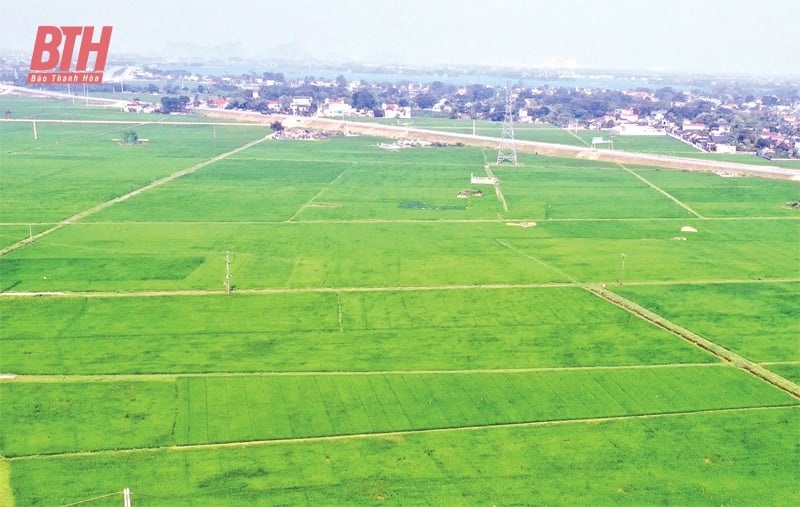
Understanding the challenges and practical demands, the agricultural sector has encouraged farmers to gradually adopt comprehensive mechanization, from land preparation, cultivation, harvesting to preservation and processing of agricultural products. In addition, emphasis is placed on piloting and replicating models of applying scientific and technological advancements in rice production on a large scale, such as: hybrid rice cultivation, deep placement of granular fertilizer, introduction of drought-resistant three-line hybrid rice varieties, and the use of drones... Currently, the percentage of high-yielding, high-quality, adaptable, and resistant rice varieties in the province accounts for up to 90%, including: Thai Xuyen 111, VT 404, Phuc Thai 168, Q5, Lam Son 8, TBJ03, DD 2, Loc Troi 183, BQ, TBR225, Thien Uu 8, Nep Thom 86... At the same time, land consolidation and concentration are being promoted to build and develop high-yielding, high-quality, and efficient rice intensive farming areas, creating conditions for the application of synchronized mechanization in the production process. People have also become more conscious in the use of pesticides, choosing biological pesticides that are selective and highly effective in controlling pests and diseases, decompose quickly, and leave minimal residue in the environment and on products.
In Thieu Vien commune (Thieu Hoa district), many years ago, the Thieu Vien Agricultural Service Cooperative began researching and conducting trial production of the Japanese rice variety Japonica (J02) according to VietGAP standards. This is one of the 10 best quality rice varieties currently available, with many outstanding advantages such as: strong stems, vigorous tillering, good lodging resistance, cold tolerance, good resistance to pests and diseases, and good resistance to bacterial blight, especially during the main cropping season. However, previously, the concept of VietGAP was quite unfamiliar to traditional farming practices. Therefore, the cooperative renovated and restored the commune's barren fields for production, and simultaneously signed production linkage and product purchase contracts with businesses to reassure farmers and encourage them to invest in production. In addition, the cooperative has partnered with Green Agriculture Co., Ltd. to transfer advanced science and technology, provide seeds and pesticides, and purchase all products from farmers.
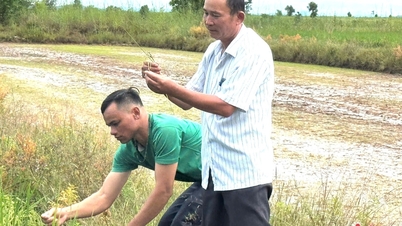
Ms. Nguyen Thi Tuoi, a member of the cooperative, said: “During the cultivation process, we received guidance and support from the cooperative in accessing modern, safe planting and care techniques that protect the health of producers and the environment. The entire production process is strictly controlled by the cooperative from sowing, caring for, harvesting to processing, along with post-harvest packaging and preservation procedures.”
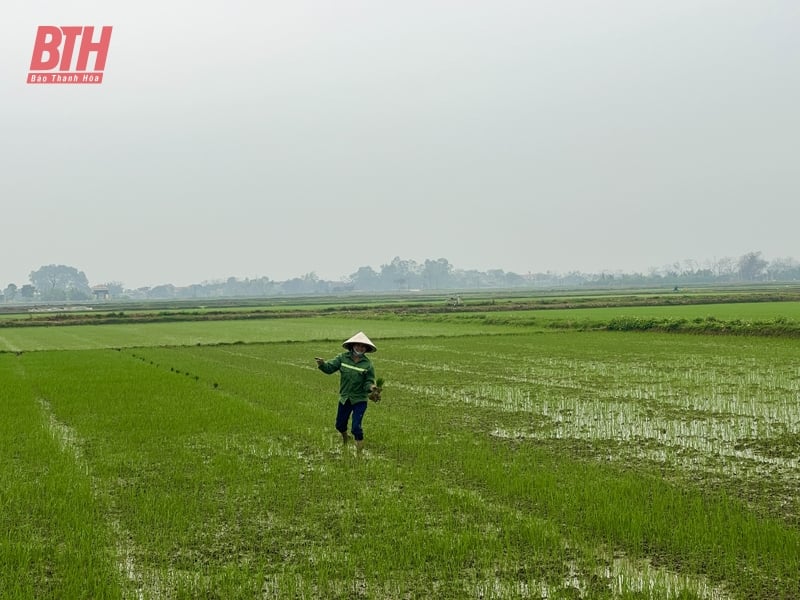
To improve the quality of rice products, localities have also focused on forming and developing many rice production linkage models along the value chain that achieve high economic efficiency, such as: the rice production and processing model of Sao Khue Trading Joint Stock Company with households in Trieu Son and Nong Cong districts; the high-quality organic rice production model linked to product consumption between Bac Trung Bo Joint Stock Company and households in communes in Quang Xuong district. Along with investing in production, localities in the province also focus on building brands for rice products such as: Gia Mieu Ngoai Trang glutinous rice, Tien Son rice, Huong Que clean rice, Van Dai rice... which have been recognized as OCOP products.
According to Nguyen Van Thinh, Head of the Agriculture and Rural Development Department of Ha Trung District, "Based on the local topographical conditions, in the coming years we will continue to develop models of rice cultivation combined with aquaculture. In addition, applying scientific and technical measures; strengthening deep processing, and focusing on brand building are considered important solutions to enhance the value and efficiency of rice production in the area."
It can be said that recently, rice production in the province has become increasingly sophisticated, with improved quality and higher profits. Farmers have changed their production mindset, applying new science and technology to all stages of production, from planting to cultivation; building large-scale, high-quality rice production models; and creating stable raw material areas for processing plants. In the future, with the goal of ensuring both quality and quantity, the agricultural sector will continue to direct localities to apply advanced technical advancements, high-quality seeds, new technologies, and smart technologies in rice production; process safe rice products to meet the growing demands of consumers; and build and develop the province's rice brand.
Text and photos: Le Ngoc
Source: https://baothanhhoa.vn/san-xuat-lua-gao-nbsp-chat-luong-cao-240569.htm

![[Image] "Journey of Hope" promotes the organ and tissue donation movement in Vietnam.](https://vphoto.vietnam.vn/thumb/1200x675/vietnam/resource/IMAGE/2026/05/20/1779294400833_1-8910-jpg.webp)























































Comment (0)