Following the implementation of the two-tiered local government model, the Trang Dinh District Health Center provides professional guidance, technical support, and coordinates with commune health stations to carry out tasks related to medical examination and treatment; preventive medicine; population; and health education and communication in 7 communes with over 60,000 inhabitants. Due to the large geographical area, many villages are far from the center, and the awareness and economic conditions of the people are uneven, so encouraging pregnant women and families with newborns to participate in screening needs to be done regularly at the grassroots level. Therefore, the Trang Dinh District Health Center focuses on coordinating with commune health stations to manage pregnant women early, providing timely and appropriate counseling for each target group.

Dr. Be Van Khanh, Director of Trang Dinh District Health Center, said: "Prenatal and postnatal screening is one of the important aspects in improving the quality of the population. From the beginning of the year, the center has assigned targets to departments and wards, coordinating with commune health stations to integrate screening counseling into prenatal examinations, vaccinations, postpartum care, and population communication sessions. The unit's view is to ensure accurate management of pregnant women at the grassroots level, preventing pregnant women from lacking information or missing the appropriate screening opportunities."


Accordingly, commune-level population officials regularly review and update the list of pregnant women in the area, monitor prenatal check-up schedules, remind women of tetanus vaccination schedules, provide nutritional advice, and track important prenatal check-up milestones. By 2025, the entire region will have 498 out of 536 pregnant women receiving regular prenatal check-ups, reaching 92.9%; and 535 out of 536 women giving birth at medical facilities, reaching 99.8%. From the beginning of 2026 to the present, 38 out of 41 pregnant women have received regular prenatal check-ups, and all 41 women have given birth at medical facilities. This provides a foundation for health workers to advise and encourage women during pregnancy and childbirth to undergo prenatal and postnatal screening at the right time.
In addition, the District Health Center has coordinated with commune health stations to strengthen direct communication in the community. From 2025 to the present, the Trang Dinh District Health Center has organized 14 social mobilization, behavior change, and professional counseling sessions in the community on pre-marital health check-ups, prenatal screening, and reproductive health screening, reaching nearly 1,200 listeners. Simultaneously, they have collaborated on the development of 16 programs broadcast on the hospital's radio system 56 times, in communes 52 times, and displayed 52 banners at the District Health Center and commune health stations.
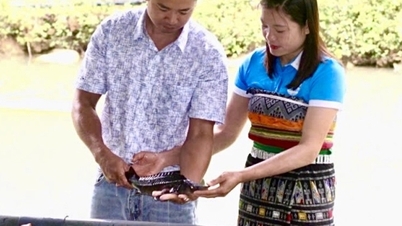
Mr. Ma Duy Anh, a population officer in That Khe commune, said: "The commune currently has 33 villages with over 18,000 inhabitants, including more than 4,500 women of childbearing age. We regularly coordinate with village health workers to update the list of pregnant women, remind them of prenatal check-up schedules and vaccinations, advise on key milestones for prenatal screening, and encourage families to carry out prenatal screening. The most difficult thing is that some people still think that if the pregnancy is normal and the child is born healthy, screening is not necessary. Therefore, population officers have to repeatedly educate people, using relatable examples, to help them understand that this is a necessary step to detect early risks of congenital diseases and defects, giving children the opportunity for timely intervention."
This approach to outreach has helped many pregnant women change their perceptions. Ms. Chu Thi Phuong, from Cap Ke village, That Khe commune, shared: "Initially, I thought that regular ultrasounds and prenatal checkups were enough. After receiving advice from healthcare workers on prenatal and newborn screening, I understood that this is necessary to monitor the health of both mother and child, and to receive early treatment if there are any potential abnormalities. Therefore, my family proactively underwent screening as instructed by healthcare workers, and as a result, my child was born completely healthy."
Thanks to the synchronized implementation of measures, the work of screening for newborns and infants in the commune has seen many positive changes. In 2025, the screening rate of the Trang Dinh Regional Health Center reached 90.5%, 18.5% higher than the provincial average; the screening rate for newborns reached 33.3%. From the beginning of 2026 to the present, the entire region has had 242 newborns, of which 183 were screened for newborns, reaching 75.6%; and 129 were screened for newborns, reaching 53.3%.



Building on the achievements, in the coming period, the unit will continue to closely manage pregnant women at the grassroots level; increase the rate of regular prenatal check-ups; provide timely screening and counseling; improve the quality of postpartum care for mothers and children; and strengthen direct communication in villages, hamlets, schools, and through the local broadcasting system. When every pregnant woman receives comprehensive counseling and every newborn is cared for from the very first days of life, the monitoring of maternal and newborn health will not only be a professional indicator but also a practical solution to improve the quality of the population in Trang Dinh district.
Source: https://baolangson.vn/sang-loc-som-bao-ve-tre-5096387.html
![[Image] Ho Chi Minh City: Ma Lang area, Chicken-Rice Market about to change its appearance](https://vphoto.vietnam.vn/thumb/1200x675/vietnam/resource/IMAGE/2026/06/25/1782377698627_ndo_br_m1-jpg.webp)







































![[Image] Schools organize meetings and introduce teaching models to students admitted to grade 10.](https://vphoto.vietnam.vn/thumb/1200x675/vietnam/resource/IMAGE/2026/06/25/1782368077271_ndo_br_z7970052192242-1ec8daeb77a6eed1a4e9f58c564ddd3e-jpg.webp)