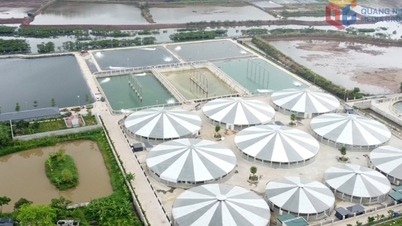
Currently, the total area planted with durian nationwide has exceeded 150,000 hectares, double the government's target for 2030. In the Mekong Delta alone, the durian planting area has increased to 40,000 hectares.
Third-year warning
Durian cultivation is not only concentrated in the traditional growing areas of Dong Thap, Vinh Long, and Can Tho provinces, but has also spread to many other localities such as Tay Ninh and An Giang . A large portion of this new cultivation area is not included in the planning and lacks a foundation of sustainable farming techniques.
Field surveys conducted by scientists from the School of Agriculture - Can Tho University show that many farmers do not understand the characteristics of durian-growing soil, and have never even assessed whether their existing soil is suitable. A series of warning signs have been identified from soil analyses in the Mekong Delta region.
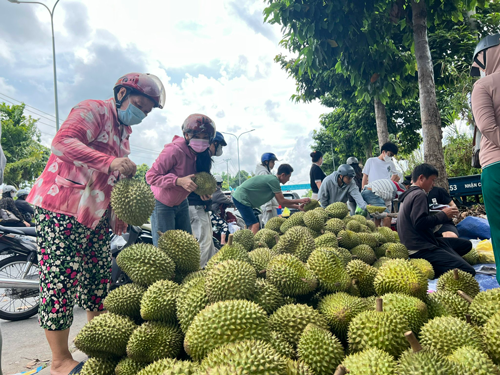
Effective cadmium control will contribute to improving the quality of durian fruit in the Mekong Delta.
Research results on soil health indicators show significant degradation: low pH, ranging from 4 to 5; organic matter content of only 2% to 4%; deficiencies in nitrogen (N), potassium (K), and trace elements such as boron, molybdenum, and copper. Furthermore, the microbial population and enzyme activity in the soil are very weak, indicating a serious biological imbalance.
In addition, durian orchards currently accumulate many toxins. This is a consequence of the overuse of chemical pesticides, especially those that stimulate flowering.
Recently, durian prices in the Mekong Delta have consistently dropped during peak season. Ms. Nguyen Hong Tram Tuyen, Deputy Director of Diem Phuc Fruit Import-Export Co., Ltd. (Dong Thap), believes the reason lies not only in the supply and demand dynamics, but more importantly, in the fact that durian does not meet the technical standards for export. Notably, durian is often contaminated with Yellow O and cadmium heavy metal residues from fertilizers; while the growing areas and packaging facilities still have limited capacity.
"The number of durian samples from the Mekong Delta contaminated with cadmium is very high. This rate is very low in the Eastern region, and almost non-existent in the Central Highlands. The quality of durian from the Mekong Delta is considered by the Chinese market to be on par with Thai durian, but the cadmium contamination has been warned about for the third year. If this problem is not thoroughly resolved, all the efforts of the durian industry will be back to square one, threatening the survival of the specialized cultivation region," Ms. Tuyen expressed her concern.
According to Mr. Vo Tan Loi, Chairman of the Durian Association of Dong Thap province, one of the reasons why durian from the Mekong Delta is difficult to export to the Chinese market is due to cadmium contamination exceeding the permitted limit.

He stated: "This is a consequence of the use of fertilizers, especially phosphate fertilizers, and the residual cadmium in the soil. Although research institutes and plant protection agencies have intervened and implemented cadmium removal models, the results are still unclear due to the complex nature of the soil environment."
Having cultivated durian for over 10 years, Mr. Bui Van Nam (residing in Quoi Thien commune, Vinh Long province) requested that the agricultural sector and relevant agencies promptly send officials to his orchard for surveys and provide hands-on guidance. He also requested a clear list of safe fertilizers and agricultural supplies currently available on the market that do not contain cadmium.
"More importantly, we need specific technical protocols and procedures for soil remediation, detoxification, and removal of residual cadmium in order to save people's livelihoods," Mr. Nam expressed.
Standardizing production processes
Dr. Tran Huu Phuc, from the Department of Crop Science - Can Tho University, believes that the habit of fertilizing based on intuition among farmers, the overuse of inorganic fertilizers, and the lack of organic fertilizers have negatively impacted durian trees.
Dr. Phuc proposed an urgent solution: absolutely no more fertilizers containing cadmium should be added to the soil, and only the permitted dosage should be used. State management agencies and relevant businesses need to quickly develop a plan to control cadmium in the soil, and organize widespread and continuous training for farmers on techniques. In addition, a list of safe materials and fertilizers - especially phosphate fertilizers - should be compiled so that people can make the right choices.
According to statistics, from the beginning of 2026 to the present, Can Tho City has implemented 99 production-consumption linkages covering an area of nearly 872 hectares, supplying more than 19,300 tons of fruit to the market. Among these, durian and longan are two fruit crops that have seen many large-scale linkage models. Specifically for durian, there are 24 linkage chains covering an area of over 421 hectares, with a production of nearly 9,300 tons.
Ms. Pham Thi Minh Hieu, Head of the Crop Production and Plant Protection Sub-Department of Can Tho City, said that the unit will tighten management through regular and surprise inspections using random field sampling for 657 durian growing area codes right before the durian harvest. This aims to monitor the quality and responsibility of the entities participating in the value chain.
Meanwhile, in Dong Thap province, nearly 50% of durian growing areas have been granted planting area codes. The province is accelerating the standardization of the entire production process towards cadmium-free safety, while also digitizing planting area data for transparent traceability.
Many have agreed that cadmium control is not just a temporary solution but requires a comprehensive strategy, spanning from land reclamation and input selection to post-harvest quality monitoring.
Production with a focus on safety.



Mr. Tran Van Chien, Director of Truong Khuong A Fruit Tree Cooperative (Truong Long commune, Can Tho city), said that in recent years, the cooperative has boldly applied production methods towards safety and sustainability. The cooperative pays special attention to controlling inputs, limiting the use of fertilizers with high potassium content, and eliminating pesticides with high toxicity and long decomposition times, which has significantly improved the quality of durian fruit.
According to Mr. Chien, thanks to the strict implementation of this process, for the past three years, products from Truong Khuong A Cooperative have all met inspection requirements, with no cadmium residue detected.
Source: https://nld.com.vn/siet-chat-quan-ly-chat-luong-sau-rieng-196260614203353869.htm