

Maintaining a rate of 8% per year, exceptionally up to 10% per year.
Recently, the State Bank of Vietnam (SBV) issued a document requesting its regional branches to inspect commercial banks regarding the implementation of interest rate reductions on savings accounts.
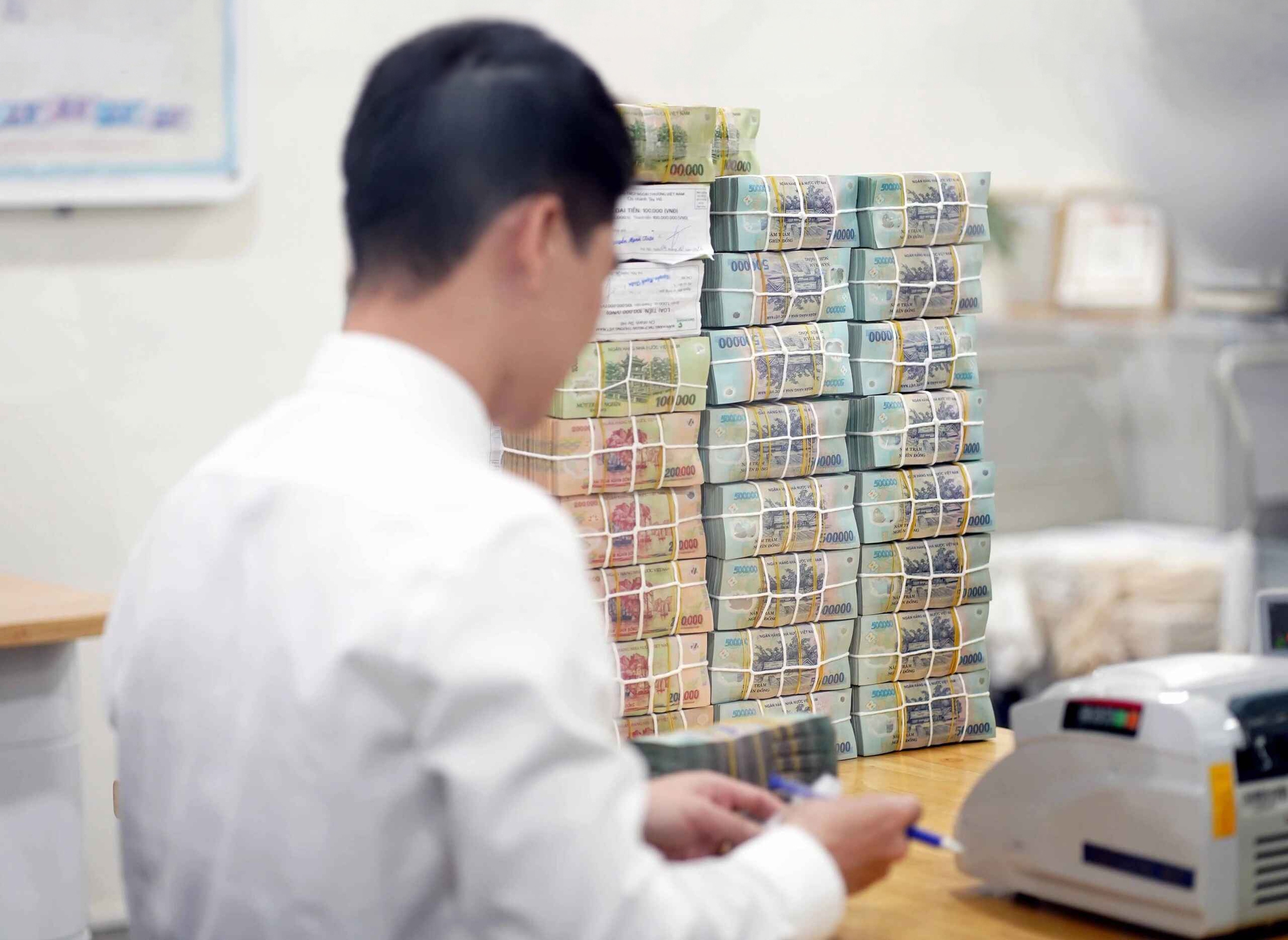
Savings and lending interest rates remain high despite numerous actions taken by the State Bank of Vietnam.
Photo: Ngoc Thang
Earlier, in early April, the State Bank of Vietnam (SBV) held a meeting urging commercial banks to agree on reducing interest rates to support businesses and individuals; lowering listed deposit and lending rates to increase access to capital for businesses and individuals. Immediately after the meeting, many commercial banks proactively and actively implemented interest rate reductions.
However, in recent days, there have been isolated cases of some commercial banks not strictly adhering to directives, adjusting interest rates upwards, which has been reported by the press and media. The officially published interest rates of banks have not changed much compared to the beginning of May; for terms under 6 months, they are almost at the maximum allowed rate of 4.75%/year, and for terms from 6 to 12 months, they range from 6 to 7%/year. Yet, on forums and social media groups, the race to attract deposits is quite fierce, with interest rates offered exceeding 8%/year for 6-month terms and 9.1%/year for 12-month terms. In reality, depositors who bring their money to the counter also receive higher interest rates than the officially announced rates.
Ms. Thanh An (from Ben Thanh Ward, Ho Chi Minh City) shared that earlier this week, her 6-month savings account at a commercial bank was due to mature, and when she renewed it, the 6-month term still offered an interest rate of 8.3%/year, while a 12-month term would yield 8.5%/year. The credit officer even stated that if she deposited 2 billion VND or more, the interest rate would be about 0.1-0.2% higher, depending on the term.
Similarly, Ms. Kim Yen (residing in Tan Hung Ward, Ho Chi Minh City) matured her savings account on May 22nd at a branch in the area and was also offered an interest rate of 8% per year for a 12-month term, even though the amount was only slightly over 200 million VND. The most surprising thing is that this same bank had previously announced and listed its highest interest rate at only 6.5% per year... The situation of banks secretly raising savings interest rates higher than the rates published on their websites or at branches, as described above, is not uncommon.
According to statistics from the Vietnam Banking Association, the deposit market from May 11-16 showed signs of a reversal compared to before, with interest rates at some commercial banks adjusting upwards, mainly through online channels and promotional programs. Sacombank significantly adjusted deposit interest rates through online channels, increasing them by 0.2-1% per year depending on the term and deposit amount. Cake by VPBank also implemented a policy of adding up to 1.5% per year in interest for new customers depositing savings for terms of 6 months or more. OCB slightly increased interest rates by 0.1% per year for terms of 6-36 months. Bac A Bank also increased interest rates by 0.25% per year for the 13-month term, bringing the interest rate to 7% per year for deposits under 1 billion VND…
Meanwhile, state-owned commercial banks continue to maintain significantly lower interest rates compared to private joint-stock banks. Specifically, for regular savings accounts, Vietcombank, BIDV , and VietinBank list around 3.5% per year for 6-year terms.
Interest rates are typically 9 months and around 5.9-6% per year for terms of 12 months or more. Some major banks even see a decrease in interest rates for certain terms. For example, at Vietcombank , for flexible savings accounts, interest rates have decreased by 0.2-0.4% per year for 6-month and 12-month terms, down to 7% per year and 7.4% per year respectively...
Lending interest rates remain high.
A series of moves by the State Bank of Vietnam (SBV) shows the central bank's determination to tighten savings interest rates in order to lower lending interest rates and support businesses. Specifically, Circular 08 allows commercial banks to include 20% of time deposits from the State Treasury in their mobilized capital when calculating the loan-to-deposit ratio (LDR), effective from May 15th instead of ending at the beginning of the year.
Regulations on calculating State Treasury deposits have helped state-owned commercial banks (the Big 4 group including Vietcombank, BIDV, VietinBank, and Agribank) cool down their Loan-to-Deposit Ratio (LDR), which is approaching the 85% ceiling. This allows the commercial banking system to expand by tens to hundreds of trillions of dong without the pressure of accelerating new capital mobilization from the public. Analysts consider this slight loosening of the credit valve as a solution to remove technical barriers, contributing to reducing pressure on deposit interest rates and supporting the stability of the monetary market.
However, lending interest rates have not decreased. According to Mr. Thanh Trung (residing in Tan Thuan Ward, Ho Chi Minh City), at the beginning of April, the interest rate on his apartment loan contract was adjusted upwards by the bank to 13.6% per year, nearly 2% higher than at the end of 2025. In May, the interest rate remained at this level with no further changes. This interest rate increase has resulted in a monthly interest payment of 1 million VND more than before.
In fact, the average lending interest rates announced by banks continue to increase and remain unchanged. For example, the average lending interest rate in April at Eximbank was 7.76%/year (an increase of 0.6%/year compared to January), with the average lending interest rate for individual customers being 8.2%/year and for businesses 7.28%/year. Similarly, the average lending interest rate for March at Vietcombank increased by 0.2%, to 6.6%/year. Techcombank also recently announced an average lending interest rate of 10.3%/year for disbursements in April (an increase of 0.03% compared to March). MB applies lending interest rates for individual customers from 8.3 - 9.1%/year; for small and medium-sized enterprises from 9.5 - 9.7%/year...
According to the Vietnam Banking Association, lending interest rates in April and the first week of May continued to show a clear stratification. The Big 4 banks maintained preferential rates ranging from 5.42% to 7%, while other joint-stock commercial banks ranged from 10.8% to 15% per year. The average VND lending interest rate of domestic commercial banks for both existing and new loans remained in the range of 7.1% to 9.4% per year.
Associate Professor Dr. Dinh Trong Thinh, a financial and economic expert, believes that in the context of high inflation both globally and in Vietnam, there is not much room for further interest rate reductions. To lower interest rates, the State Bank of Vietnam needs to proactively use various tools, including promoting overnight lending in the interbank market at low interest rates. This would give commercial banks more opportunities to reduce both savings and lending rates. Statistical data also shows that people's deposits in banks are still lower than the rate of lending. If savings interest rates are reduced too much, people will not deposit money in banks, creating further difficulties for many banks. Commercial banks themselves must continue to focus on reducing costs, especially profits, to support businesses and individuals, thereby contributing to the country's overall economic growth.
Savings deposits are slower to accrue than loans.
According to a survey of the business results of 27 commercial banks in the first quarter of 2026, lending increased by 3.6%, but deposits only increased by 0.6%. Twelve of these commercial banks recorded a decrease in deposit balances. The ratio of demand deposits (CASA) decreased by an average of 15.18% to 13.77%, reflecting pressure on capital mobilization in the context of more difficult liquidity conditions across the industry and interest rates that have not decreased, or have even increased. The State Bank of Vietnam (SBV) stated that it will continue to closely monitor the developments in deposit and lending interest rates in the market and of each commercial bank, as well as the publication of lending interest rates on the websites of commercial banks, in order to implement timely policies and measures to ensure that commercial banks strictly comply with the directive to reduce interest rates. At the same time, the SBV will implement appropriate monetary policy solutions and is ready to support liquidity for the banking system.
Source: https://thanhnien.vn/siet-lai-suat-tiet-kiem-185260524222812097.htm









































































































Comment (0)