In the context of agriculture facing pressure from climate change and the demand for sustainable development, utilizing post-harvest straw is not only an environmental solution but also an opportunity to increase agricultural production efficiency in many localities.
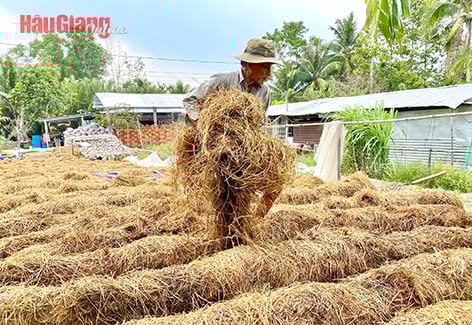
Locals are utilizing straw to grow mushrooms, thereby increasing their income.
Rice straw after harvest is not just a waste product, but actually an invaluable resource in agriculture. Instead of wasting it, Mr. Pham Van Phai, in Hamlet 3, Luong Tam Commune, Long My District, chooses to make full use of the straw from his rice fields. His family cultivates 5 acres of rice, and after each harvest, he collects and stores it to use for growing straw mushrooms, or sells it to neighboring households that grow straw mushrooms to earn extra income even after the rice season is over.
Mr. Phai said: “Currently, I utilize the vacant land around my house to grow straw mushrooms. I use the straw I just harvested and buy more from outside to grow the mushrooms. With a selling price of about 45,000-50,000 VND/kg of fresh mushrooms, my family harvests nearly 100kg of mushrooms every day, bringing a considerable profit to the family after the rice harvest.”
Not stopping there, after the straw mushroom harvest, Mr. Phai continued to use the remaining straw to compost and fertilize his lettuce garden behind his house. "Straw is a very good organic fertilizer for plants and safe for human health. Above all, it helps me save on the cost of buying chemical fertilizers for my vegetables," Mr. Phai added.
Not only Mr. Phai's family, but many rice farmers in Long My district are now utilizing rice by-products to supplement their income. Those without land for mushroom cultivation can collect the straw into large bales, which are then stored by farmers for their own use or sold to other households as animal feed, mushroom cultivation, fertilizer, mulch for crops, or as padding for preserving certain agricultural products. Currently, an average bale of straw weighing 12-15 kg sells for 20,000 VND or more. During peak demand periods, the price can reach 50,000 VND per bale.
Besides being used as animal feed and a renewable energy source, straw can also be transformed into organic fertilizer. Through natural decomposition or microbial treatment, straw can be turned into nutrient-rich fertilizer, providing minerals to the soil and improving soil structure. Mr. Nguyen Van Han, from Thuan Hung commune, Long My district, is one of the farmers who has boldly transformed straw into organic fertilizer for his rice fields. Mr. Han said: “The most noticeable effect of using straw as organic fertilizer is the reduction in the number of pesticide applications per crop, and the fertilizer is also lighter compared to conventional sowing, thus saving costs and increasing post-harvest profits.”
According to the Long My District Plant Cultivation and Protection Station, farmers in the district have been utilizing straw in production, primarily collecting it for mushroom cultivation. However, the area where straw is collected and removed from the fields remains low. Burning straw in the fields causes air pollution, generates CO2, and contributes to greenhouse gas emissions. Furthermore, burning straw kills beneficial organisms (natural enemies) in the fields and wastes nutrients from the straw.
Mr. Tran Hoai Nhan, Head of the Crop Production and Plant Protection Station of Long My District, said: "To increase production value per unit area, improve the income and living standards of rice farmers; protect the environment, reduce greenhouse gas emissions; and contribute to the implementation of the project 'Sustainable development of 1 million hectares of high-quality and low-emission rice cultivation associated with green growth in the Mekong Delta by 2030', people need to implement 'rice straw management according to circular and low-emission agriculture'. This is a very effective model that needs to be maintained and developed in the future."



"To promote the application of new technologies such as mechanized collection of wet and dry straw, mechanized production of organic fertilizer from straw, and the integration of mechanization with microbial technology to improve process efficiency and facilitate scaling up application, this model is suitable for many target groups such as farmers, cooperatives, farms, and businesses," Mr. Nhan added.
Text and photos: MAI THANH
Source
![[Photo] A phone-free summer afternoon at the village library](https://vphoto.vietnam.vn/thumb/1200x675/vietnam/resource/IMAGE/2026/06/27/1782551770949_anh-1-jpg.webp)

![[Photo] Thousands of people participate in a run to show their support for the campaign "Sharing a common determination to build drug-free communes, wards, and special zones".](https://vphoto.vietnam.vn/thumb/1200x675/vietnam/resource/IMAGE/2026/06/27/1782554475933_0673e2a3df7b5e25076a-8283-jpg.webp)