

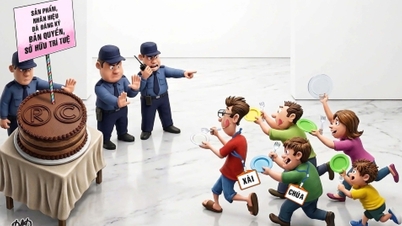
However, to date, there is still no specific legal framework to allow these platforms to operate legitimately. Meanwhile, the need for copyright protection in the country is growing, with Ho Chi Minh City alone having thousands of members of professional associations (fine arts, photography, music , film, etc.) and independent creative practitioners.
Not only is there a lack of tools, but creators of digital artwork are also struggling and unfamiliar with creating "digital birth certificates" to protect their works. Only when a "conflict" occurs, such as discovering plagiarism or legal disputes related to copyright, do those involved become concerned about protecting their intellectual property...
This is also the most obvious weakness, preventing the respect for copyright from being fully upheld and hindering the formation of a professional art market from even the most fundamental stage.
The story of artist Teo Pham is a prime example: his digital artwork, posted on his personal page, was copied, encoded into an NFT, and successfully sold for nearly $1,000. What's even more concerning is that before any legal action was taken, the same person who stole it was again stolen, encoded, and sold by another account, making it extremely difficult to track down and remove the infringing work.
Furthermore, while the trend of applying AI to creative processes is increasingly popular, major questions remain unanswered: will the technology only go as far as suggesting ideas, or will it handle every detail? Will products created by AI be considered art? Does copyright belong to the creator of the commands or to the AI?
The cultural industry has been identified as a key development goal for Vietnam and many other countries. Before calculating the specific contribution to the economy , the first concern is how to build a systematic and professional creative environment, gradually forming a market with respect to the rule of law… and the core issue for all solutions remains the human element.
Copyright is not just a right; first and foremost, it needs to be understood correctly and comprehensively, especially in the current context of intertwined legal issues. Furthermore, the tools for addressing this issue need to be continuously updated to ensure transparency and alignment with new creative trends. This will not only facilitate the application of copyright by creative practitioners but also instill confidence in both creators and consumers.
Source: https://www.sggp.org.vn/tac-quyen-nghe-thuat-so-giay-khai-sinh-con-bo-ngo-post805328.html
![[Image] Shipbuilders exposed to steel and record-breaking heat.](https://vphoto.vietnam.vn/thumb/1200x675/vietnam/resource/IMAGE/2026/06/04/1780545781745_ndo_br_img-5402-4683-jpg.webp)





























![[Video] Sunset at Lap An Lagoon – Where the sun sets over the fishing nets](https://vphoto.vietnam.vn/thumb/1200x675/vietnam/resource/IMAGE/2026/05/31/1780192137701_beach-landscape-sea-water-nature-grass-745871-pxhere-com.jpeg)
























Comment (0)