

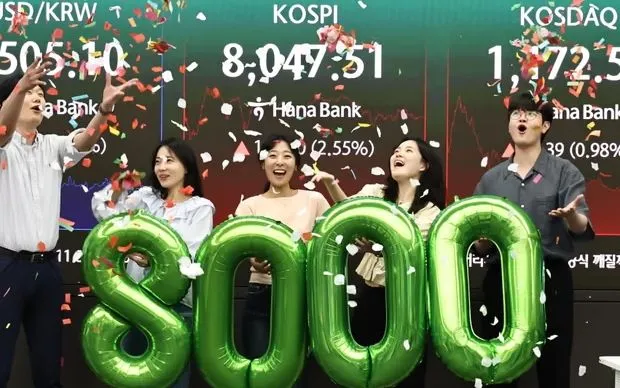
South Korea's Kospi index surpassed 8,000 points on May 26, 2026, driven by gains in chip and AI stocks. (Photo: YONHAP/EPA)
South Korean chip stocks surged on booming demand for artificial intelligence (AI), pushing the country's stock market to record highs. However, some experts warn that this rally is overly reliant on two major chipmakers, Samsung Electronics and SK Hynix.
South Korea's Kospi index has surged since the end of 2025 and has repeatedly set records. According to the information provided, the South Korean stock market has surpassed India to become the world's sixth-largest stock market, ahead of the UK, Germany, and France.
SK Hynix has just joined the group of Asian companies with a market capitalization of $1 trillion, alongside Samsung Electronics and TSMC of Taiwan (China). These are all businesses that have benefited greatly from the demand for AI chips.
Over the past year, SK Hynix's stock price has increased by 1,000%, while Samsung's has risen by 500%. The Kospi index reached an all-time high of 8,880 points this week, up 220% in 12 months. Goldman Sachs forecasts the Kospi could continue to rise to 9,000 points in the next 12 months, driven by profits in the semiconductor industry.

The SK Hynix logo at the Korea Electronics Show in Seoul on October 8, 2019. (Photo: AP)
The wave of investment in AI is also driving other markets in the region. In Japan, Tokyo's Nikkei 225 index hit new records as investors poured money into AI-related and semiconductor stocks. SoftBank Group, a conglomerate heavily invested in AI technology, surpassed Toyota to become Japan's most valuable listed company.
According to Peter Kim, global investment strategist at KB Securities, there is a major shift in technology capital flows. After years of focusing on digital platforms like Alphabet, Amazon, and Meta, investors are now turning their attention to hardware, especially chips.
However, this rapid increase has also raised concerns about the risk of an AI bubble. The chip industry is inherently volatile, often experiencing cycles of rapid growth followed by sharp declines. Some experts argue that the current stock price charts of chip manufacturers bear similarities to the tech bubble of 2000.
Furthermore, research by KB Securities shows that Samsung and SK Hynix are expected to contribute up to 70% of Kospi's growth in 2026. This makes the South Korean market vulnerable if global spending on AI slows or the chip supply chain experiences problems.
Nevertheless, some analysts believe that demand for chips is still being supported by large technology corporations such as Meta, Amazon, Alphabet, and Microsoft, which have substantial financial resources and continue to invest heavily in AI.
Source: https://vtv.vn/co-phieu-chip-han-quoc-tang-manh-nho-ai-100260603162119024.htm


![[Photo] First session of the 14th Congress of the Vietnam Trade Union](https://vphoto.vietnam.vn/thumb/1200x675/vietnam/resource/IMAGE/2026/06/03/1780465947883_ndo_br_img-3852-jpg.webp)

![[Photo] General Secretary and President To Lam presides over a meeting with the Central Organizing Committee.](https://vphoto.vietnam.vn/thumb/1200x675/vietnam/resource/IMAGE/2026/06/03/1780482764658_a1-bnd-4741-3342-jpg.webp)
![[Photo] Secretary of the National Assembly Party Committee, Chairman of the National Assembly presides over the meeting of the Standing Committee and Executive Committee of the National Assembly Party Committee.](https://vphoto.vietnam.vn/thumb/1200x675/vietnam/resource/IMAGE/2026/06/03/1780480353201_ndo_br_bnd-2585-jpg.webp)













































![[Video] Sunset at Lap An Lagoon – Where the sun sets over the fishing nets](https://vphoto.vietnam.vn/thumb/1200x675/vietnam/resource/IMAGE/2026/05/31/1780192137701_beach-landscape-sea-water-nature-grass-745871-pxhere-com.jpeg)

































Comment (0)