

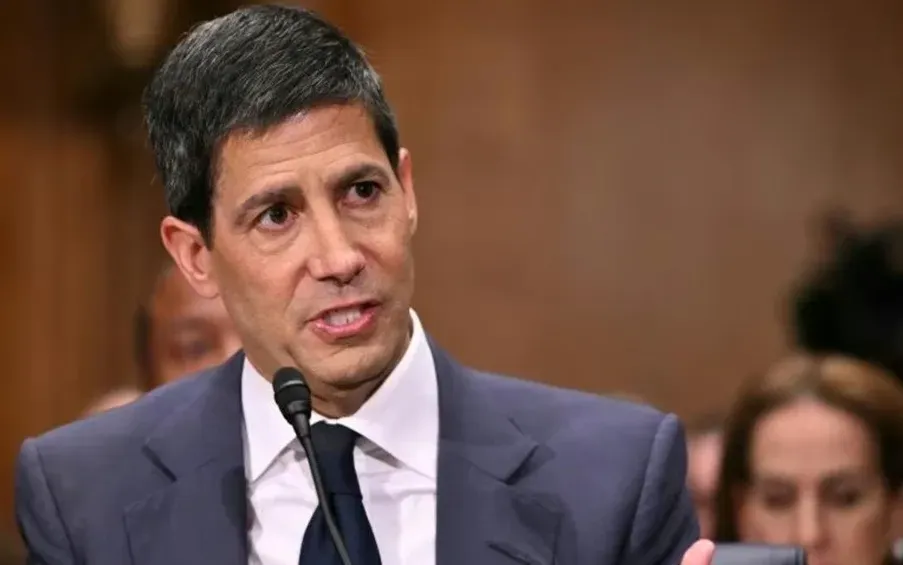
Mr. Kevin Warsh. (Photo: The Straits Times/VNA)
According to The New York Post on May 17, former Federal Reserve Chairman Ben Bernanke was once seen as the man who performed a "miracle" during the 2008 and 2009 financial crisis with unprecedented measures to save the American banking system from collapse. Now, Kevin Warsh takes over as Fed Chairman under completely different but equally dangerous circumstances.
During the financial crisis, Bernanke, along with figures like Tim Geithner, lowered interest rates to near 0%, injected massive liquidity into the banking system, and implemented a policy of "Quantitative Easing," which involved printing money to prevent the US from falling into another Great Depression like that of the 1930s.
Those policies remain controversial to this day. Many argue that the Fed rescued banks that would have failed under free market conditions. Others argue that the biggest mistake was allowing Lehman Brothers to collapse. Furthermore, many critics say that excessive money printing sowed the seeds of later inflation and created financial asset bubbles.
However, Bernanke then had a very clear mission: to do everything possible to save the American economy from another Great Depression.
Kevin Warsh is now beginning his term as Fed Chairman in a completely different context. While the Fed under Bernanke printed money for years, Warsh currently lacks consensus even on short-term interest rate cuts, as President Donald Trump is demanding.
The situation is further complicated by the fact that Jerome Powell, who recently stepped down as Fed Chairman and has repeatedly clashed with President Trump, remains on the Fed's Board of Governors and has voting power on interest rates.
Powell stated that he would not leave his position until the investigation into his testimony before the Senate regarding the cost of building the Fed's new headquarters was resolved.
This investigation was spearheaded by President Trump and had previously slowed the confirmation process for Kevin Warsh to head the Fed.
Kevin Warsh's interest rate policy has become the biggest focus of his future. While Warsh wants to lower interest rates to meet President Trump's wishes, he has long been known as an "inflation hawk," meaning someone who is extremely hardline on inflation.
After leaving the Fed in 2011 and becoming an academic, Warsh frequently criticized the "easy money" policies of Fed Chairs Bernanke, Janet Yellen, and Jerome Powell.
He argued that the Fed's prolonged period of cheap money after the financial crisis contributed to the current inflationary pressures.
Warsh has previously urged the Fed to pursue a more "disciplined" policy and shrink its massive balance sheet. If possible, Warsh wants to both lower short-term interest rates and begin selling off the Fed's holdings of bonds to combat inflation.
However, the current situation makes that very difficult. Consumer inflation in the US just reached 3.8% year-on-year, the highest since May 2023. The main reasons are the conflict in the Middle East and sharply rising energy prices.
Last week, wholesale prices rose even faster. By May 15th, the futures market began betting that the Fed might have to raise interest rates later this year instead of lowering them as previously predicted.
On the positive side, the US economy remains quite strong. The explosion of artificial intelligence (AI) is creating a wave of investment and new jobs, especially in manual labor industries related to AI infrastructure.
Many optimists believe that the conflict in the Middle East will not last forever and that when the conflict ends, energy prices will fall again, helping to ease inflationary pressures.
However, many are skeptical about this prospect. The conflict in the Middle East has now entered its third month, while Tehran continues to send conflicting signals about its nuclear program and the Strait of Hormuz.
Many experts fear that if oil rises to $200 per barrel, the US economy could fall into a state of "stagflation," meaning both high inflation and slow growth, similar to the 1970s.
In short, the head of the US central bank, Kevin Warsh, is currently shouldering one of the most difficult tasks in the history of the Fed.
Source: https://vtv.vn/thach-thuc-doi-voi-tan-chu-tich-fed-kevin-warsh-100260518100409366.htm


































































































Comment (0)