

The Ministry of Justice is reviewing a proposal to draft a National Assembly Resolution on tolls for state-invested expressways.
In the draft proposal, the Ministry of Transport stated that the toll rates must meet three principles: They must be consistent with the interests and affordability of users; after covering organizational costs, there must be a surplus to balance the state budget; and they must be calculated for each specific section and route to suit the operating conditions and socio-economic conditions of each area.
Highways funded by central and local government budgets are allocated proportionally based on the investment capital contributed to the project. The revenue collected is remitted to the State budget and prioritized for investment, management, and maintenance of road transport infrastructure, fulfilling the State's responsibilities for road investment projects under the BOT (Build-Operate-Transfer) contract model.
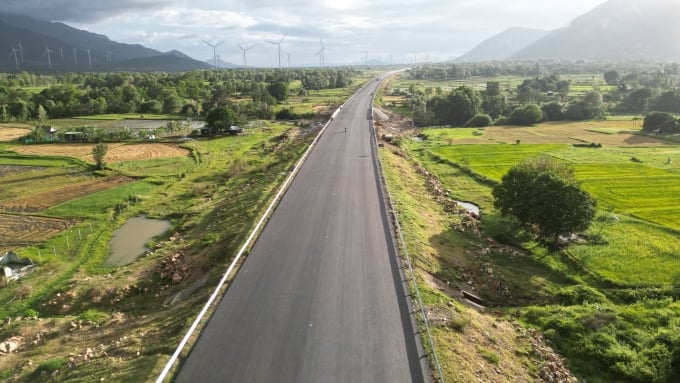
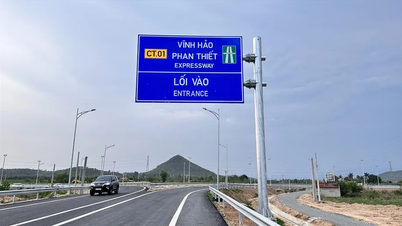
The Cam Lam - Vinh Hao expressway is nearing completion, scheduled for December 2023. Photo: Viet Quoc
The Ministry of Transport believes that collecting tolls on state-invested expressways will help increase budget revenue by mobilizing resources from expressway users; contributing to the funding for the development of the expressway system. This money will also be used for the management and maintenance of expressways, and will be a resource for implementing policies to develop transportation infrastructure.
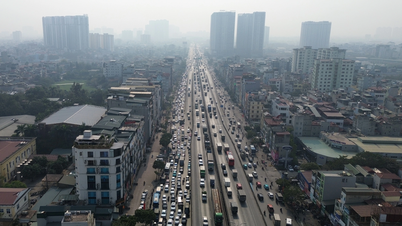
Furthermore, toll collection helps increase the efficiency of highway operation, balance traffic flow on highways and parallel national roads, and facilitate vehicle weight control. Without tolls, vehicles would tend to concentrate on highways, reducing average traffic speed and decreasing operational efficiency.
Commenting on this matter, the Ministry of Planning and Investment suggested clarifying the obstacles in current regulations on fees, prices, state budget, public assets, and road maintenance, in order to have a basis for issuing the Resolution, and suggested that only a pilot resolution should be issued.
Regarding the mechanism and fee levels, the Ministry of Planning and Investment proposes calculating fees without necessarily limiting the collection period, as a stable revenue source is needed to cover the continuous, lifetime management and maintenance costs of the expressway. In addition, the toll rates for expressways invested in by the State should be lower than those for privately invested expressways and can be flexibly adjusted according to the socio-economic development situation in each period.
Tolls should be reduced for routes that do not truly meet highway standards, or are designed according to phased investment standards (limited number of lanes and lane width, lack of continuous emergency stopping lanes, permitted vehicle speeds lower than the calculated speed).
In February, the Ministry of Finance worked with the Ministry of Transport and related agencies on this matter. The Ministry of Transport has studied a plan to report to the Government and submit to the National Assembly for promulgation a pilot mechanism for collecting tolls on expressways invested in by the State. The scope includes routes completed and operational before 2025. The pilot collection period under this mechanism will last a maximum of 5 years from the start of toll collection.
The Ministry of Transport has repeatedly proposed charging tolls on several state-invested expressways. In early May, the Ministry planned to charge tolls on nine expressways, including: Ho Chi Minh City - Trung Luong; Cao Bo - Mai Son, Mai Son - National Highway 45, National Highway 45 - Nghi Son, Nghi Son - Dien Chau, Cam Lo - La Son, Vinh Hao - Phan Thiet, Phan Thiet - Dau Giay, and My Thuan 2 Bridge.
Source link




























































































Comment (0)