


Every year on President Ho Chi Minh's birthday, thousands of people visit the Ho Chi Minh Memorial Temple to offer incense and flowers in remembrance of him.
The Ho Chi Minh Memorial Temple, located in Luong Tam commune, Can Tho city, is familiar to us, natives of Ngan Dua (now part of Ca Mau province), bordered by the Cai Trau River, now connected by the Xeo Vet bridge. In the past, and even now, there's no specific place name or clear address, but when people in the area mention the Ho Chi Minh Memorial Temple, it's a way of identifying and locating it, filled with pride and reverence. People from Ngan Dua, Vinh Tuy, Cau Do, Ninh Hoa, Ninh Quoi, etc., easily understand and picture it when they say "going to the Ho Chi Minh Memorial Temple" or "just passing by the Ho Chi Minh Memorial Temple."
We begin this article with this story to show that the Ho Chi Minh Memorial Temple in Luong Tam commune is not only a source of pride for the people of Can Tho throughout different periods, but also a shared reverence for the people of a vast country, transcending local boundaries.
Interestingly, "Ho Chi Minh Memorial Temple" is a sacred and affectionate way of remembering a legendary temple, a heroic land, and people who are steadfast, resolute, and wholeheartedly devoted to Uncle Ho. This May, I returned to Ho Chi Minh Memorial Temple to pay my respects to our beloved Uncle Ho. Seeing the people of Luong Tam busily preparing to celebrate Uncle Ho's birthday, I further understood the devotion of the people of this region.
***
Upon hearing the news of President Ho Chi Minh's passing, the people of Can Tho, along with the people of Southern Vietnam and the entire country, were deeply saddened and remembered him. The people of the Mekong Delta had many touching ways of commemorating him. For example, at that time, Can Tho town was the nerve center of the enemy's 4th Tactical Zone, yet hundreds of cadres of the National Liberation Front, monks, and Buddhists, together with Abbot Thich Hue Thanh of Khanh Quang Pagoda (now at the corner of Hoa Binh and Nam Ky Khoi Nghia streets, Ninh Kieu ward), held a memorial service and prayed for his soul. The photograph of President Ho Chi Minh displayed during the memorial service, along with the rosary and prayers, is still proudly exhibited in the museum today.
In Luong Tam commune, upon hearing of President Ho Chi Minh's passing, Comrade Lu Minh Chanh (Hai Chanh), Secretary of the Commune Party Committee, decided to set up an altar for President Ho Chi Minh right in the Commune Party Committee office. A solemn memorial service was held, with the participation of numerous leaders, departments, organizations, hamlets, main army units, local troops, and the people of the commune. Immediately after the national mourning period, cadres, soldiers, and people of Luong Tam discussed and decided to build a temple dedicated to President Ho Chi Minh to have a place for incense burning and remembrance. The chosen location was in Hamlet 3, at the intersection of the Long My 2 canal and the Nam Can canal. However, amidst numerous difficulties and dangers such as time constraints, materials, scale, design, and the fierce fighting, the Luong Tam Commune Party Committee decided to keep the altar for President Ho Chi Minh at the Commune Party Committee office, waiting for favorable conditions to proceed with the construction of the temple.
In 1972, the US and its South Vietnamese allies launched numerous large-scale attacks and sweeps in the Long My area. The Commune Party Committee office was bombed, and the altar dedicated to President Ho Chi Minh was destroyed. Afterwards, the Commune Party Committee headquarters moved to another location, a new altar was built, and the tradition of commemorating President Ho Chi Minh three times a year – his birthday, the anniversary of his death, and the Lunar New Year – continues.
After 1975, the altar dedicated to President Ho Chi Minh was placed solemnly at the headquarters of the Luong Tam Commune Party Committee, where officials and people daily offered incense to commemorate him. In 1990, as part of the "Year of Culture and Society" initiated by Hau Giang province to commemorate the 100th anniversary of President Ho Chi Minh's birth, the Long My District Department of Culture and Information, in coordination with the Luong Tam Commune Party Committee, planned the construction of a temple dedicated to President Ho Chi Minh. The site was also the same location planned during the resistance war. The simple temple, with its traditional Southern Vietnamese architecture, was built amidst the deep emotion of the people of Luong Tam. On May 19, 1990, the temple was inaugurated, and a portrait of President Ho Chi Minh was brought from the Commune Party Committee Office to be enshrined inside. On September 2nd of that year, the Party Committee, government, and people of Luong Tam Commune solemnly offered incense to honor President Ho Chi Minh, with the participation of numerous people, religious leaders, and ethnic groups from the province and neighboring localities of Kien Giang and Minh Hai. The elders of Ngan Dua Temple at that time donated ancient trees and planted them in the temple grounds.
In accordance with the wishes of the Party Committee, government, and people of Can Tho province to build a more spacious and magnificent Ho Chi Minh Memorial Temple to serve people from all over who come to pay their respects to President Ho Chi Minh, the new Ho Chi Minh Memorial Temple was completed on May 19, 1996, the 106th anniversary of President Ho Chi Minh's birth. Provincial and district leaders and the people of Luong Tam commune respectfully brought the statue of President Ho Chi Minh to be enshrined. Since then, the Ho Chi Minh Memorial Temple has undergone many renovations and upgrades, becoming a sacred temple and a place of pilgrimage for millions of hearts filled with love and respect for President Ho Chi Minh.
***
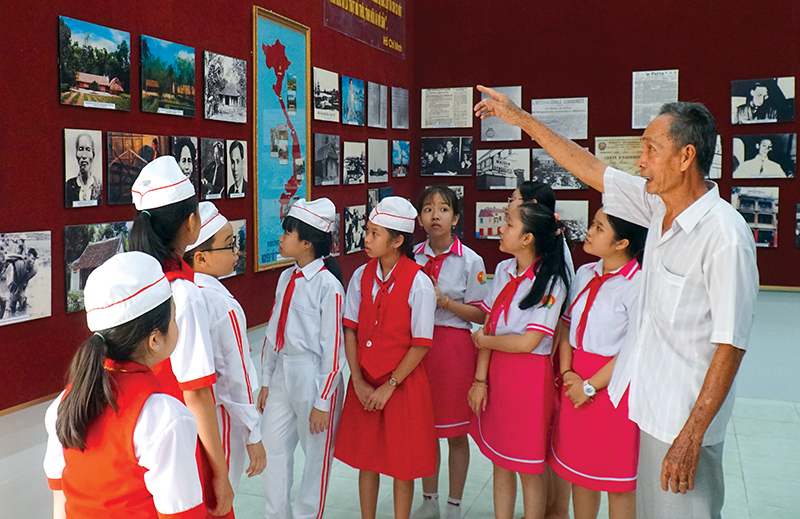
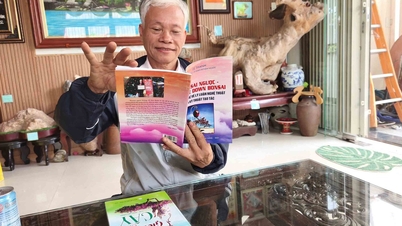
Mr. Tu Thong introduced the history of the Ho Chi Minh Memorial Temple to the youth of Luong Tam commune.
When discussing the history of the Ho Chi Minh Memorial Temple, the people of Luong Tam commune mention Mr. Le Van Thong, also known as Tu Thong, as a historical witness. With affectionate eyes and an emotional voice, Mr. Tu recounts the story of the legendary temple, where he was present from the very beginning.
In 1969, when President Ho Chi Minh passed away, Mr. Tu Thong, then a commune secretary, was tasked with printing a large portrait of President Ho Chi Minh to be used in the memorial service. Mr. Tu Thong recounted that upon receiving the assignment, he went searching and encountered a farmer who had a 5-dong banknote with President Ho Chi Minh's portrait printed on it. When Mr. Tu Thong borrowed it to paint, the farmer readily agreed. Because the banknote had faded over time, to see clearly, Mr. Tu Thong asked someone to buy a magnifying glass, painting sauce, and tracing paper from the market. Each stroke conveyed his deep respect and love, resulting in a 60x80cm portrait of President Ho Chi Minh, which was placed respectfully on the altars at the four memorial service locations throughout the seven days of national mourning. Mr. Tu Thong also instructed villagers with sewing machines on how to make mourning bands for the service.
In 1990, when the Party Committee, government, and people of Luong Tam commune joined hands to build the Ho Chi Minh Memorial Temple, Mr. Le Van Thong, then Head of the Culture and Information Department of Long My district, was assigned the task of leading the project's steering committee. Mr. Thong emotionally affirmed that this was truly a project of the people's hearts. The people of the nine hamlets of Luong Tam commune, despite their difficulties at the time, were all willing to contribute money and labor to build the Ho Chi Minh Memorial Temple. Everyone contributed as much as they could; those without money contributed their labor. Thus, the blueprints were drawn, materials were gathered, and the simple yet solemn temple was erected right in Luong Tam, a homeland rich in revolutionary traditions.
Later, after retiring, Mr. Tu Thong became a storyteller about his hometown, recounting the story of the temple, the devotion of the people of Luong Tam and Long My to President Ho Chi Minh… The stories he told reflected the heartfelt experiences of someone who was directly involved.
***
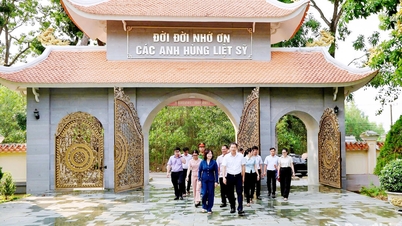
In May, visiting the Ho Chi Minh Memorial Temple and passing through the entrance gate, one is deeply moved by the couplet: "Independence and freedom are thanks to the Party's grace / Warm clothes and full stomachs are thanks to Uncle Ho."
Text and photos: DANG HUYNH
Source: https://baocantho.com.vn/thang-nam-ve-luong-tam-vieng-den-tho-bac-ho-a204758.html






![[INFOGRAPHICS] 25 targets and groups of targets that Can Tho City strives for by 2030](https://vphoto.vietnam.vn/thumb/402x226/vietnam/resource/IMAGE/2026/05/25/1779688983034_1779688951.webp)
























































Comment (0)