

Contributing to the promotion of green economic development.
Planting and transforming forests into large-timber forests is a sustainable development direction being implemented by many localities in Phu Tho province, aiming to improve economic efficiency, create jobs, increase people's income, and protect forests, thereby contributing positively to the protection of the ecological environment. However, to continue the transformation from small-timber forests to large-timber forests and promote sustainable forestry economic development, a comprehensive set of solutions needs to be implemented.
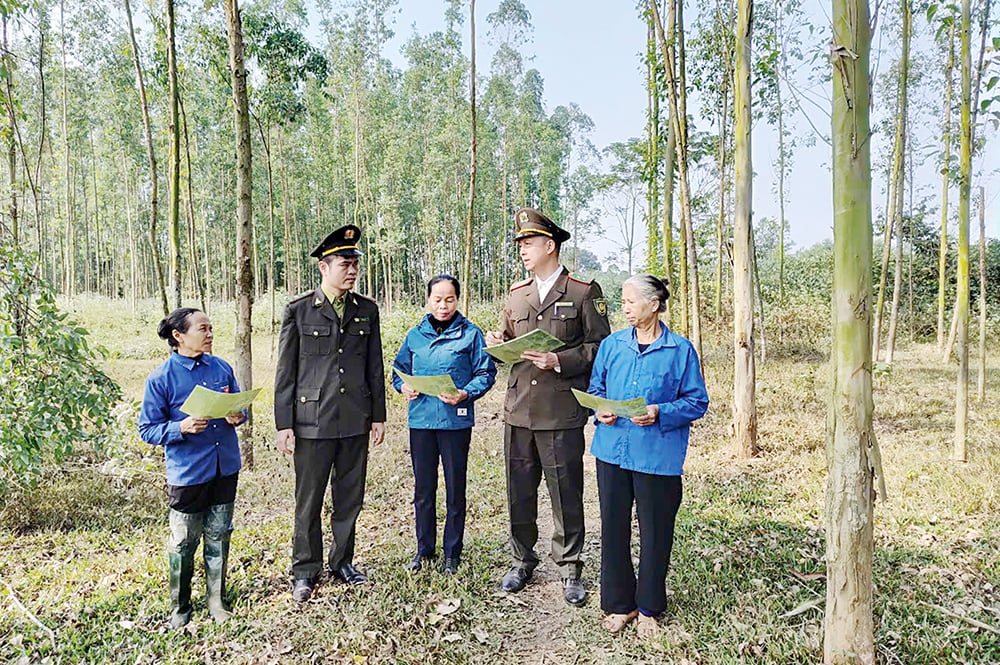
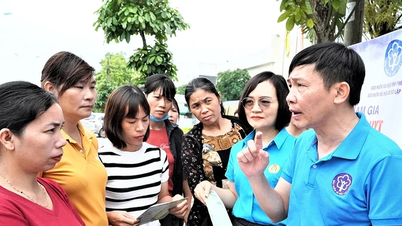
Forest rangers are educating local people about planting and protecting forests in Tien Kien commune, Lam Thao district.
Identify the difficulties
To promote sustainable forestry development, the province has issued several policies to support the planting of large timber forests. The objectives are to create large timber raw material areas for deep processing; improve economic and environmental efficiency; conserve biodiversity; and promote the certification of production forests to increase the added value of the forestry sector. According to calculations by specialized agencies, compared to planting small timber forests, the profit from large timber forests is many times higher, depending on the harvesting age and tree diameter. The average yield of planted forests is 70-75 m3/ha/cycle of 5 years. Meanwhile, with a cycle of 10-12 years for large timber plantations, the average yield can reach 250 m3/ha, increasing profits by approximately 18-25 million VND/ha/year.
As one of the households with a large forest area in Tat Thang commune, Thanh Son district, Mr. Dinh Duc Tho shared: “Planting and transforming small-timber forests into large-timber forests brings many benefits, not only saving on seedlings and planting and care costs, but also reducing pests and diseases, limiting forest soil degradation, and protecting the ecological environment. Expanding effective models is crucial to increasing the area of large-timber forests, helping people benefit from the forest, and gradually improving the quality of forest timber year after year. Therefore, relevant agencies and localities need to continue promoting awareness about the economic and environmental benefits, as well as providing guidance on forest planting techniques, planting and caring for the trees, and supporting people with seedlings.”
In Doan Hung district, one of the difficulties in implementing the conversion of large timber forests is that households with small, fragmented forest areas do not meet the criteria for support; the number of forest product processing and trading units in the area is relatively large, however, the needs of these units are mainly for raw processing such as wood chips, sawn timber, veneer, and peeled wood, so they mainly need small timber raw materials; concentrated large timber raw material areas with sufficiently large areas to facilitate joint ventures and investment in infrastructure have not yet been formed. There is no typical model of large timber plantation forest in the area to serve as a basis for demonstrating the economic comparison between the two types of forests. These factors also significantly impact the local forest conversion efforts.
Comrade Nguyen Duy Lam - Deputy Head of Doan Hung Forest Ranger Station, said: Another reality is that planting large timber forests has a long business cycle, requiring capital, while the economic conditions of households are still difficult. Therefore, forest owners often plant small timber forests with a short cycle of 5-7 years because it provides a quicker income to cover living expenses, or allows for faster reinvestment. On the other hand, the forest ranger force in localities is quite small, lacking the resources to regularly monitor each family and cooperative to encourage, support, and supervise people in converting forests to large timber.
Towards sustainable forest management, the province has developed a plan for the development of agriculture, forestry, and fisheries until 2020, with a vision to 2030, which includes planting and converting over 8,000 hectares of large timber forests in Thanh Son, Tan Son, Yen Lap, Cam Khe, Doan Hung, and Ha Hoa districts. Specifically, with policies supporting and encouraging agricultural and rural development, all cooperatives, cooperative groups, farm owners, and households will receive initial support of 7 million VND/ha when the forest reaches 6 years of age or older and has implemented technical measures for converting to large timber. A second support payment of 5 million VND/ha will be given 3 years after the first support. The province will also provide a one-time subsidy of 70% of the cost of sustainable forest certification, with a maximum subsidy of 300,000 VND/hectare... At the same time, it encourages businesses and households to collaborate and invest in intensive forest planting to develop the area of large timber forests in the province commensurate with the available potential in the locality.
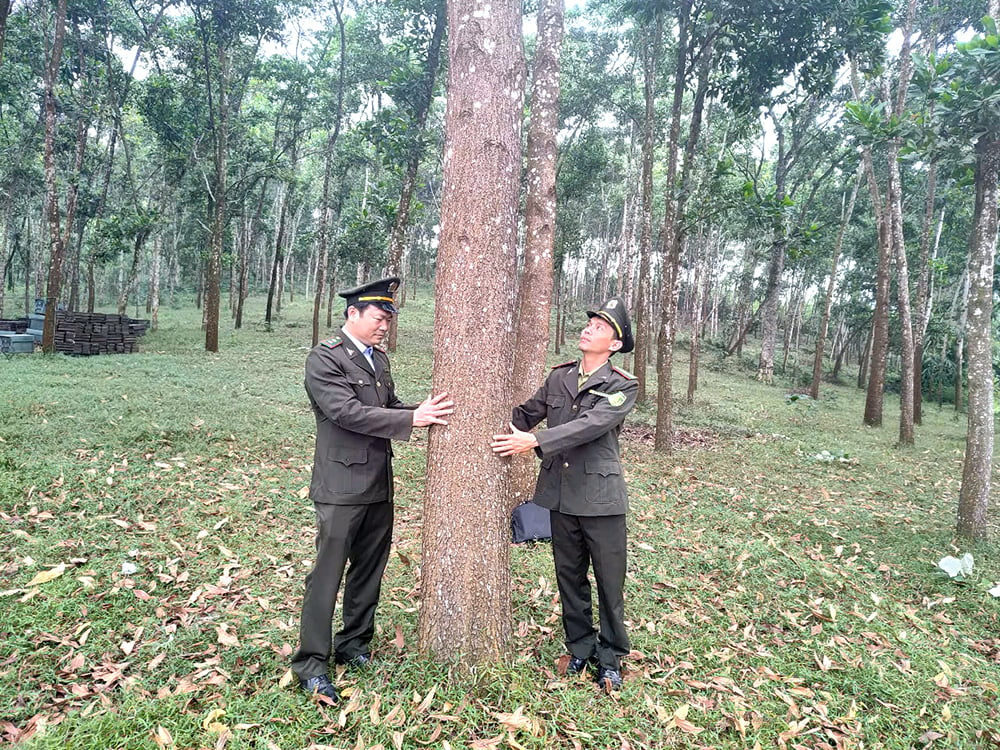
Inspect the area of large timber forests that have been converted within the province.
To achieve the goal of transforming large timber forests.
Recognizing forestry as a potential and advantage in the local economic development, the province has implemented comprehensive solutions and strengthened policies to encourage and support the development of the forestry economy. This includes promoting the application of technical measures and focusing investment on planting and transforming large-timber forests – a necessary trend in the province's forestry sector. This not only brings high economic benefits to forest planters but also contributes to reducing soil erosion and runoff, protecting the environment, and responding to climate change. In 2024, the province planted nearly 9,500 hectares of concentrated forest, achieving 103% of the plan; planted 2.5 million scattered trees, achieving 105% of the plan; and cared for over 28,000 hectares of planted forest. Over 330 hectares of large-timber forest were transformed; nearly 14,000 hectares received FSC sustainable forest management certification; and the average yield of large-timber plantation forests reached 18 m³/ha/year. This contributes to increasing people's income.
Currently, Yen Lap district is focusing on developing large timber trees and medicinal plants to concretize the goals, tasks, and solutions for effectively implementing Resolution No. 42-NQ/HU on the development of hill and forest economy, with a focus on large timber trees, medicinal plants, and fruit trees in the 2021-2025 period. This includes focusing on the efficient use of resources; maximizing internal resources and the contributions of the people to develop the hill and forest economy; encouraging, creating opportunities, and providing favorable conditions for economic sectors to actively invest in the development of the hill and forest economy, leveraging the potential and strengths of each locality and the entire district. By 2025, the district aims to plant 1,200 hectares of concentrated forest annually, plant and convert 400 hectares of large timber forest; develop 2,600 hectares of cinnamon and medicinal plants, and 7,740 hectares of natural forest, increasing forest cover to 61%.
The provincial forestry sector's goal by 2025 is to promote the planting and conversion of 20,000 hectares of large timber forests, including 15,350 hectares of new planting and 4,650 hectares of conversion; support the FSC sustainable forest certification for 25,000 hectares of forest; and achieve a planted forest productivity of 17 m³/ha/year. To achieve this goal, a comprehensive approach is needed, starting with appropriate planting area planning; effective communication and mobilization of the public and businesses; leveraging all social resources for the development of large timber businesses; technical solutions from seed selection and breeding, planting and care, harvesting and processing; and the policies and guidelines of the State.
In the coming period, all levels, sectors, and localities need to continue strengthening the dissemination of the Party and State's policies on forestry development in general, and the development of large timber forests in particular. Especially important is the policy supporting the conversion of commercial large timber forests. Support and encourage businesses to link with forest owners to create large-scale raw material areas, invest in planting large timber forests, and practice sustainable cultivation to achieve Forest Stewardship Council (FSC) certification. This should be done through the following method: Businesses invest capital and technology, while forest owners contribute capital in the form of land use rights. When products are harvested, they receive benefits according to their capital contribution ratio, forming a value chain for forestry products and increasing market competitiveness.
Along with that, we will promote research and development of high-yielding, high-quality varieties, selecting high-yielding varieties suitable for the development of large timber forests according to the specific site conditions of each planting location; and build high-tech forestry cultivation models to enhance the value of forestry production. At the same time, we will strengthen inspection, monitoring, and supervision of seed and material management in the province to ensure that the seeds and materials supplied to the market are of guaranteed quality, contributing to increased forest yield, quality, and value, and socio-economic development in the province.
Comrade Tran Quang Dong - Deputy Head of the Provincial Forest Protection Department, noted that the large-timber forest planting model implemented in the area has attracted many forest-planting households to participate. This shows that people are aware of the benefits and role of the large-timber forest planting model, gradually abandoning old forest planting methods. Large-timber forest planting not only brings economic benefits but also contributes significantly to environmental protection, climate change adaptation, land use reduction, and increased sustainability in forestry production...
Economic Reporting Team
Source: https://baophutho.vn/ky-ii-thao-go-rao-can-de-dat-muc-tieu-226592.htm

![[Photo] General Secretary and President To Lam presides over a working session with the Central Policy and Strategy Committee on the development of the materials industry.](https://vphoto.vietnam.vn/thumb/1200x675/vietnam/resource/IMAGE/2026/05/21/1779359935432_a3-bnd-3129-1412-jpg.webp)


![[Photo] National Assembly Chairman Tran Thanh Man working with the Standing Committee of the Law and Justice Committee](https://vphoto.vietnam.vn/thumb/1200x675/vietnam/resource/IMAGE/2026/05/21/1779378929214_ndo_br_1-4610-jpg.webp)


































































Comment (0)