

Motivation from the project
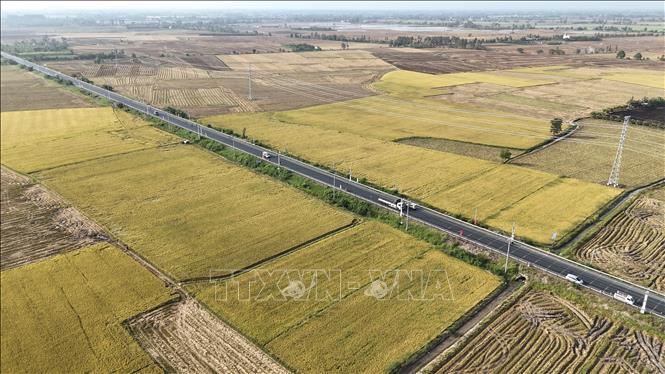
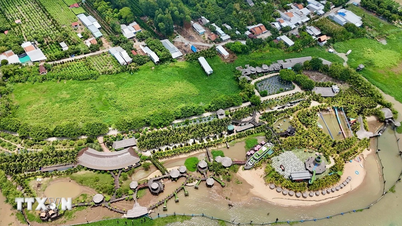
An Giang province has the largest rice-producing area in the Mekong Delta, with over 600,000 hectares of cultivated land, planting over 1.3 million hectares annually and producing approximately 8.7 million tons. Rice production is a key industry, accounting for over 60% of the people's livelihoods. However, the province's rice production faces numerous challenges, including increasingly severe climate change, rising input costs, fragmented production, weak linkages, high greenhouse gas emissions, and increasing environmental pressure.
In this context, the Project for 1 million hectares of high-quality, low-emission rice is considered a fundamental solution to help An Giang comprehensively restructure its rice industry. Not only does it aim to improve the quality and value of rice grains, but the Project also aims to transform production methods towards reducing emissions, conserving resources, and adapting to climate change.
By 2025, An Giang had implemented over 150,150 hectares according to the project's guidelines. Of that, more than 43,430 hectares fully met all 5 criteria as stipulated, and nearly 108,760 hectares met 4 criteria, creating a buffer zone ready for upgrading to a comprehensively standardized area. To date, An Giang has achieved approximately 50% of the project's plan for the period up to 2030.
According to the An Giang Department of Agriculture and Environment, the implementation of the project in An Giang has shown positive results. Farmers' awareness has clearly changed, from production based on experience to adopting scientific and technical approaches. Advanced application models such as cluster sowing, water-saving management, reduced seed quantity, and rational fertilizer use have been widely adopted, contributing to reduced costs, stable yields, and improved economic efficiency.
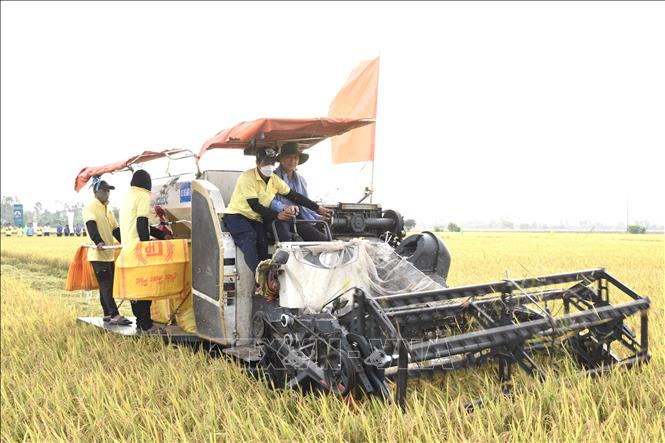
In 2025 alone, An Giang province implemented 55 models covering nearly 1,500 hectares, along with 34 models proactively developed by the local authorities. The results showed a reduction in production costs of 3.3 – 4.1 million VND/ha, an average increase in yield of 0.78 tons/ha, and an increase in profit of 6.1 – 9.35 million VND/ha. Beyond economic benefits, the project is gradually forming production-consumption linkages, helping farmers feel secure in their production, ensuring businesses have a reliable source of raw materials, and creating a foundation for sustainable development.
Unblocking connection bottlenecks
According to businesses, the project to cultivate 1 million hectares of high-quality, low-emission rice is a very correct and effective policy decision. The project repositions the rice industry on the foundation of quality, added value, and sustainability. However, after two years of implementation, the biggest obstacle now lies not in the vision or policy, but in the implementation process.
Mr. Pham Thai Binh, Chairman of the Board of Directors of Trung An High-Tech Agriculture Joint Stock Company, said that many rice cultivation projects linked with businesses have not yet been approved by local authorities, leaving businesses, cooperatives, and farmers without a legal basis for investment and cooperation. This leads to the consequence that credit institutions have no basis for lending capital, causing the flow of capital to be "stuck" right from the start.
“Every year, An Giang produces nearly 9 million tons of paddy rice, equivalent to 5 million tons of exported rice, playing a crucial role in the national rice supply chain. However, paradoxically, the rice industry continues to develop spontaneously and fragmentedly. Production is not closely linked to consumption; farmers mainly sell their rice through traders, while businesses lack stable raw material sources,” Mr. Binh shared.
Mr. Binh stated: In recent years, despite directives from the central and local governments and the agricultural sector on restructuring the rice industry for sustainable development, rice farmers still depend on traders for sales. Whenever the market experiences negative fluctuations, rice farmers face numerous difficulties and challenges, while businesses are unable to share the burden with them.
With over 30 years of experience in the rice industry, Mr. Binh affirmed that the project is the fundamental solution to end the unsustainable linkages that have persisted for decades in the Mekong Delta's rice sector. With just 350,000 hectares in An Giang participating in the project, and only 2 to 3 businesses involved, it could generate at least $2.1 billion USD annually, not including value-added products from by-products. More importantly, farmers' income could increase by at least 15 million VND per hectare without worrying about rice sales.
Linking the "four stakeholders" to achieve breakthroughs.
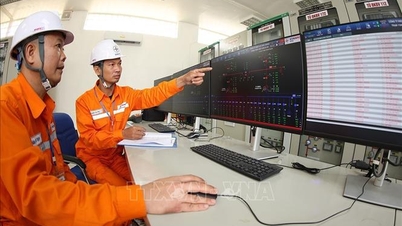
According to Ms. Nguyen Duy Linh Thao, Deputy Director of the An Giang Department of Industry and Trade, the rice industry is currently facing significant pressure from rising input costs and unstable output prices. Although the government has invested in energy infrastructure, it remains overloaded in some areas and cannot meet the needs of large-scale production. Furthermore, the rice industry is currently characterized by small-scale production, weak linkages, and consumption through multiple intermediaries, resulting in low added value.
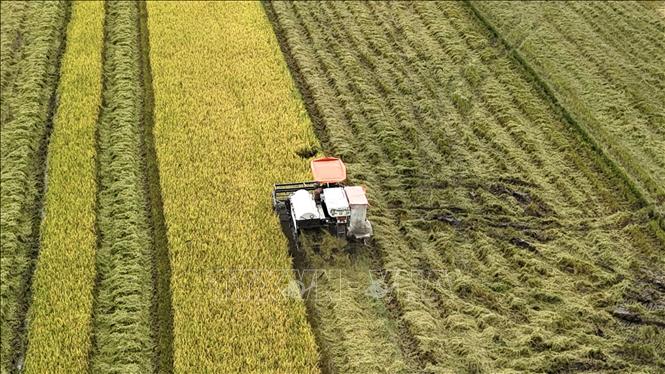
“To ensure the project's effectiveness, the industry and trade sector will focus on securing energy sources, proactively managing fuel supplies according to seasonal cycles, and upgrading the power grid to serve production; at the same time, reorganizing the materials market, developing value chains linked to the ‘four stakeholders’ (farmers, businesses, scientists, and the government), and forming large raw material areas. In addition, businesses need to strengthen links with farmers and cooperatives, proactively secure input supplies, and promote deep processing to enhance product value…,” Ms. Linh stated.
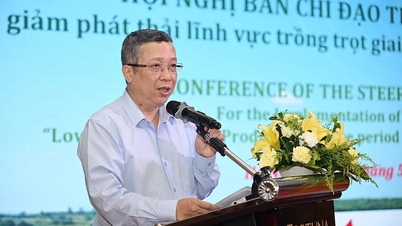
Mr. Pham Thai Binh, Chairman of the Board of Directors of Trung An High-Tech Agriculture Joint Stock Company, emphasized that the decisive factor is the synchronized participation of the "four stakeholders": the State, businesses, farmers, and banks. Currently, the "three stakeholders"—businesses, farmers, and banks—are all ready. The missing element is the stronger involvement of the government in project approval and the completion of the legal framework. Once this "bottleneck" is removed, the supply chain will be formed, capital flows will be unlocked, and all parties will have a basis for long-term cooperation.
By 2030, An Giang province aims to establish 351,362 hectares of high-quality, low-emission rice cultivation, linked to the reorganization of the production system along the value chain. The focus will be on reducing seeds, fertilizers, pesticides, and water usage; increasing quality, efficiency, income, and protecting the environment.
An Giang aims to achieve the following targets by 2030: 100% of specialized farming areas will have linkages between businesses and cooperatives/farmer groups; the rate of synchronized mechanization will exceed 70%; over 130,000 farming households will apply sustainable farming practices; and 100% of straw will be collected and reused.
Source: https://baotintuc.vn/kinh-te/thao-nut-thatcho-de-an-1-trieu-hecta-lua-chat-luong-cao-20260506161004351.htm















































































Comment (0)