

According to the Food Waste Index report published by the United Nations Environment Programme (UNEP) on March 27, the world wasted 1.05 billion tons of food in 2022, equivalent to about 20% of the world's food supply. Meanwhile, one-third of the world's population faces food insecurity and 783 million people are affected by hunger.
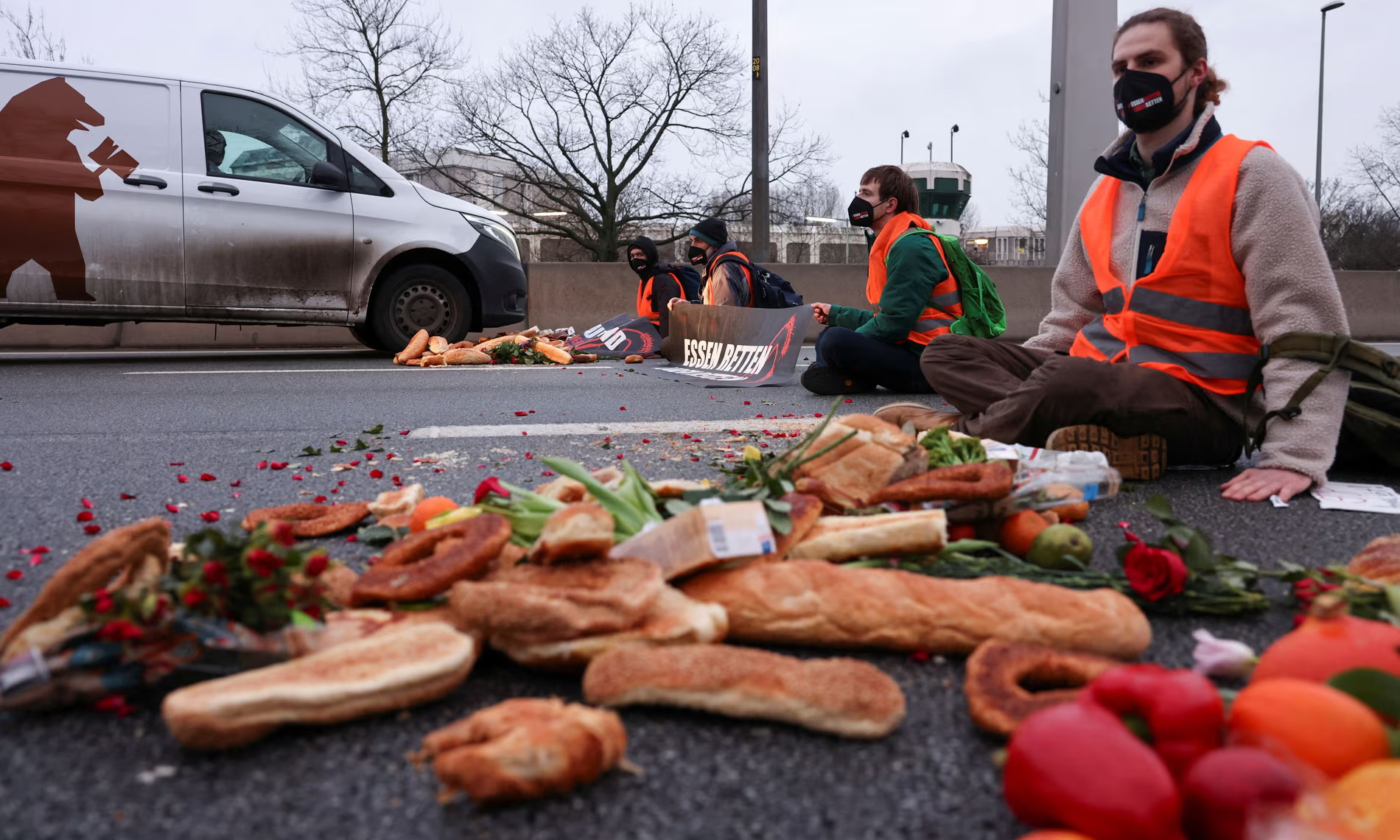
Activists in Berlin, Germany, blocked a highway to protest food waste. Photo: Reuters
On average, a person wastes 79 kg of food per year.
According to statistics, households waste 631 million tons of food, equivalent to 60% of all food waste. The food service sector accounts for 28% of waste, and the retail sector accounts for 12%. In addition, 13% of the world's food is lost during the production process.
In addition, the report also shows that the average person wastes 79 kg of food per year, meaning that at least one billion meals are wasted every day by households.
But in some countries, including the UK, Australia, Indonesia, Mexico, and South Africa, food waste has decreased significantly since 2007. Japan has cut its food waste by almost a third, and the UK by around 18%.
Food waste not only wastes natural resources but is also a major contributor to climate and biological crises. It accounts for nearly 10% of global greenhouse gas emissions and forces wildlife to switch to intensive farming, as more than 25% of the world's agricultural land is used for food production but is then wasted.
According to UNEP Director Inger Andersen, the staggering statistics raise questions about the world's ability to distribute its produced food and highlight the impact of food waste on climate change.
"Food waste is a global tragedy. Millions of people are starving while food is wasted all over the world. The problem of food waste doesn't just lie there; it also causes significant damage to the climate and the environment," Andersen said.
Making climate change worse
Most countries do not include this issue in their carbon emission reduction proposals. Only 21 countries have included food waste and waste in their national climate plans, despite the fact that food waste generates 8-10% of global warming emissions, almost five times more than emissions from the aviation industry.
Food production requires vast resources, demanding enormous amounts of land and water. The food system is responsible for approximately one-third of greenhouse gas emissions that contribute to global warming.
Much of food waste ends up in landfills, producing methane gas as it decomposes. As a potent greenhouse gas, methane has the potential to increase temperatures by approximately 80 times compared to carbon dioxide within the first 20 years.
According to the report, food waste can exacerbate climate change. Countries with hotter temperatures were found to waste more food than countries with cooler temperatures.
Poorer households tend to throw away more food than higher-income households. This may be due to a lack of access to refrigerators or storage. They also rely on lower-quality food and lack the time to prepare nutritious meals.
Harriet Lamb, Director of the UK's Waste and Resource Action Programme (Wrap), urged countries to act: "We need more coordinated action across continents and supply chains. Whether charities, businesses, or governments, all stakeholders must come together to address the enormous impact of food waste on food security, the climate, and the economy ."
Hoai Phuong (according to Guardian, CNN)
Source


![[Photo] Closing Ceremony of the 15th Conference of the Central Committee of the 13th Party Congress](/_next/image?url=https%3A%2F%2Fvphoto.vietnam.vn%2Fthumb%2F1200x675%2Fvietnam%2Fresource%2FIMAGE%2F2025%2F12%2F23%2F1766462841764_a1-bnd-3731-1647-jpg.webp&w=3840&q=75)
































































































Comment (0)