 |
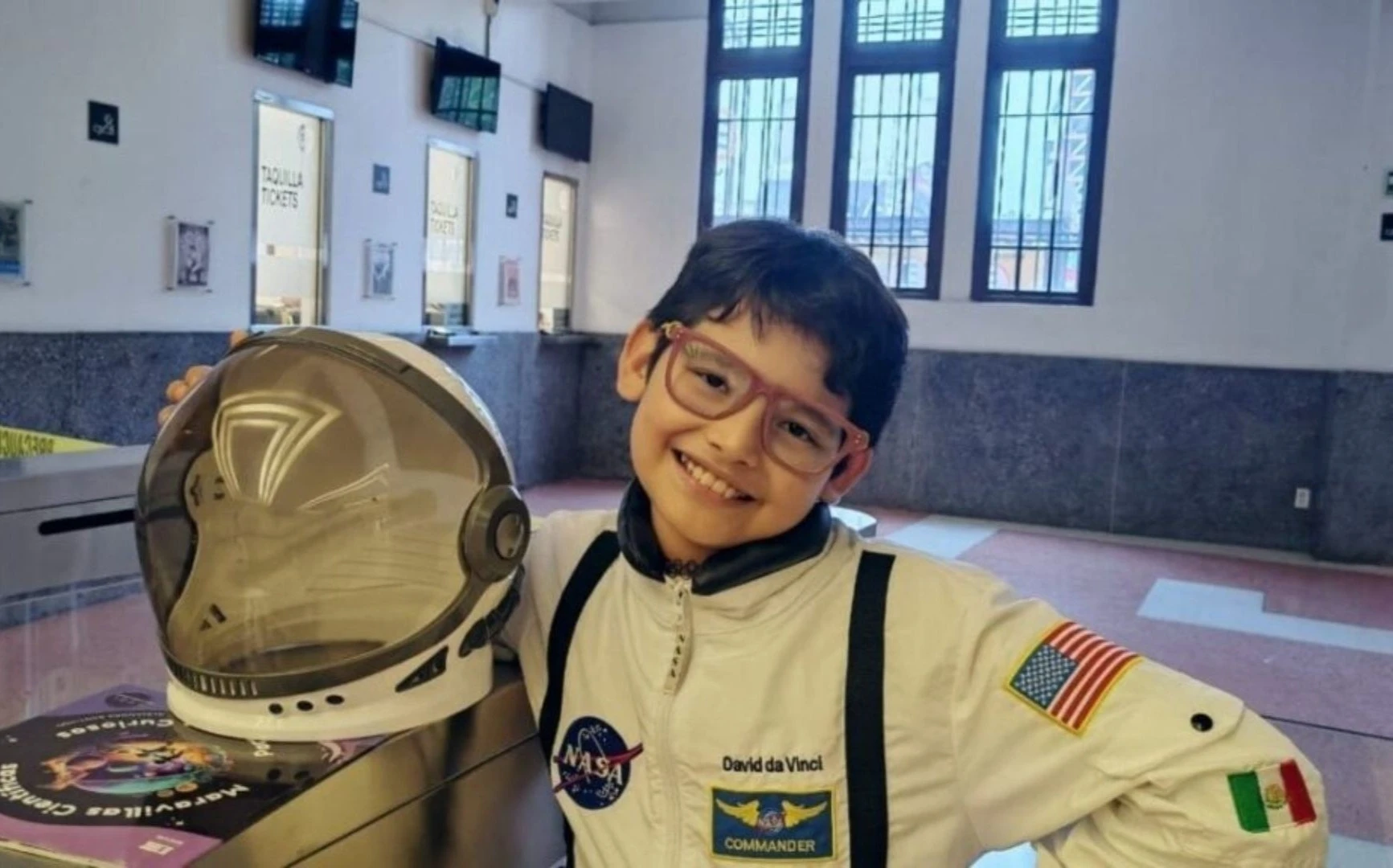
David Camacho participated in an experiential program organized by NASA. Photo: ColombiaOne . |
At just 10 years old, David Camacho has already achieved accomplishments that many adults would envy. The Mexican boy speaks four languages, has participated in training programs at NASA, given lectures at universities, and is writing a book.
Most remarkably, she also possesses an IQ of 162 – a number said to be higher than that of the physics genius Albert Einstein.
Showed talent from the age of 4.
From the age of four, David showed a remarkable aptitude for languages, learning English and German during his time in kindergarten. Currently, in addition to his native Spanish, he is fluent in English, French, and German, and is continuing to learn Russian, Portuguese, and Italian.
On social media, David calls himself "David da Vinci," inspired by Leonardo da Vinci. He particularly admires how the Renaissance scholar connected various fields, from science and technology to art. For David, knowledge shouldn't be divided into separate subjects but should be interconnected to generate new ideas.
That very mindset brought him closer to his space dream. At the age of 9, David was selected to participate in a youth experience program at NASA in Houston, USA. There, he participated in activities simulating astronaut training environments, experienced weightlessness, piloted aircraft with expert assistance, and performed exercises in a wind tunnel.
For many children, it might be the most memorable experience of their childhood. But for David, NASA also helped him visualize the future he wanted to pursue.
The Mexican genius once shared his desire to combine medicine with space technology, even dreaming of performing surgeries in extraterrestrial environments. David also hoped to one day study at Harvard or a world- leading university to realize his ideas.
Recently, David Camacho's interview with BBC News Mundo unexpectedly went viral on social media. This interview brought the boy with an IQ of 162 to global public attention.



However, the boy wasn't particularly enthusiastic about the "genius" label the media had bestowed upon him. Instead of viewing intelligence as an achievement to be proud of, David saw it as a starting point. He believed that the value of knowledge lay not in numbers or praise, but in the ability to create something useful for others.
 |
David Camacho was bullied and isolated because he was too different. Photo: ColombiaOne . |
I don't want to be remembered as a genius.
Contrary to the media's praise for a child with an IQ of 162, David Camacho's childhood was far from happy. From a young age, thanks to his exceptional learning ability, he often felt bored in class. This unintentionally created a distance between him and those around him.
David's mother, Claudia Flores, said the family only truly realized their son's exceptional abilities during the Covid-19 pandemic, when schooling shifted online.
Sitting next to her son during study sessions, the mother noticed that David wasn't simply learning faster, but was also operating at a completely different pace. The rapid repetition of already known material was quickly causing the boy to lose interest.
After being assessed by experts, David was determined to be a child with exceptional intellectual abilities. This early detection allowed him to transition to a more flexible learning model, suited to his individual developmental pace. However, exceptional ability does not equate to a smooth childhood.
David admitted that he often found it easier to connect with adults in conversations than with his peers. Differences in thinking, interests, and approaches to problems often made him feel out of place in the school environment. In fact, his academic strengths became the very reason he was bullied for many years.
Learning faster, knowing more, and having different interests inadvertently made her an outcast. That experience made her realize early on that gifted children also experience emotional trauma just like any other child.
Instead of letting negative memories shape his life, David chose to transform them into motivation for action. That's how Macayos – his first startup project – was born.



This app uses artificial intelligence to help children identify, understand, and manage their own emotions. Through relatable real-life situations, interactive activities, and personalized responses, Macayos helps children learn how to communicate, empathize, and cope with negative emotions.
For David, the project's goal wasn't just to curb school bullying. More importantly, he wanted to create a tool to help children develop socio-emotional skills. David didn't see bullying as an external problem to be solved, but as a personal memory that motivated him to act so that other children wouldn't have to silently endure the loneliness he once experienced.
At the age of 10, David Camacho still enjoyed playing, exploring , and dreaming like any other child. He didn't want to be remembered as a genius with a higher IQ than Einstein or a media sensation. What David aimed for was much simpler. He wanted to use his abilities to create something useful for others.
Source: https://znews.vn/them-mot-than-dong-co-iq-cao-hon-einstein-post1662025.html

![[Image] Ho Chi Minh City: Ma Lang area, Chicken-Rice Market about to change its appearance](https://vphoto.vietnam.vn/thumb/1200x675/vietnam/resource/IMAGE/2026/06/25/1782377698627_ndo_br_m1-jpg.webp)

![[Image] Schools organize meetings and introduce teaching models to students admitted to grade 10.](https://vphoto.vietnam.vn/thumb/1200x675/vietnam/resource/IMAGE/2026/06/25/1782368077271_ndo_br_z7970052192242-1ec8daeb77a6eed1a4e9f58c564ddd3e-jpg.webp)
![[Photo] General Secretary and President To Lam receives Palestinian Ambassador Saadi Salama](https://vphoto.vietnam.vn/thumb/1200x675/vietnam/resource/IMAGE/2026/06/25/1782365384740_a1-bnd-9423-8322-jpg.webp)










![[GALLERY] Voidling Bound takes Steam by storm with 94% positive reviews.](https://vphoto.vietnam.vn/thumb/402x226/vietnam/resource/IMAGE/2026/06/25/1782396892878_tua-1-png.webp)