

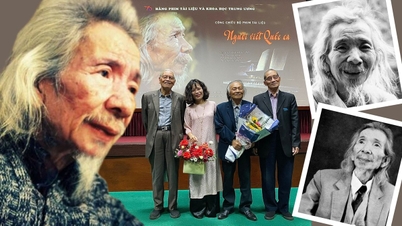
Van Cao wrote music, poetry, and painted. In each field, he left a mark that posterity still remembers and admires.
A rare phenomenon
Professor Phong Lê commented: Not only today, on the occasion of his 100th birthday, but since 1945, Văn Cao has been a great artist whose name and legacy are known and appreciated by the entire Vietnamese nation, from young to old. He is the author of "Tiến quân ca" (Marching Song), which later became the national anthem of the Democratic Republic of Vietnam in August 1944. "Tiến quân ca" alone is enough to establish Văn Cao's name and a great career in the world of music .
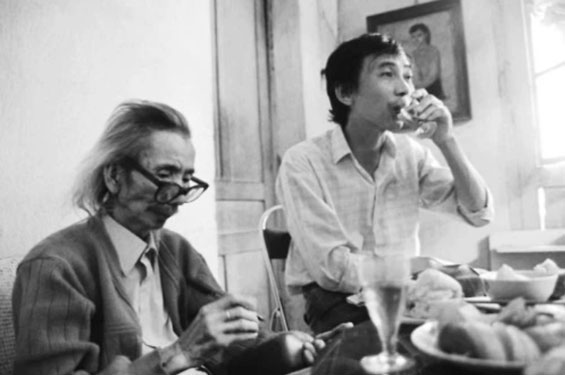
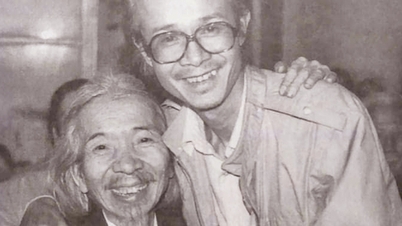
Composer Văn Cao and poet Thanh Thảo. (Photo: NGUYỄN ĐÌNH TOÁN)
However, this is just one highlight, because Van Cao's musical career goes back five years before 1945, when he was a major composer in the world of modern music, with works like "Sadness of Late Autumn," "Heavenly Paradise," "Spring Wharf," "Lonely Autumn," "Ancient Melody," "Vietnamese Birds,"... each of which alone would bring glory to anyone.
Composer Nguyen Thuy Kha shared that anyone who saw the photo of Van Cao shirtless and wearing shorts with his elementary school classmates at Bonnal School in Hai Phong would find it hard to guess that one of them would become the author of Vietnam's national anthem. Leaving Bonnal School to attend Saint Joseph's Catholic School nearby was perhaps a crucial turning point in Van Cao's life. There, his innate talent met music, poetry, and painting, allowing them to flourish. It's inexplicable why, at only 16 years old, Van Cao sang his first song, a melody imbued with the sounds of traditional Vietnamese folk music, titled "Sadness of Late Autumn."
Even more surprising is that at the age of 18, Van Cao soared to "Heaven" with the epic musical genre, a style that continues to stir our emotions in the early days of modern Vietnamese music. This same romantic figure, with his melancholic compositions like "Ancient Melody," "Lonely Autumn," "Dream Stream," and "Spring Wharf," suddenly burst into powerful, epic marches like "Thang Long March" and "Dong Da."
"The Marching Song," written in the winter of 1944, is considered a crucial turning point in Van Cao's musical creative thinking. It marked a break with romantic music and a shift to revolutionary music. After "The Marching Song," Van Cao embarked on a long journey with many sources, radiating in many directions. According to Professor Phong Le, this journey reveals a symphony of resistance life, with "Bac Son," "Vietnamese Soldiers," "Vietnamese Workers," "My Village" and "Harvest Day," "Vietnamese Navy" and "Vietnamese Air Force," "The Epic of the Lo River" and "Marching Towards Hanoi," "Praise to President Ho Chi Minh"... All are imbued with heroic, optimistic, exploratory, and prophetic resonance regarding the resistance struggle and the nation's journey.
Van Cao's great musical career extended to 1975 with the work "The First Spring," a miraculous anticipation of the joyful reunion of the North and South after 20 years of separation, although it wasn't until the 1990s that the public became aware of it.
Pioneers - those who pave the way
From a young age, when he entered the arts, Van Cao excelled in music, poetry, and painting. Besides being a great musician to whom the entire nation owes a debt of gratitude, as Professor Phong Le noted, speaking of Van Cao is also speaking of a great poet. Poet Thanh Thao, on the other hand, believes that with his entire poetic career, Van Cao was a poetic genius, not just a musical genius.
Associate Professor Dr. Nguyen Dang Diep commented that in the field of poetry, Van Cao did not write much. During his lifetime, he only published one collection, "Leaves," containing 28 poems, and after his death, the "Anthology of Van Cao's Poems" only contained 59 poems. However, Van Cao's artistic legacy has the potential to endure because it is a crystallization of quality, not an overwhelming abundance. Van Cao's talent is evident in his poetry, music, and painting, but compared to music and painting, poetry is the realm that most clearly expresses Van Cao's individuality.
There, he directly chose his attitude: "Between life and death/ I choose life/ To protect life/ I choose death" (Choice, 1957), recognizing the dark side of medals: "People are sometimes killed/ by bouquets of flowers" (Bouquets of Flowers, 1974) and loneliness, brokenness: "Sometimes/ alone with a knife in the forest at night, not afraid of tigers/ Sometimes/ hearing leaves falling in the day, how terrifying/ Sometimes tears cannot flow out" (Sometimes, 1963). Van Cao's poetry is unique from the very beginning because it is the product of profound philosophical reflections. So profound that it is silent, a swirling silence of undercurrents: "Like a stone falling into silence."
Besides his innate sensitivity, the roots of Van Cao's stature lay in the depth of his thought and the refinement of his personality. This was his humanist ideology and aesthetic spirit. Humanism enabled Van Cao to hate hypocrisy and falsehood, to love freedom, and to connect his own fate with that of his nation. Aestheticism helped Van Cao to elevate the beauty and purity of spiritual values.
Beyond poetry, Văn Cao also wrote prose, with short stories published in the Saturday Novel magazine in 1943, such as "Cleaning the House," "Super Hot Water," etc., contributing a unique color to the late realist literary movement alongside Bùi Hiển, Mạnh Phú Tư, Kim Lân, Nguyễn Đình Lạp...
Van Cao also had a very noteworthy career in painting, as an artist, even before 1945, with paintings titled "Thai Ha Hamlet on a Rainy Night" and "The Dance of Suicides" in an art exhibition in 1943.
Van Cao's artistic talent "saved" him during 30 years of hardship. He couldn't, or wasn't allowed to, compose music or poetry, and could only earn a living by illustrating for newspapers and books, and designing book covers. "In those years, any author whose book cover was designed by Van Cao was very happy and proud, because of the creativity and talent shown through the word 'Van' in a small corner of the cover," recalled Associate Professor and Doctor Nguyen Dang Diep.
Shining brightly in the "Heavenly Realm"
Following a trip to Quy Nhon facilitated by poet Thanh Thao, in 1985, Van Cao truly experienced a resurgence when he wrote three poems about Quy Nhon, which were featured in the "Literature and Arts" newspaper after many years of absence from mainstream poetry. With these three poems, Van Cao officially returned to the literary scene; before that, he had only been able to draw illustrations for the "Literature and Arts" newspaper to earn meager royalties for his wife, Thuy Bang, to buy groceries.
On July 10, 1995, about a month after the 5th National Congress of Vietnamese Musicians, Van Cao ascended to heaven with the melody of "Thien Thai" (Heavenly Realm). 28 years after his death and 100 years since his birth, Van Cao's passing is but a blink of an eye in the boundless expanse of time.
But time not only did not forget Van Cao's name, but as time passed, his name became even more prominent, shining brighter and more brilliantly like a star in his beloved country.
Source: https://nld.com.vn/van-nghe/thien-tai-van-cao-20231114213348728.htm


























![[Workers' Month 2026] Spreading love on the Vinh - Dong Hoi frontline: Nearly 1 billion VND spent on caring for the lives of workers.](https://vphoto.vietnam.vn/thumb/402x226/vietnam/resource/IMAGE/2026/05/20/1779237885217_img_8650.jpeg)







































Comment (0)