

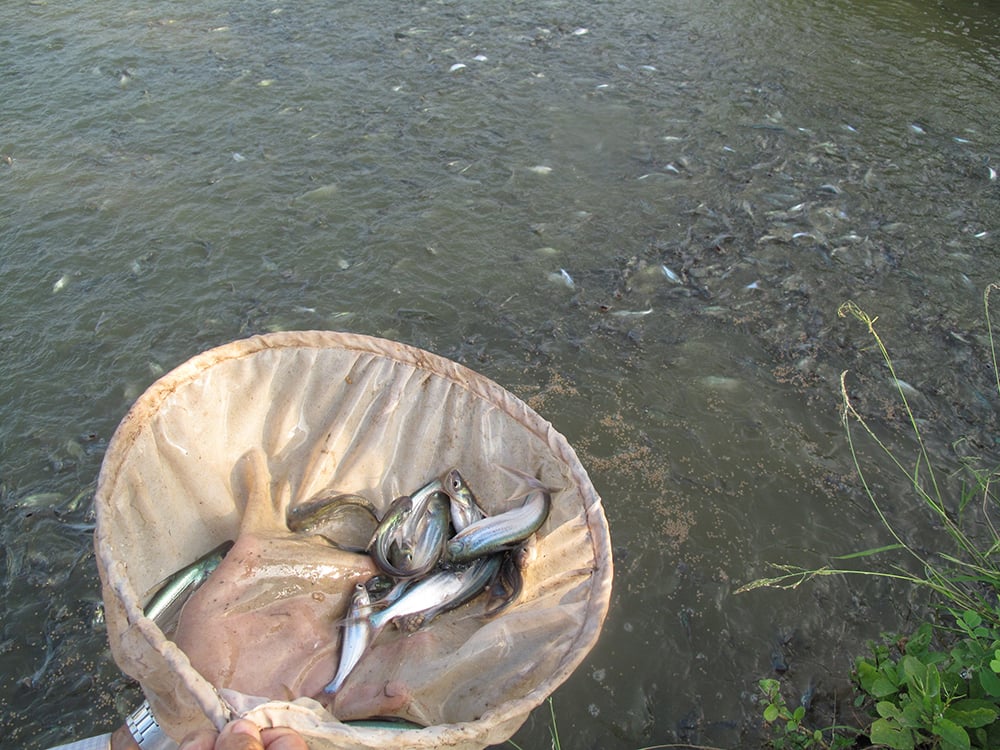
Currently, the price of pangasius fingerlings is at its highest level in the past 10 years. Photo: MINH HIEN
Double impact
Sitting and chatting by his fish pond, preparing for stocking, Mr. Nguyen Manh Kiem, a resident of Hoa Lac commune, said that the price of catfish fingerlings (about 30 fish/kg) has suddenly increased from 43,000 VND/kg to 55,000 - 58,000 VND/kg, while at the beginning of the year it was only 25,000 - 28,000 VND/kg. "The price has increased sharply, making farmers hesitant to stock more because input costs have gone up too much."
Mr. Kiem is one of many fish farmers in the Mekong Delta who have just finished selling their commercial fish crop and want to resume farming to avoid interruptions in production. Mr. Kiem said: “I just harvested nearly 1,000 tons of fish from my pond, selling them at 29,000 VND/kg. At this price, farmers are making a pretty good profit.”
Mr. Phan Anh Vu, residing in Phu Hoa commune, who has 3 hectares for raising catfish fingerlings, said: “In the previous two seasons, I sold fingerlings for 38,000 - 42,000 VND/kg. Now the price has increased sharply, but I don't have enough to supply because the weather this year has been harsh, resulting in significant losses.”
Surveys conducted in many localities in An Giang and some provinces in the Mekong Delta show that the localized shortage of fish fry is due to the current off-season, making it very difficult to raise fish fry successfully. In addition, the increasingly severe effects of climate change are increasing the mortality rate of fish fry during the rearing process, leading many small-scale producers to abandon the profession due to losses. Fluctuating prices of commercial fish also make farmers hesitant to expand their farming operations.
Mr. Le Chi Binh, Vice Chairman of the Provincial Fisheries Association, commented: "The current bottleneck is not a shortage of fish fry in overall quantity, but rather a lack of stability in quality, supply timing, and supply chain linkage."
Rising seed prices have a "double" impact. For farmers, a 30-40% increase in input costs can alter the feasibility of an entire farming season. Ms. Tran Thi Kieu, residing in Hoa Lac commune, shared: "The increase in seed costs alone is discouraging for farmers, not to mention the costs of feed and aquatic medicine."
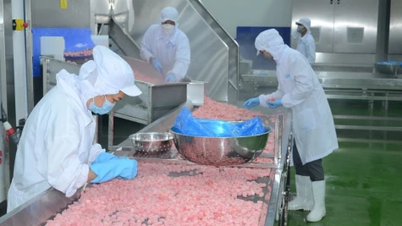
For processing businesses, a shortage of fish fry means a shortage of raw fish. A representative of a seafood processing plant in Long Xuyen ward expressed concern: "If the supply is unstable, we will find it difficult to maintain delivery schedules for international partners, and our brand reputation will be directly affected."
Untangling the knot
According to managers, if the "fever" for pangasius fingerlings persists, the entire pangasius value chain, from production and processing to export, will be affected, even risking the loss of orders in demanding markets. Master's degree holder Tran Anh Dung, former head of the Provincial Fisheries Department, analyzed: "The shortage of fingerlings is a clear lesson about the lack of synchronized production planning. For many years, we have strongly developed the area for commercial farming but have not paid enough attention to the fingerling stage, leading to localized shortages. The lesson learned is that we must build concentrated fingerling production areas, closely linking production and consumption, and have a mechanism to coordinate supply and demand to avoid repeating this vicious cycle."
Mr. Dung believes that local authorities need to play the role of "conductor" in regulating production, from managing the quality of broodstock and controlling diseases to providing loan and technical support to fish farmers. To overcome the "bottleneck" in fish fry supply, all parties involved in the pangasius industry chain need to synchronize solutions such as management and planning, technology application, chain linkages, and market information transparency in the areas of management and planning. At the same time, it is necessary to continue forming concentrated fish fry production areas, similar to the three-tiered pangasius fish fry program, selecting locations less affected by climate change, and strictly controlling the fish fry rearing process.
Regarding technological applications, the State needs to encourage fish breeding facilities to invest in water treatment systems and adopt new techniques to reduce losses and improve disease resistance in fish fry. Strengthening supply chain linkages is also crucial, with processing companies signing contracts with production and breeding facilities to guarantee the purchase of their products. This would both reassure farmers and ensure a stable supply of raw materials for the factories.
"The crucial issue here is the need for market information transparency. To achieve this, participating parties need to establish channels for forecasting supply and demand, prices, farming area, etc., so that farmers and businesses can plan accordingly, avoiding the uncontrolled, simultaneous stocking of fish as seen in the past," Mr. Le Chi Binh suggested.
The high price of fish fry partly reflects the demand for preparing for the new farming season, but also highlights long-standing shortcomings. For the pangasius industry to develop stably, it is necessary to quickly resolve the "bottleneck" related to fish fry supply to prevent this situation from recurring.
| “Solving the issue of breeding stock is key to Vietnam’s pangasius industry consolidating its position as a multi-billion dollar export sector. To achieve this, long-term planning, strict management, and enhanced regulatory role of local authorities are needed,” emphasized Mr. Le Chi Binh, Vice Chairman of the Provincial Fisheries Association. |
Source: https://baoangiang.com.vn/thieu-hut-con-giong-ca-tra-a463251.html

















![[Photo] Reception to welcome General Secretary and President To Lam and his wife on their State visit to the Philippines](https://vphoto.vietnam.vn/thumb/1200x675/vietnam/resource/IMAGE/2026/06/01/1780295488620_vna-potal-chieu-dai-chao-mung-tong-bi-thu-chu-tich-nuoc-to-lam-va-phu-nhan-tham-cap-nha-nuoc-toi-philippines-8798060-7855-jpg.webp)





















































Comment (0)