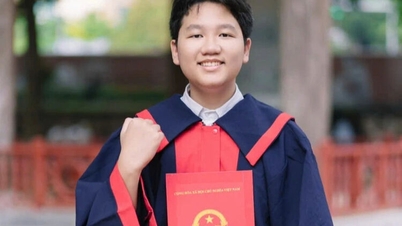
Chinese students on their graduation day. Photo: Global Times
The ministry said that educational institutions and universities are encouraged to accelerate the implementation of employment support policies. Recruitment for positions in the public sector, government agencies, and state-owned enterprises will be expedited, with plans to complete them by the end of August.
This campaign is expected to include at least 4,000 job fairs at universities nationwide, offering more than 5 million job opportunities. The National University Student Employment Service platform will also organize more than 10 themed online job fairs, providing 1.5 million job opportunities.
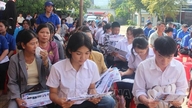
With the economy slowing down (this year's GDP growth target is only 4.5-5%) and a huge number of young people entering the labor market each year, finding suitable employment is becoming increasingly difficult for recent university graduates. According to Hong Kong's South China Morning Post , the unemployment rate among young people aged 16-24 in China has been steadily rising, reaching 16.9% in March, just before nearly 13 million new graduates entered the job market.
In fact, the difficulty for young people to find jobs is not unique to China.
![[Image] Schools organize meetings and introduce teaching models to students admitted to grade 10.](https://vphoto.vietnam.vn/thumb/192x108/vietnam/resource/IMAGE/2026/06/25/1782368077271_ndo_br_z7970052192242-1ec8daeb77a6eed1a4e9f58c564ddd3e-jpg.webp)
In the US, the unemployment rate for recent college graduates is projected to reach 5.6% by early 2026, while the overall unemployment rate is 4.2%. This is the largest unfavorable disparity ever recorded for recent college graduates in the country.
Previously, a university degree was seen as a "guarantee" that gave young people significantly better job opportunities compared to the average. However, researchers say this trend has changed since 2019, especially as artificial intelligence (AI) has become a powerful factor impacting the job market.
Growing concerns among young Americans about the impact of AI on the future of work are becoming a widely discussed topic after a video of University of Central Florida students' reactions went viral on social media in late May. In the video, many students booed and protested when a graduation speaker referred to AI as "the next industrial revolution." The reaction intensified when the speaker claimed that AI is now "in the palm of our hands."
In South Korea, a survey of recent or soon-to-be-graduated university students revealed that six out of ten job seekers had low expectations of being hired. One in two cited "lack of job opportunities" as the main reason for their lack of enthusiasm for job searching. Four out of ten believed the job market for graduates this year was "more challenging than last year."
In late April, the South Korean government announced the “Youth New Deal” plan, worth 800 billion won, aimed at helping 100,000 young people find jobs. Currently, more than 1.7 million South Koreans in their 20s and 30s are unemployed.
According to research by the U.S. Federal Reserve, the employment advantage of college graduates has gradually declined over the past two decades. By 2019, the gap in job opportunities between college graduates and those with only a high school diploma was almost negligible. However, college degrees still offer long-term advantages. For example, the unemployment rate for workers aged 25 and older with a bachelor's degree or higher is currently only about 2.8%, significantly lower than that of those without a college degree.


NATIONAL DAY (Compilation)
Source: https://baocantho.com.vn/thoi-cu-nhan-kho-tim-viec-a206703.html
![[Image] Ho Chi Minh City: Ma Lang area, Chicken-Rice Market about to change its appearance](https://vphoto.vietnam.vn/thumb/1200x675/vietnam/resource/IMAGE/2026/06/25/1782377698627_ndo_br_m1-jpg.webp)


![[Photo] General Secretary and President To Lam receives Palestinian Ambassador Saadi Salama](https://vphoto.vietnam.vn/thumb/1200x675/vietnam/resource/IMAGE/2026/06/25/1782365384740_a1-bnd-9423-8322-jpg.webp)
![[Image] Schools organize meetings and introduce teaching models to students admitted to grade 10.](https://vphoto.vietnam.vn/thumb/1200x675/vietnam/resource/IMAGE/2026/06/25/1782368077271_ndo_br_z7970052192242-1ec8daeb77a6eed1a4e9f58c564ddd3e-jpg.webp)