

From the rustic hoofbeats of horses in the vast mountains, we journey to the capital...
At the thematic exhibition, the public in Hanoi had the opportunity to admire a collection of folk wooden horse sculptures bearing the distinct cultural imprint of the Central Highlands, created by Central Highlands cultural researcher Dang Minh Tam. Without flashiness or elaborate details, these horse sculptures seem to have just emerged from the rhythm of life in the highlands, with their pristine, rustic beauty, retaining the original carving and sculpting marks.
To complete the collection, researcher Dang Minh Tam spent more than four months diligently creating the pieces. Notably, the works were entirely spontaneously created. Each horse was carved based on the natural shape of the piece of wood, whether curved or straight, round or flat, with knots or branches. The wood used in the works is also diverse, ranging from common woods like pine, fir, and oak to precious woods such as ironwood, green lim, gõ, and hương.
Researcher Dang Minh Tam shared: "When I see a piece of wood, I imagine a horse doing something, and then I carve the wood according to that idea. Therefore, no two horses in the collection of wooden horse statues are alike."
 |
The collection of wooden horse sculptures owned by researcher Dang Minh Tam has attracted public attention. |
Thus, a collection of 50 wooden horses was created, each with its own appearance and story. Some are plump horses drinking rice wine, their manes woven from jute; others carry wine jars and wear wooden clappers; many are stylized with Central Highlands motifs such as gourd flowers, moonlight, and the sun. The paired horse statues also make a strong impression, with one horse carrying a copper pot symbolizing abundance, and the other carrying a jar of rice wine, evoking family reunions. Statues of mother horses cradling their foals, with baskets on their backs, bring a sense of closeness and warmth to life in the highlands.
The exhibition also features seven wooden pillars, each approximately 20cm in diameter, depicting a slice of the cultural life of the Ede ethnic group. The pillars are carved with various themes, from sacred animals like grasshoppers, deer, and buffaloes; familiar animals like elephants, geckos, turtles, chickens, and birds; traditional patterns; to scenes of community life such as gong playing, drumming, horn blowing, playing the t'rưng instrument, pounding rice, and drinking rice wine. Some pillars also represent the human life cycle, from birth, labor, love, marriage, to returning to one's ancestors; along with images of tombs, symbolizing the connection between generations. At the top of each pillar is the image of a horse, serving as a central spiritual element, connecting the pillars to the entire exhibition space.
 |
| The seven wooden pillars were designed by researcher Dang Minh Tam. |
In addition, to celebrate the 950th anniversary of the Temple of Literature - National University, researcher Dang Minh Tam also presented a collection of horse sculptures with the theme "Returning Home in Glory," featuring horses carrying each other, one carrying a golden plaque, and another carrying a wreath. There were also humorous works such as a horse reading a book, a horse supervising an exam, or even a horse lazy in studying, creating a lively atmosphere for the exhibition.
Mr. Le Xuan Kieu, Director of the Cultural and Scientific Activities Center of Van Mieu - Quoc Tu Giam, shared: "The works of researcher Dang Minh Tam, with their spontaneous expression and rich Central Highlands identity, not only possess artistic value but also contribute to spreading Central Highlands culture in activities promoting Vietnamese cultural heritage."
...To horses that embody contemporary springtime colors.
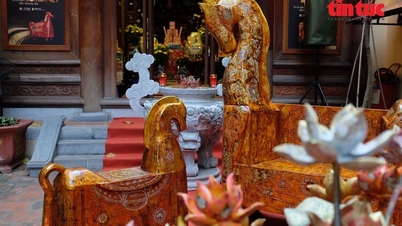
Also featured in the "Horses Returning to the City" exhibition are lacquer horse artworks by artist Le Huy and the Lamphong Studio group founded by the artist, bringing a different nuance: modern yet deeply traditional, generous yet relaxed, historical yet full of springtime charm.
Lamphong Studio began its creative journey with the desire to tell the story of a glorious period in the nation's history, as expressed in the two lines of poetry: "Using righteousness to overcome brutality / Using humanity to replace tyranny" ("Proclamation of Victory over the Wu" - Nguyen Trai).
The inspiration also comes from the image of the horse in the familiar folk rhyme: "The joyful cheers of the people when the Lam Son army advanced to liberate Dong Quan citadel ( Hanoi )." Through this, Lamphong Studio conveys in its works the wish for "successful arrival of the horse," with new opportunities, prosperity, and brilliance.
 |
| Horse artworks by artist Le Huy and the Lamphong Studio group. |
The artworks are entirely handcrafted using traditional lacquerware, featuring the five colors of the Five Elements. The horses are adorned with cloud and fire motifs, a hallmark of Vietnamese art. The horses are depicted with full, majestic forms. Many have a relaxed, leisurely gait, as if victory is already assured. Instead of galloping, they move steadily forward, embodying the confidence and steadfastness of those who are masters of their own destiny.
Notably, the horse's back is adorned with a brass kite depicting a "moon chasing a phoenix." Artist Le Huy shared: "In folk beliefs, kite flying is not just a game, but also a ritual to ward off evil, pray for peace, and was even used to transmit messages. Today, the image of a kite evokes images of vast countryside, soaring dreams, and faith in the future. Through this, the kite symbolizes taking flight, like a victorious flag fluttering in the spring sky."
Amidst the ancient and majestic setting of the Van Mieu - Quoc Tu Giam National Special Monument, the lacquer horses by artist Le Huy and Lamphong Studio seem to carry the spring sunshine and breeze, harmonizing the past and present, so that history does not remain dormant on the pages of books, but steps into life, conveying wishes for a new year full of hope.
Source: https://www.qdnd.vn/van-hoa/van-hoc-nghe-thuat/thong-dong-vo-ngua-ve-pho-1021624

























































Comment (0)