

 |
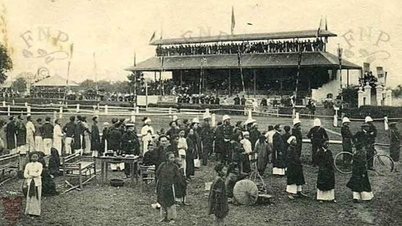
| Horsemen of the Nguyen Dynasty at Nghi Mon Gate - Trung Dao Bridge, Hue Imperial Citadel (Photo courtesy of the early 20th century) |
In 1826, the imperial court established the Thượng Tứ Institute in the Hue Citadel, dedicated to raising and training horses for the emperor. Initially, the institute belonged to the Imperial Guard, but later it was transferred to the regular Army. The institute comprised three divisions: the Elite Cavalry, the Light Cavalry, and the Flying Cavalry, housing over three hundred horses at its peak. During the reign of Minh Mạng, three large stables were built, each with seventeen bays; during the reign of Thiệu Trị, another twelve-bay stable was added. In addition, there was an auxiliary stable in Ninh Bạt ward with twenty-one bays, demonstrating the impressive scale of this facility.
Horses were purchased from localities such as Ninh Binh , Quang Nam, and Phu Yen; sometimes they were imported from Yunnan (China) or the West to improve the breed. Because they were "horses of the king," they were carefully selected and systematically trained to become the most elite "cavalry."
Horses of the Imperial Order were divided into several categories, depending on their purpose: Imperial horses (horses reserved for the king); Road horses (horses used to pull carriages); Ceremonial horses (horses used in grand ceremonies); and Servant horses (horses accompanying the royal procession).
Imperial horses were considered close companions of the emperor, and many were given names and titles by the king. Emperor Minh Mạng named his beloved horses Cát Thông, Thần Lương, Phúc Thông, Thiên Trúc, and An Tường. Among them, the horse An Tường Ký received a special decree from the king after he test-drove it and praised it as "calm and pleasing." Emperor Thiệu Trị also had precious horses named Đại Uyển Long Tuấn Mã, Hiểu Lương Thông, etc.
The horses that accompanied the emperor were lavishly adorned: saddles covered in gold carved with dragons and clouds, ropes with bells embroidered with gold thread, stirrups intricately carved, whips inlaid with gold, and saddlebags made of brocade. In 1830, the court specially commissioned two sets of "horse ornaments," each detail reflecting the majesty of imperial power.
Besides serving in ceremonies, the Thượng Tứ horse also participated in emergency missions. When there was a fire in the capital, the horse was used to scout and report the situation; or it was sent to garrisons and relay stations to deliver official documents and news. In one year, King Minh Mạng even provided Thượng Tứ horses to soldiers at Điện Hải citadel ( Da Nang ) to patrol the seaport and send urgent reports back to the capital.
Besides raising horses, the Thượng Tứ Institute also served as a breeding center. In 1846, King Thiệu Trị issued a decree: "Since foals are born in large numbers, they should be distributed to the stations." At that time, the Institute had 251 stallions, of which 200 healthy ones were assigned to the two light cavalry and flying cavalry units, and the rest were distributed to the relay stations.
The training of horses and cavalry was also strictly regulated. From 1840, soldiers had to practice horseback riding three times a day at three levels: low, medium, and high. Every ten days they practiced throwing spears and wielding swords; monthly they practiced shooting and battle formations. In 1851, the court organized a large-scale military exercise: more than 200 soldiers, 100 horses, 80 guns, hundreds of swords and spears, and banners filling the sky – a majestic scene in the ancient capital. However, in actual military practice, the cavalry of the Nguyen Dynasty did not leave a profound mark. Horses were mainly used for transporting letters and documents, or for serving in major ceremonies such as the Giao and Xa Tac sacrifices. Their role was more ceremonial than combat.
From the activities of the Thượng Tứ Institute, we can get a glimpse of the appearance of the royal horses and cavalry of the Nguyễn Dynasty – a system that was both administrative and ceremonial, reflecting the meticulous organization of the dynasty. The word "Tứ" in "Thượng Tứ" originally consists of the radical "mã" (horse) and the radical "tứ" (four), referring to a four-horse carriage, later taking on the meaning of "precious horse". Therefore, "Thượng Tứ" was the place dedicated to raising and training the king's finest horses.
In the Year of the Horse, recalling the story of the Thượng Tứ horse is also a way of looking back at a piece of history that has faded away. Today, the place where the sound of horse hooves once echoed only remains as the name of the Thượng Tứ Gate, the southeastern gate of the Hue Imperial City. Few know that next to that gate once stood a large horse stable, a majestic corner of the Nguyen Dynasty. In the twilight on the city walls, somewhere the poem of Bà Huyện Thanh Quan seems to echo: "The traces of ancient carriages and horses, the soul of autumn grass / The old foundation of the castle, the shadow of the setting sun…" in a moment of quiet contemplation in the ancient capital, where the sound of Thượng Tứ horse hooves once resounded in the golden memory of a bygone era.
Source: https://huengaynay.vn/van-hoa-nghe-thuat/hoai-niem-ngua-thuong-tu-162457.html
![[Image] Nearly 125,000 Hanoi students completed the Literature exam for the 10th grade entrance exam.](https://vphoto.vietnam.vn/thumb/1200x675/vietnam/resource/IMAGE/2026/05/30/1780117233041_ndo_br_thiet-ke-chua-co-ten-2-png.webp)




















![[Photo] Admire the coral "masterpiece" amidst the million-year-old heritage of Dak Lak province.](https://vphoto.vietnam.vn/thumb/1200x675/vietnam/resource/IMAGE/2026/05/30/1780107638639_y25-jpg.webp)


















































Comment (0)