

 |
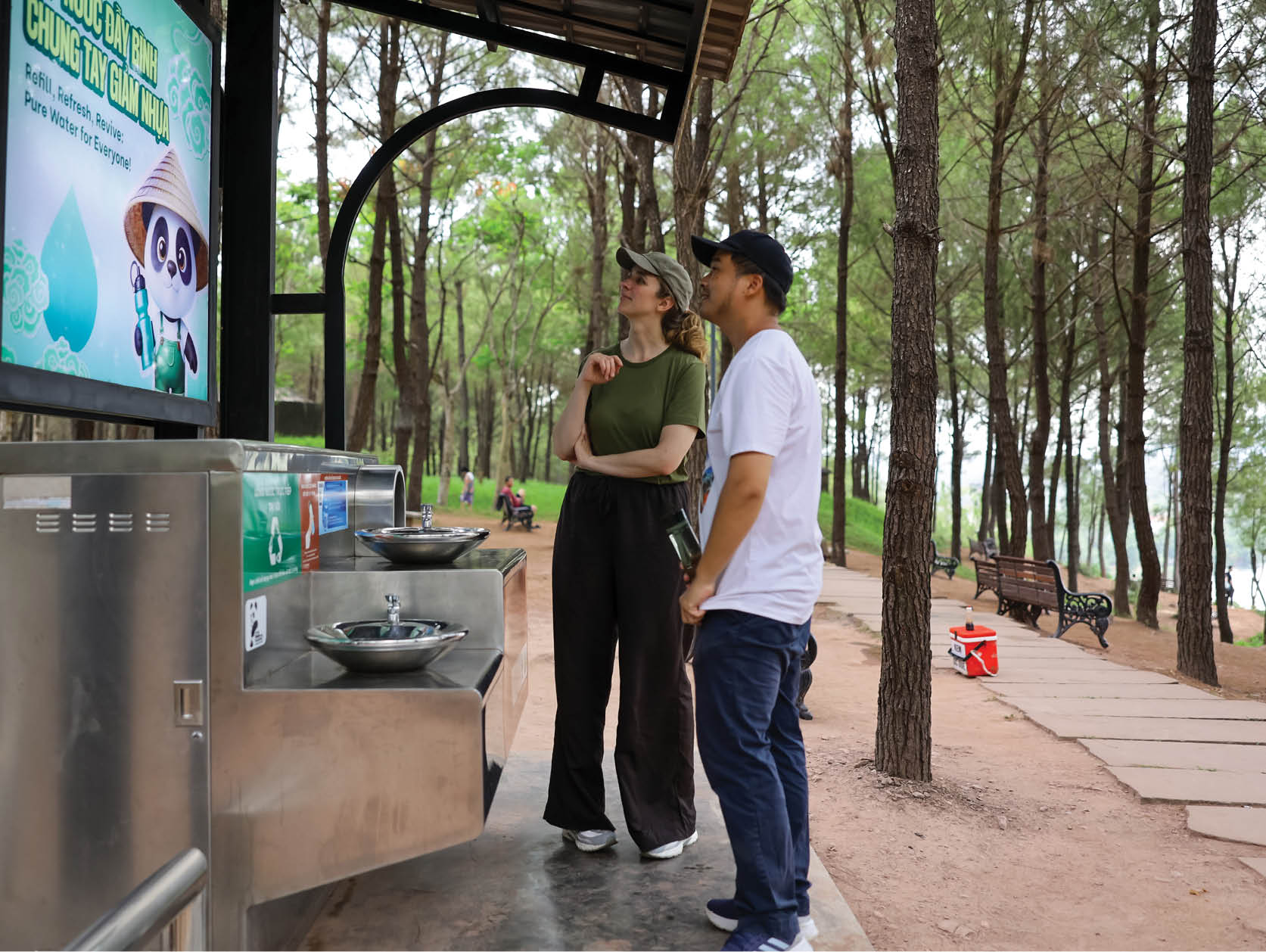
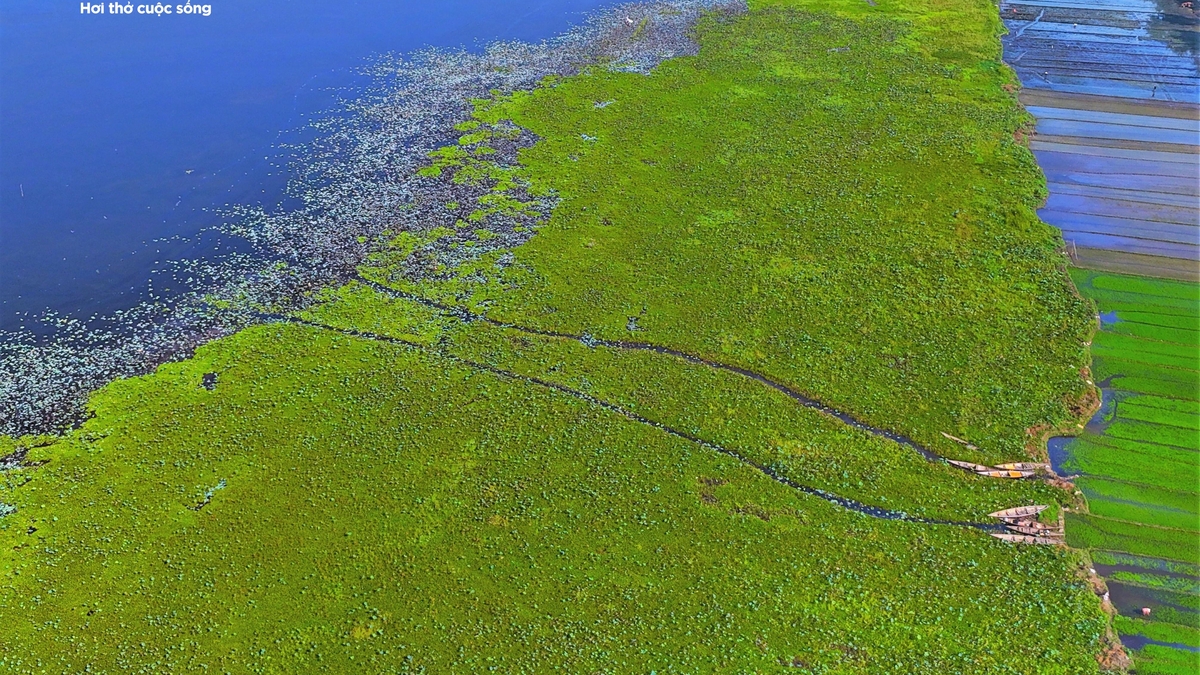
| The provision of free drinking water at bus stops in coastal communes and wards aims to reduce the use of single-use plastic bottles, contributing to environmental protection. |
Many bright spots
Since 2022, the Hue - Plastic-Reduced City in Central Vietnam Project (TVA) has partnered with Hue City in implementing a waste sorting program at source, aiming to gradually raise awareness about environmental protection and change daily habits. Through the program, people are guided on how to sort waste scientifically and effectively. The project not only provides technical support and installs sorting bins, but also collaborates with local authorities and waste collection units to ensure that waste is collected, transported, and processed efficiently, preventing environmental pollution.
In particular, this model also creates livelihood development opportunities for those working in the scrap collection industry through the establishment of technology-based scrap collection cooperatives via the mGreen app; while simultaneously promoting a spirit of community awareness and responsibility towards the environment. From schools and residential areas to public spaces, waste sorting at source and plastic waste reduction activities have been contributing to building Hue into a green, clean, and bright city, where every citizen becomes a "pioneering force" working together to protect the environment.
Mr. Nguyen Van Tan, Chairman of the Phu Vinh Commune People's Committee, said that to minimize plastic waste along the coast and lagoons, the Commune People's Committee has effectively developed and implemented several exemplary models, including a model for collecting and sorting waste at the source. This model focuses on installing sorting bins in public places and residential areas along the coast and lagoons. Installing these sorting bins helps increase recycling efficiency, reduce environmental pollution, save processing costs, raise community awareness, create valuable products from waste, improve the quality of life for residents, and ensure compliance with the law.
Specifically, the People's Committee of the commune has installed 20 sets of waste sorting bins at 20 locations in public areas, residential areas, community beaches, and village cultural centers. Simultaneously, surveys are underway at 27 more locations to install waste sorting bins funded by the TVA project. In addition, there is a model for composting and producing biodegradable cleaning enzymes from organic waste. This model, supported by the TVA project, involves training for women's associations and is currently being piloted in 22 households in the commune to reduce local solid waste and save on waste treatment costs. The model also helps households learn how to implement it at home, improving their waste sorting skills and reducing plastic waste.
To support the city in implementing the household solid waste sorting program at source, the TVA project also provided technical and financial support. Accordingly, 156 sets of sorting bins were installed at designated locations for storing sorted household waste in Phase I, and 139 sets for Phase II; 144 "Green Houses" for recyclable waste were equipped for wards and communes; and over 25,000 sets of garbage bags (including orange bags for hazardous waste, mesh bags for recyclable waste, and gray bags for glass waste) were distributed to educate and guide local residents on proper waste sorting and storage at home.
Infrastructure meets requirements
According to the Environmental Protection Agency, from 2024 to the present, the main technologies for treating municipal solid waste in the city have been incineration for electricity generation and landfilling. There are no facilities for receiving and processing sorted food waste; the recommended methods for processing sorted waste are using it as animal feed and compost. In the first 10 months of 2025, localities in the city continued to implement the waste sorting at source program, disseminating information and encouraging people to actively sort waste into recyclable and reusable categories, and to use sorted food waste as animal feed and compost at home for planting trees. To date, the amount of municipal solid waste generated in the city is approximately 720 tons/day, with over 194,474 tons processed by incineration at the Phu Son Waste-to-Energy Plant, about 15,497 tons disposed of through landfilling in the remaining 7 communes, and 38.96 tons collected from "Green Sunday" activities.
By 2025, the rate of solid waste collection and treatment across the city will have reached approximately 97%. With the commissioning of the Phu Son Waste-to-Energy Plant, local waste is being treated using modern technology, meeting environmental requirements. In 2025, solid waste from the former Phong Dien area will also be processed at the Phu Son Waste-to-Energy Plant. Currently, only the former Quang Dien and A Luoi areas still use landfill methods for waste treatment. Overall, the current waste treatment infrastructure meets the needs of the entire city.
Within the city, there are still landfill investment projects that have not yet become operational. Specifically, the Phu Son landfill, part of the project to thoroughly address environmental pollution caused by household waste in the city and surrounding areas, covers an area of 4.992 hectares with a landfill capacity of 200,898 m3. The project is currently completed and undergoing acceptance testing and handover for use. The Phu Son reserve landfill has a landfill area of 5.38 hectares and a landfill capacity of approximately 300,000 m3. This project has been approved for adjustment by the City People's Committee in Decision No. 3036/QD-UBND dated September 23, 2025. The Huong Binh landfill, part of the project to thoroughly address environmental pollution caused by household waste in key areas of the city, covers an area of approximately 26.5 hectares and has a capacity of approximately 195,000 m3...
Recently, the Environmental Protection Sub-Department has also coordinated with the People's Committee of Phong Dien town (formerly) to implement the project "Model for collecting and treating domestic wastewater" for approximately 100 households, combined with treating wastewater from An Lo market in Phong Hien commune, Phong Dien district (now Phong Thai ward). The units and localities have completed the basic construction and are currently conducting acceptance testing for equipment installation. The project is expected to be completed by the end of this year.
According to the Department of Environmental Protection, although the volume of household waste increased in the first 10 months of 2025 compared to the same period last year, the rate of solid waste collected and processed reached 97%, meeting the set target. The landfill rate reached 7.4%, exceeding the set target. This shows that the waste collection and processing infrastructure still meets the requirements.
Mr. Le Ba Phuc, Deputy Director of the Department of Agriculture and Environment, said that by 2026, the city aims to have 100% of its wards and communes implementing waste sorting at source. The Department will focus on building, perfecting, and effectively implementing policies and laws on environmental protection; innovating the inspection and monitoring of environmental law enforcement, focusing on post-inspection, and bringing production activities that generate waste into a structured framework through strict output monitoring. Furthermore, it will strictly enforce environmental protection regulations during the planning, approval, and implementation of key programs; and advise city leaders and relevant units to prioritize the development of industries and sectors with high added value, clean technology, environmental friendliness, and resource conservation. |
Source: https://huengaynay.vn/kinh-te/thuc-day-phan-loai-rac-tai-nguon-160583.html
![[Photo] My Son at night: A thousand-year-old heritage site amidst the Milky Way](https://vphoto.vietnam.vn/thumb/1200x675/vietnam/resource/IMAGE/2026/04/15/1776261039184_ndo_br_chon6-jpg.webp)
![[Photo] Mrs. Ngo Phuong Ly meets and exchanges views with Mrs. Peng Li Yuan](https://vphoto.vietnam.vn/thumb/1200x675/vietnam/resource/IMAGE/2026/04/16/1776277858080_phu-nhan-1-jpg.webp)
![[Photo] National Assembly Chairman Tran Thanh Man attends the opening session of IPU-152](https://vphoto.vietnam.vn/thumb/1200x675/vietnam/resource/IMAGE/2026/04/16/1776277863731_ctqh5-jpg.webp)
![[Photo] The General Secretary, President and his wife meet with Vietnamese-Chinese friendship leaders.](https://vphoto.vietnam.vn/thumb/1200x675/vietnam/resource/IMAGE/2026/04/15/1776264829725_vna-potal-tong-bi-thu-chu-tich-nuoc-to-lam-gap-mat-nhan-sy-huu-nghi-viet-nam-trung-quoc-8703641-3130-jpg.webp)





















































Comment (0)