According to the new planning map, Lam Giang commune in Lao Cai province possesses a large area and a strategic location along the Red River and the Con Voi mountain range. However, many development potentials remain untapped due to geographical barriers and outdated production mindsets.
In our conversation, the Party Secretary of Lam Giang commune, Nguyen Anh Tien, outlined an ambitious roadmap to revitalize this land, placing his faith in two pillars: a revolution in commercial agriculture and a breakthrough in transportation infrastructure.

Mr. Nguyen Anh Tien, Secretary of the Party Committee of Lam Giang Commune. Photo: Thanh Tien.
Concerns about spontaneous production
Merging the two communes means expanding the development space to nearly 180 square kilometers and increasing the population to over 16,500 people. However, this larger scale also more clearly exposes the limitations of the fragmented agricultural system in Lam Giang.
The story begins with Mr. Tien's concern about sugar beet cultivation. Mr. Tien recounted how the commune had previously placed high hopes on this crop. The fertile riverside land and favorable climate meant that sugar beets grown in Lam Giang were large, sweet, and highly productive. However, the joy of a bountiful harvest was accompanied by worries about falling prices. Farmers had to sell their harvested beets piecemeal at markets and on the streets. The product was good, but without a stable market or processing plants to guarantee purchase, it ultimately became a burden.
"The most valuable lesson we've learned is that spontaneous production is impossible. If we continue to follow trends and plant whatever crops or raise whatever animals we see, without establishing value chain linkages, Lam Giang's agriculture will never be able to grow," Mr. Tien emphasized.
Towards commodity production
Based on the lessons learned, for the 2025-2030 term, Lam Giang commune has identified a breakthrough in its agricultural structure. No longer relying on fragmented plots of land for self-sufficient rice and potato cultivation, the commune is moving towards large-scale, high-tech commercial agriculture.

Agricultural and forestry production has not yet created a breakthrough in the socio-economic development of Lam Giang. Photo: Thanh Tien.


Party Secretary Nguyen Anh Tien spoke enthusiastically about the potential waiting to be explored. With the advantage of over 30km along the Red River, the commune possesses beautiful alluvial plains and sandy-silt sandbanks. "This is a great potential for developing mulberry cultivation and silkworm farming. Mulberry trees are extremely well-suited to the soil here, and we are planning to transform the riverside land into a key silk production area," Mr. Tien shared.
Besides mulberry trees, Lam Giang also boasts unique microclimates rarely found elsewhere. A prime example is Truc Trong village, with its vast fields spanning hundreds of hectares nestled in the valley. Here, the climate is cool year-round, and the mountain stream water is pure.
According to Mr. Tien, this area is being oriented towards developing high-tech agriculture. The commune is actively inviting experts and businesses to survey the area for planting vegetables and fruits for deep processing, such as winter squash and bitter melon, to make tea bags and medicinal herbs. At the same time, they are utilizing the clean, cold water source to expand sturgeon farming models.
"The mindset for the next term is to do things on a large scale, not just a few scattered hectares. We are replanning everything, determining which areas are for growing vegetables, which are for growing strawberries, and which are for concentrated livestock farming... We must create a sufficiently large raw material area to attract businesses to invest in processing plants, establish linkages, and guarantee the purchase of products from farmers. The ultimate goal is for Lam Giang's agricultural products to have a brand, to be able to enter supermarkets, and to become OCOP products, not just sold in rural markets," Mr. Tien shared.
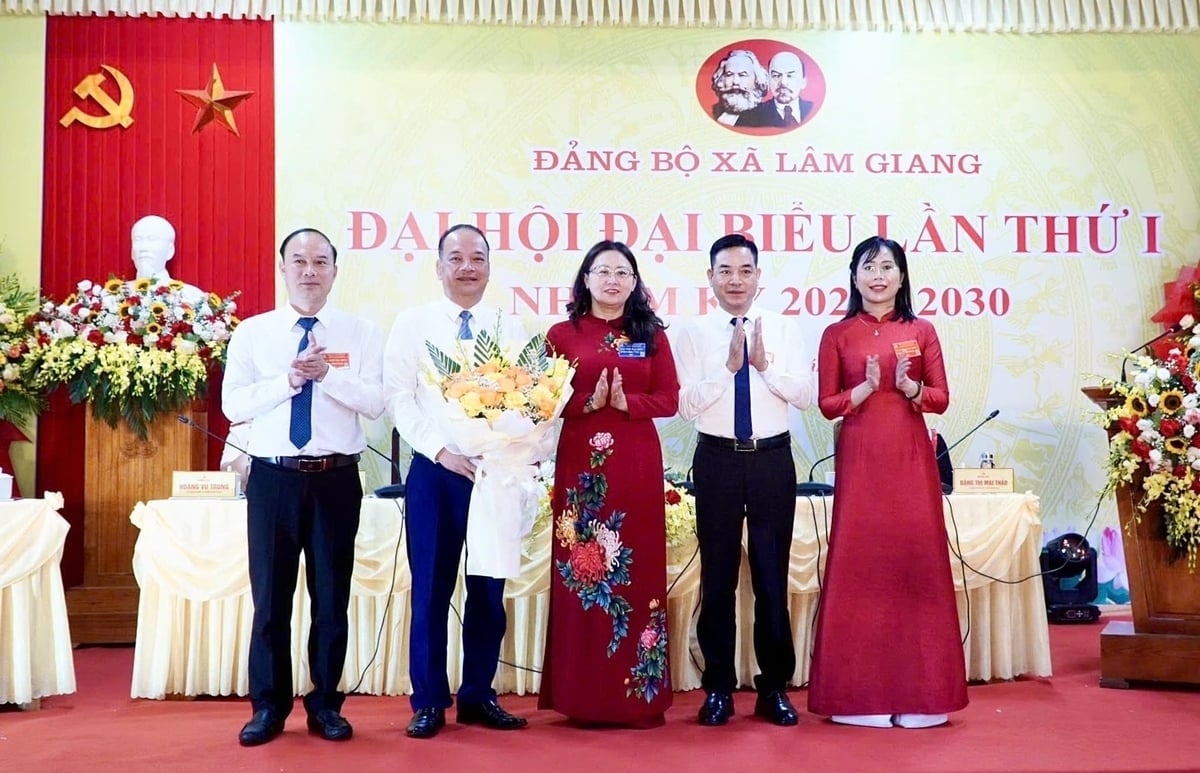
The Party Congress of Lam Giang commune for the 2025-2030 term has established a roadmap for breakthrough development in the coming period. Photo: Thanh Tien.
Transportation is the second key area for breakthrough.
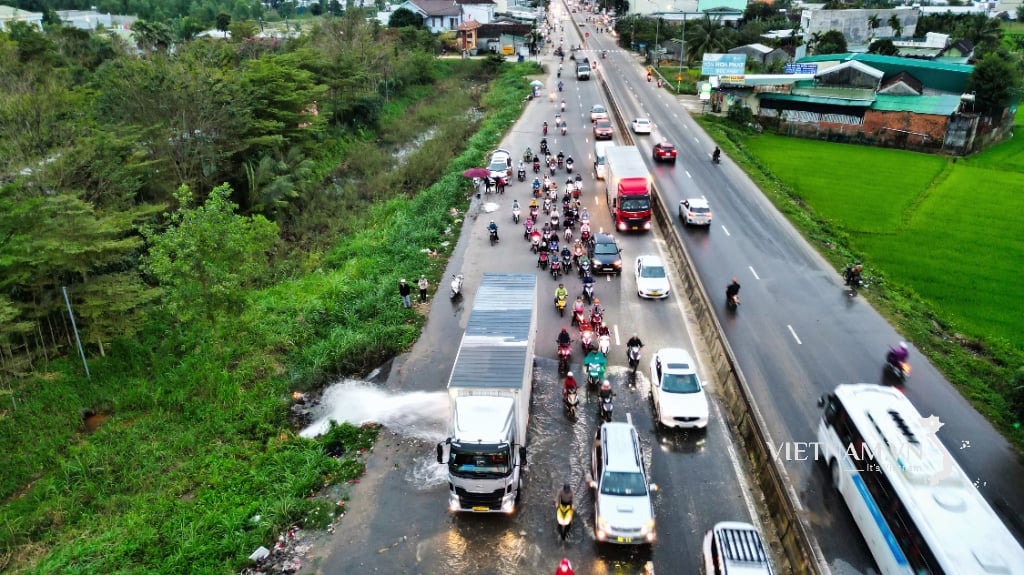
The aspiration for commercial agriculture will remain just a pipe dream if the infrastructure problem is not solved. The terrain, fragmented by hills and deep streams, makes logistics costs in Lam Giang too high. No matter how good the agricultural products are, if the roads are difficult to access and transportation costs erode all profits, the farmers will not be enthusiastic.
Therefore, transportation has been identified by Lam Giang as the second crucial breakthrough area. First, the upgrading and expansion of the approximately 30km main road connecting Dong Cuong and Mau A communes will serve as the backbone for intra-regional trade. Second, and a long-held dream of the people on both sides of the Red River, is the construction of a bridge connecting Chau Que Thuong commune to Lam Giang.
Analyzing the importance of this bridge, Mr. Tien expressed his hope: "Currently, Lam Giang is isolated, with transportation hindered, like an island. This bridge will not only simply connect the two banks of the river but will also help Lam Giang connect directly with the Noi Bai - Lao Cai expressway and the region's development axes. When this bottleneck is removed, the impasse will be broken, and the value of land, agricultural products, and services in the commune will increase."
Alongside transportation, urban planning was also included in the commune's resolution. After the merger, a paradox exists: from one end of the commune to the other, one cannot recognize the administrative or economic center. The area around Lam Giang train station or the former Lang Thip commune center are both small, have developed spontaneously, and are not commensurate with their potential.
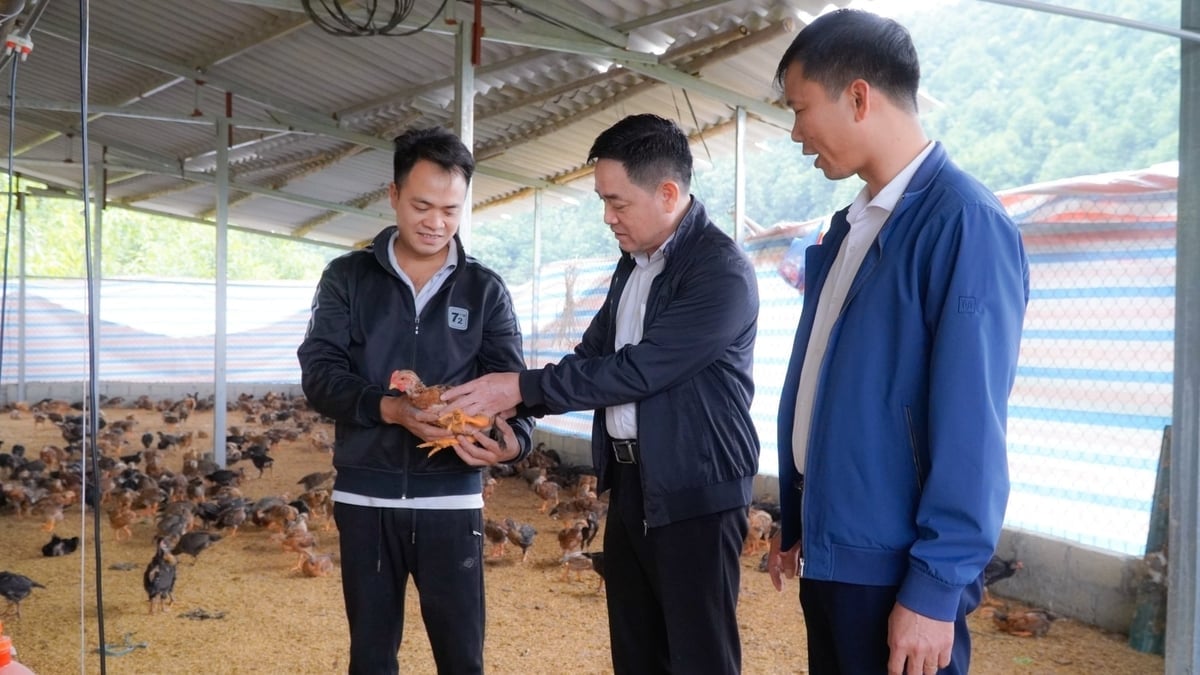
Commercial agricultural production is one of the pillars for Lam Giang's breakthrough development. Photo: Thanh Tien.



To address this issue, the commune has been planning a new administrative center with a scale of 45-50 hectares in the riverside area.
Mr. Tien shared his vision for the future: "We will build a true center with modern offices, a plaza, parks, and public recreational areas for the people. We will clear the riverside area to create a landscaped space and guide the development of commerce and services."
This systematic planning is not only aimed at administrative purposes but also serves as a catalyst for economic restructuring, gradually reducing the proportion of purely agricultural activities and increasing the proportion of trade and services, transforming Lam Giang into a civilized and modern urban area.
Through the story told by the commune secretary about the high-tech vegetable fields and the bridge connecting the riverbanks in the future, we clearly felt the new vitality rising in Lam Giang. Hopefully, by correctly identifying the infrastructure bottlenecks and choosing the right development direction, the aspirations for change of the people living along the Con Voi mountain range will soon become a reality.
Source: https://nongnghiepmoitruong.vn/tiem-nang-dang-cho-danh-thuc-o-lam-giang-d789124.html


























![The Essence of the Viet Bac Villages: [Part 3] The Precious Fragrance of Nghinh Tuong](https://vphoto.vietnam.vn/thumb/402x226/vietnam/resource/IMAGE/2026/05/29/1780020600366_5237-tinh-tuy-ban-lang-viet-bac-bai-3-chuyen-o-nghinh-tuong-050626_700.jpeg)
![The Quintessence of Northern Vietnam's Villages: [Part 2] The Famous Cassava Noodles of Kunming](https://vphoto.vietnam.vn/thumb/402x226/vietnam/resource/IMAGE/2026/05/28/1779937455892_3929-3144-mien-dong-15-nongnghiep-023138.jpeg)