

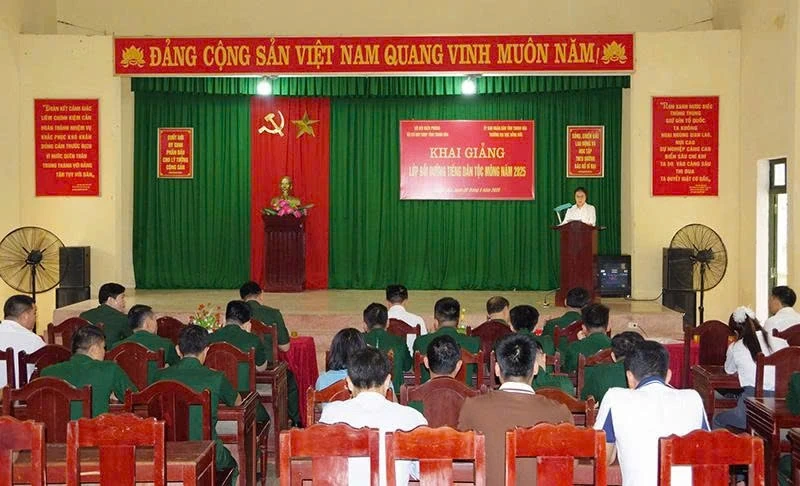
The Provincial Border Guard Command, in coordination with Hong Duc University, has inaugurated a training course in the Mong ethnic language.
The land border area of the province currently comprises 147 villages and hamlets in 16 border communes adjacent to Hua Phan province (Laos); six ethnic groups – Kinh, Muong, Thai, Mong, Kho Mu, and Dao – live together, covering a natural area of 4,012.72 km2, with a population of 15,702 households/73,290 people. Of these, the Mong ethnic group comprises approximately 3,005 households/15,669 people, accounting for about 19.1% of the total ethnic minority population in the border area of the province.
Over the years, issues of territorial sovereignty , national defense and security, and social order in the land border areas of the province have been basically stable. However, reactionary forces are exploiting ethnic and religious issues to increase propaganda activities, entice and gather Hmong people to migrate freely, and plot to establish a "Hmong State." The buying, selling, and transportation of narcotics from the border into the interior is on the rise; the methods of operation are becoming increasingly sophisticated and cunning... In particular, they thoroughly exploit the lack of understanding among some Hmong people to carry out drug trafficking. Given this situation, every officer and soldier of the Border Guard must understand the customs and traditions, and know the Hmong language to effectively carry out their work in the area, grasp the situation, and effectively mobilize the masses in the performance of their duties.
In fact, over the years, thanks to their knowledge of the Hmong language, the staff working in the Hmong ethnic minority areas have done a good job of disseminating information and mobilizing the people to effectively implement the Party's guidelines and policies, the State's laws and regulations, and local movements in promoting a civilized lifestyle, building cultured families, applying scientific knowledge to production, eradicating hunger and poverty... contributing to building an increasingly strong people's border defense system in the locality.
The Thanh Hoa Border Guard's efforts in learning ethnic minority languages have been proven by many concrete and practical results in their work. For example, at the Pu Nhi Border Guard Post, many officers and soldiers have learned and are proficient in using the Hmong language in daily communication. As a result, during propaganda and mobilization efforts, officers no longer need interpreters and can directly communicate with the local people. Consequently, the number of violations related to illegal immigration in the area has decreased significantly, and the people have proactively signed commitments to abide by the law.
In crime prevention and control, understanding ethnic languages also yields practical results. In border communes, people have proactively provided information about suspicious individuals to the Border Guard. Several cases of illegal cross-border smuggling have been detected and handled promptly thanks to information from the public. Particularly during the recent floods, border guards used the Hmong language to urge people to evacuate from dangerous areas. Thanks to the quick and clear communication of information, many households were able to evacuate in time, minimizing damage to people and property.
At Trung Ly Border Guard Post, learning the Thai and Mong ethnic languages has proven effective in poverty alleviation efforts. Border guards directly visit each village, using local languages to guide people on techniques for breeding cattle and cultivating wet rice. Thanks to this easy-to-understand approach, many families have changed their production practices and are gradually stabilizing their lives.
The Hmong language classes are not only places for learning, but also forums for exchange and strengthening the bond between the Border Guard and the ethnic minority people. At the same time, they contribute to consolidating solidarity and working together to build a strong and secure border region. Over the past three years, the Provincial Border Guard Command has coordinated with Hong Duc University to train more than 100 officials, civil servants, and Border Guard officers. To date, the quality of listening, understanding, speaking, and communication skills in the Hmong language has improved. This not only equips learners with knowledge of the traditional culture, customs, psychology, and emotions of the Hmong people, but also enables them to apply this knowledge in propaganda and mobilization work among the Hmong community.
Colonel Hoang Van Hung, Political Commissar of the Thanh Hoa Border Guard Command, stated: "Learning the Hmong language has helped officers and soldiers hone their communication skills and understand the culture, customs, and traditions of the Hmong people. This has enhanced the effectiveness of protecting border sovereignty and security, as well as preventing crime. Officers who are proficient in the ethnic language have a significant advantage in mobilizing the masses and handling situations at the grassroots level. We consider this a long-term, continuous task in our force building efforts."
Stories from border guard posts show that when soldiers understand and speak the language of the local people, the bond between the military and the people is strengthened, and trust is fostered. From there, propaganda, mobilization, and border security work become more effective, contributing to building a solid foundation of public support in the nation's frontier.
Text and photos: Tuan Khoa
Source: https://baothanhhoa.vn/tieng-dong-bao-gan-ket-quan-dan-noi-phen-dau-287071.htm








































































Comment (0)