

12 hours of continuous high-intensity work
For hundreds of thousands of preschool teachers nationwide, this is not simply a numerical or policy adjustment, but a well-deserved recognition, a great joy and hope, especially for those who are dedicated to teaching in remote and disadvantaged areas, where living and working conditions are still fraught with difficulties. This change is expected to become an important "spiritual boost," helping preschool teachers feel secure in their work and maintain their passion for nurturing future generations at this foundational level.
Many people mistakenly believe that the job of a preschool teacher is simply singing, telling stories, and playing with children. However, behind those energetic "playtime" hours lies work pressure and responsibility. Ms. Lu Thi Tuyet, a teacher at Na Meo Preschool (Na Meo commune, Thanh Hoa province), shared her joy upon reading the proposal for a special salary coefficient. For her, what is more important than money is the recognition of the contributions of preschool teachers, who work long hours and under high intensity.
"We usually have to be there from 6:30 every morning to prepare, clean, and welcome the first children to class. Work ends around 6 PM each day when the last children are picked up by their parents. That's 12 continuous hours without rest, always having to maintain the highest level of energy and alertness to ensure the absolute safety of the children," Ms. Tuyet shared.
The nature of the job doesn't just stop within the confines of school hours. When they get home, the work continues. Preschool teachers have to spend hours in the evenings and even on weekends preparing detailed lesson plans, creating innovative teaching materials, and completing required reports and paperwork. "Preschool teachers are truly 'workers who work day and night'," Ms. Tuyet emphasized.
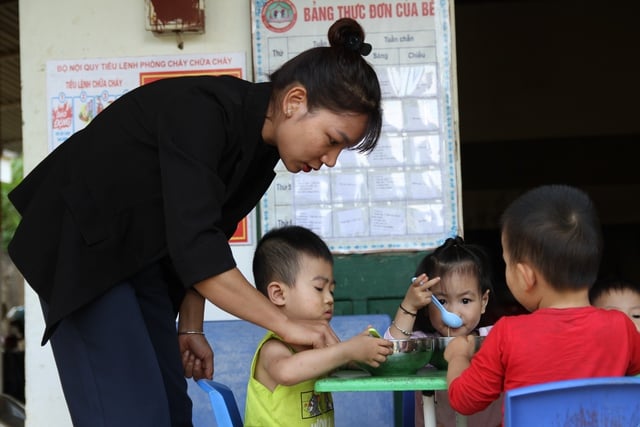
Preschool teachers must assume the roles of mother, teacher, and even basic healthcare worker in the classroom.
For Ms. Vang Thi Di, a teacher at San Chai Kindergarten (Si Ma Cai commune, Lao Cai province), the pressure of work is even heavier when placed in the context of the mountainous border communes, where living conditions and income come with countless challenges. A native of Bac Ha commune (Lao Cai), Ms. Di has been dedicated to the "nurturing of children" at San Chai Kindergarten for over 6 years. When she first graduated, Ms. Di accepted a contract job with a meager salary of 1.6 million VND per month. Even more đáng, before getting married, Ms. Di had to travel a total distance of up to 70km each day from her home to school and back.
After more than 6 years of dedication, Ms. Di is currently receiving a salary at level 2 of the college-level system, with a coefficient of 2.41. Thanks to working in the mountainous border region, she receives additional special allowances, raising her total monthly income to approximately 14 million VND. Although her income has improved compared to when she first started her career, it is still insufficient to cover her living expenses, especially since she is married and has young children.
To make work more convenient, Ms. Di had to rent accommodation near the school, shortening her daily commute to just 10km. Her job and professional responsibilities have significantly reduced the time she spends with her family and children. "In the morning, my daughter and I are busy preparing things and going to work together. In the afternoon, after dropping off the children, I have to return to the primary school to pick her up," Ms. Di shared. Besides the intellectual work of preparing lesson plans, files, and records, preschool teachers like Ms. Di also frequently have to do manual labor such as cleaning and sanitizing the school. Therefore, according to Ms. Di, being a preschool teacher is a job that is a blend of intellectual work and manual labor.
Further motivation to stay committed to the profession.
When the proposed special salary coefficient of 1.25 is approved and officially implemented, it will be a landmark change for preschool teachers, not only financially but also psychologically and socially. "This is not simply a material incentive but also a well-deserved recognition of the silent efforts of preschool teachers. It's an important 'spiritual boost,' helping preschool teachers feel more motivated and secure in their dedication," Ms. Di shared.
- "Preschool teachers must assume the roles of a mother, a caregiver, and a basic healthcare professional. With 20-30 young children who are not yet capable of managing everything themselves, the responsibility of a preschool teacher is to take care of everything from meals, sleep, and personal hygiene to basic first aid. During working hours, responsibility must always be at the highest level, with no room for distraction."
Ms. Lu Thi Tuyet , Na Meo Kindergarten, Thanh Hoa Province
- "The new policy will create a strong incentive for those already working in the field to feel secure and committed, while also attracting more young, talented, and dedicated individuals to early childhood education. Ensuring a commensurate income will make this profession more attractive and sustainable."
Ms. Ly Gio Pu , a teacher at Mu Ca Commune Kindergarten (Lai Chau Province)
Sharing the same view, Ms. Ly Gio Pu, a teacher at Mu Ca Commune Kindergarten (Lai Chau Province), believes that the proposed special salary coefficient, when implemented, will bring many positive impacts. Specifically, this policy will help teachers spend their evenings with their families and children instead of struggling with extra work outside of working hours, thereby improving their quality of life and work morale. "The special salary coefficient affirms the important position and role of teachers in the education of future generations. When teachers are relieved of the burden of making a living, they will dedicate their minds and energy to focusing on their profession, caring for and nurturing children, thereby contributing to improving the quality of early childhood education and creating a solid foundation for the development of future generations," Ms. Pu emphasized.
Ms. Le Thi Quang, Principal of Tam Quang Kindergarten (Tam Quang commune, Nghe An province), assessed the application of the special salary coefficient for kindergarten teachers as a positive sign of change, directly impacting the lives of the teaching staff. "Currently, the lives of kindergarten teachers in mountainous areas still face many difficulties. For example, many teachers travel dozens of kilometers from their homes to teach every day, along treacherous roads, especially during the rainy season. To stay at school and teach, teachers have to overcome many challenges. In the context of rising living costs, the special salary coefficient will play an important role in improving income and helping teachers reduce their economic burden. Receiving the special salary coefficient is a great source of encouragement, providing motivation for kindergarten teachers to work with peace of mind and commit to the long-term career of 'nurturing future generations'."
Source: https://phunuvietnam.vn/tiep-them-dong-luc-cho-giao-vien-mam-non-voi-he-so-125-238251222144446798.htm






























































Comment (0)