

During that time, the other children would run and hide, taking as good cover as possible. When the number 100 was read, the children would open their eyes and start looking for their friends. Whoever was discovered first lost. Counting to the 100 mark took a long time, so some clever children would shorten the number so that when they opened their eyes, their friends wouldn't have had time to hide. The phrase would go like this: "One pair, two ten, three ten, nine hundred, ten."
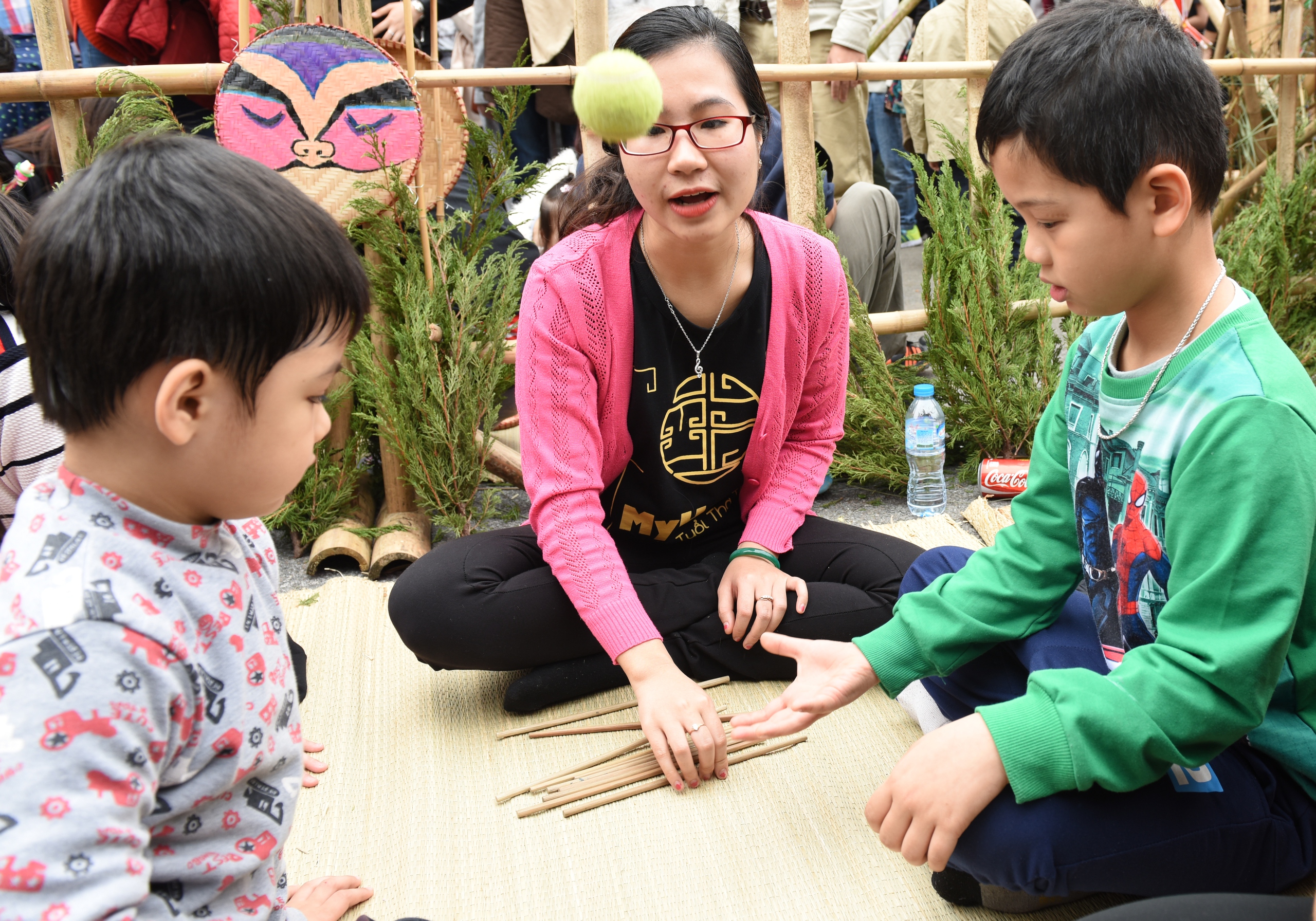
The folk game of Chắt Chuyền
Photo: Nguyen Van Canh
As a child, I played hide-and-seek, and now my children and the neighborhood kids do too. Years passed, and it wasn't until more than 60 years later, thanks to reading Phan Khoi's posthumous works - an incomplete manuscript (Tri Thuc Publishing House - 2021) compiled by the children of the creator of "Old Love ," that I learned this detail: "Our children have a game called 'chắt' (a type of game). Using bamboo sticks to play is called 'chắt que' (a type of stick game); using pebbles to play is called 'chắt chuyền' (a type of ball game). It doesn't specify how to play, only that after a round, they count the bamboo sticks or pebbles they've captured to determine the winner. Children in Central and Northern Vietnam count differently, but they are strangely similar in one respect. Children in Central Vietnam count: 'One pair, two 'đãn' (a type of ball), three 'thìn' (a type of ball), nine 'chăn' (a type of ball), ten 'cả' (a type of ball)' . Children in Northern Vietnam count: 'One 'chắt', two 'choi' (a type of ball), three 'chòi' (a type of ball), nine 'chủ' (a type of ball), ten 'cả' (a type of ball)'" (pp. 216-217).
This game, called "chắt/đánh chắt" because "chắt/hòn chắt" itself means "small, bullet-sized stones" ( Dai Nam Quoc Am Tu Vi , 1895), "A children's game, one hand picks up, throws, and catches" ( Viet Nam Tu Dien , 1931); currently, the common name is "chuyen the," and in some places it is also called "đánh nẻ."
Clearly, the shortened pronunciation in the game of hide-and-seek has existed for a very long time, at least before 1958, the year Phan Khoi wrote this article. Here, when considering the literal meaning, what do we see? To see anything, we first need to understand the meaning of those words.
"A pair" is easy to understand, no need for further explanation. But what does "đắn" mean in "two choices"? The word itself has no meaning; it must be combined with other words. For example, in The Tale of Kieu , there's the line: "Weighing beauty and talent / Forcing the lute and moon, testing the fan and poetry." It's strange how people used to "buy people" back then; not only did she have to be beautiful, but she also had to be skilled in "music, chess, poetry, painting, and singing" to be considered even more valuable.
What about "three Thìn"? "Thìn" is an ancient Vietnamese word meaning "to repair, admonish, and preserve," according to the Đại Nam Quốc Âm Tự Vị (1895). For example, the Thiên Nam Ngữ Lục has the sentence: "Thìn's heart accumulates virtue and cultivates humanity / Buddha and Heaven know, spirits and gods are aware." Regarding human psychology, not just now, but hundreds of years ago, Nguyễn Trãi already recognized this:
The sound of the zither echoed in my ears.
The heart of spring, when patient and perceptive, will surely be wise in the year of the Dragon.
Youthful spring doesn't come easily twice.
Seeing that scene made me feel even more sorry for the young man.
"Nhẫn" means to arrive, to come. It's truly fitting; sometimes, hearing the sound of a flute or stringed instrument (quan huyen) in a space or setting one loves, it's hard to remain unmoved, to feel a pang of longing, and then to regret the passing of youth. The time of youth is gone. Only a feeling of melancholy remains. It suddenly comes to mind that Thế Lữ's poem, "The mournful sound drifts into my heart / Oh sadness! So distant, so vast is sadness," was also composed when hearing the sound of the flute in Thiên Thai, thus causing the "heart of spring to be stirred, so wise."
So, what does "nine blankets" mean?
Let's hypothesize that "one pair" is 2, "two equals" is 4, and "three thousand" is 6. Does this mean "nine blankets" also falls under this calculation? No, "nine blankets" in this context is actually even/nine even, but due to the rapid pronunciation, the tilde has been omitted, becoming "blanket." Even means complete, sufficient, not odd, not too much, not too little, a pair, not uneven; there are also expressions like "evenly matched" or "evenly matched." "Nine blankets" is definitively and precisely 9. This reasoning is logical because the sentence ends with "evenly ten," which is 10. According to linguist Le Ngoc Tru, "ten" is a Vietnamese word derived from Sino-Vietnamese: "Ten: the number of things, ten items, or more (depending on the region) - gathering, a bush - Cantonese pronunciation: ten )." There's a folk song that says:
Seven plus three, he says it's ten.
Three, four, six, you calculate nine chapters
Seven plus three is exactly 10, which is a ten. The term "even ten" is still commonly used today, also called a "plain ten" or "even ten". Even knowing this for sure, how can a ten be truly 10?
We can verify this in both everyday life and literary works. For example, when writing " Seven Days in Dong Thap Muoi ," the writer Nguyen Hien Le recounts his visit to "Tan An, a town on the outskirts of Dong Thap," while having breakfast: "Mr. Binh insisted on choosing a shop near the market because he liked the hustle and bustle, enjoying watching people come and go, buying and selling. He bought a watermelon and a dozen tangerines, and was very surprised when the vendor counted twelve for him. He took two of them and returned them: '- You gave me too much. I only bought a dozen.' The vendor, hearing his strange tone, smiled and pushed the two tangerines back towards him: '- You bought a dozen, so I counted a dozen.' Mr. Binh didn't understand at all, so I had to explain: '- In this region, fruits like tangerines and plums are twelve in a dozen. Some provinces have fourteen or sixteen in a dozen.' '- That's strange! A dozen is sixteen. Only a saint would understand that.'"
This detail reflected the generous and open-minded nature of people in the South. Mr. Binh was understandably surprised, as he came from the North and didn't live there.
With the analyses and examples mentioned above, in short, we still don't fully understand the meaning of the words related to counting in children's games of the past. Furthermore, we are still confused by this nursery rhyme: "The first day is a crescent moon/The second day is a rice leaf/The third day is a sickle/The fourth day is a scythe/The fifth day is a sickle/The sixth day is a real moon/The tenth day is a hidden moon/The sixteenth day is a hanging moon/The seventeenth day is a broken bed/The eighteenth day is a burnt chaff/The nineteenth day is a mound of earth/The twentieth day is a good dream/The twenty-first day is midnight…" . Regarding the phrase "The nineteenth day is a mound of earth," some versions write "đụn dịn". This nursery rhyme describes the shape of the moon throughout the days. Roughly speaking, on the 17th night, the moon rises when people are "getting ready to sleep"; on the 18th night, the moon rises when the fire in the kitchen has "burned to a crisp"... So, how should we interpret the "dụn địn/đụn dịn" on the 19th night?
Bear.
We repeat the word "accept" once more when we hear the word "determine". In the book "Vietnamese People Speak Vietnamese" (Ho Chi Minh City Publishing House - 2023), researcher Nguyen Quang Tho explains the context in which this word appeared: "The story goes that there was a very clumsy wife. One day, her husband caught a turtle, gave it to her to cook, and then went to work in the fields, confident that he would have a delicious meal to share with friends after a few shots of rice wine. The wife put the turtle in a pot, added some spinach, and cooked it over a wood fire. While she was busy washing the rice, the turtle saw the water getting hot, crawled out of the pot, and disappeared. After washing the rice, the clumsy wife opened the lid of the pot to check. She stirred with chopsticks and realized that the spinach wasn't cooked yet, but the turtle was nowhere to be seen. She pondered for a long time, then concluded: "The spinach wasn't cooked, but the turtle has already disappeared."
I dare say that no one can explain the meaning of the words just mentioned. Regarding the way numbers are spoken in the game of "chắt," we still wonder why in Central Vietnam, "3/ba thìn" jumps to "9/chín chăn," and in Northern Vietnam, "3/ba chòi" leaps to "9/chín chủ"?
This way of speaking is not at all accidental but has been widely used in proverbs and folk songs, for example: "Bờm has a palm-leaf fan/The rich man wants to exchange it for three cows and nine buffaloes" , "Three seas and nine continents", "Three bags with nine handles and twelve eyes"... Mr. Phan Khôi admitted: "I thought about it for a long time but couldn't understand." Then he expressed his opinion: "Perhaps that children's saying has some hidden meaning in arithmetic or mathematics that we don't know. But if you say that it's just children saying whatever comes to mind, and there's no point in trying to understand it, then I wouldn't dare" (Ibid., p. 217).
Do you think so too?
Yes, I think so too. And considering it's the Lunar New Year, discussing some "mysterious" words together isn't entirely useless when we're trying to learn more about the Vietnamese language.
Source: https://thanhnien.vn/tim-ve-vai-tu-bi-hiem-trong-tieng-viet-185241231162544575.htm





















































































Comment (0)