


"Mountain flavors" are conveyed in every dish and drink, embodying the essence of mountain cuisine and encapsulating the generous and open-minded spirit of the people who live in the mountains...
Welcome guests with sincerity.
We arrived at the home of Alang Beo, a mountain friend in Blo Ben village (Song Kon commune, Dong Giang district). The small, palm-thatched house was filled with a fragrant aroma, and a woven bamboo tray laden with local specialties was laid out: grilled meat, sticky rice cooked in bamboo tubes, carp, buffalo horn-shaped cakes... and, of course, a jar of rice wine.
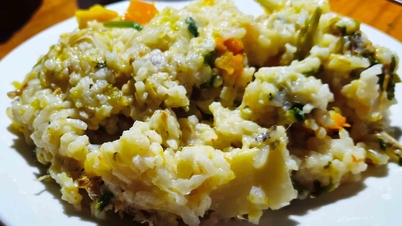
Mountain fish, already famous, along with buffalo horn-shaped cakes and bamboo-cooked rice seasoned with wild pepper and "rang ray" salt, create a memorable experience for those who have the chance to visit the highlands and participate in the communal feast of the villagers.

The Co Tu people in Alang Beo's village always welcome guests with utmost warmth and hospitality. Beo says that the feast served to guests is a token of the affection of many families in the village. Each person contributes a dish, all working together to treat guests from afar.
The custom of "sharing food," deeply ingrained in the local people's consciousness, serves as a testament to their hospitality. It seems that, thanks to the heartfelt sentiments embedded in each simple food item brought along, the feasts are always joyful and hearty.
Joy is reflected in the shy eyes of the highland girls beside their earthenware jars of rice wine, intoxicating in the melodious songs of the elders welcoming guests. And beauty lies in the way the local specialties are arranged on smoke-stained woven bamboo trays, in the green of the leaves used to wrap the buffalo horn-shaped cakes, and in the steaming hot bamboo tubes of sticky rice, fragrant with the scent of freshly cooked glutinous rice, held in the hands of visitors to the village...

On another occasion, while visiting Bac Tra My, we were invited by Tran Thi Luu Ly, a local Co girl, to drink rice wine from a traditional earthenware pot, using tiny bamboo tubes inserted deep into the pot. The drinking was done by adding water to the pot.
Guests and hosts take turns tasting the rice wine, with one person in the group carefully adding water to the jar to keep it full. The best, richest part of the rice wine lies deep at the bottom. The gentle sweetness of the rice wine permeates the air, creating a rich and flavorful atmosphere, and the festivities continue throughout the night, filled with the boundless camaraderie of the mountain people.
The scent of the mountains
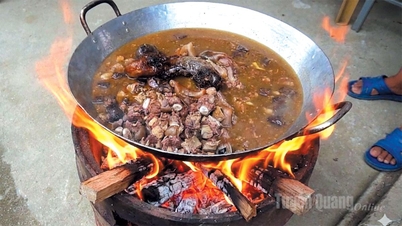
I noticed a distinctive "spice" in every communal meal, a characteristic of mountain cuisine that's unmistakable: smoke. The smoke from the stilt house kitchen permeates the dried meat hanging in the kitchen, the sticky rice cooked in bamboo tubes, and the grilled meat. The smoke lingers around where we sit. Inside the stilt house, by the fire, the rice wine, the tà-vạt wine, and tr'din seem to have a richer flavor, a dizzying intoxication.

Someone started getting drunk, and they sang. The lyrics, carried by the kitchen smoke, rose and resonated in the biting cold of the highlands, warming the entire house. One person after another passed the wine jar, swaying and becoming intoxicated in an atmosphere steeped in traditional culture.
It's difficult to count all the dishes that make up the "brand" of each locality, because each ethnic group and region preserves its own unique recipes. The adaptation of traditional culture also makes highland cuisine more diverse and suitable for tourists. However, the distinctive traditional characteristics remain intact.
Mr. Tran Ngoc Hung, Head of the Culture and Information Department of Nam Giang district, said that cuisine is a vibrant piece of the puzzle, containing the distinctive values of each ethnic group and each village.
Rice wine and other alcoholic beverages are also found in Dong Giang and Tay Giang, but the people in Nam Giang have their own unique ways of adjusting the ingredients during preparation, resulting in distinct differences.
Similarly, dishes may use the same ingredients like snakehead fish and pork, but the cooking methods and spices used will create distinctive dishes, affirming the unique character of each region.
Community creativity has made cuisine increasingly unique, with some dishes being developed into OCOP products such as smoked black pork, bamboo shoots, ta-vat wine, wild bananas, etc.
"Through promotional activities, we hope that traditional cuisine will not only exist within the village community but will also reach further, attracting tourists and enriching their experiences when visiting the highlands," Mr. Hung shared.
There will be many strange and wonderful things to discover , with many specialties such as wild game meat dipped in rang-ray salt of the Co Tu and Ta Rieng people, grilled free-range chicken with honey, frog jelly, sour ant salt, forest rat meat with Ngoc Linh ginseng... Rustic yet unique, simple yet enough to stimulate all the senses, highland cuisine always beckons with its own distinct mountain and forest flavors.
Return to the mountains to savor the essence of the highlands, encapsulated in every dish, every sip of wine, and in the generous and sincere hearts of the people of the mountainous regions...
Source


























































































Comment (0)