

1. The taxi started its engine and sped along Hung Vuong Street, heading south, the city of Tuy Hoa still asleep. Occasionally, at street intersections, I would spot a few people working the night shift hurrying home. Or someone working the early shift would silently pass by. Hoa, the taxi driver, after initially keeping his distance from the passengers, said with a cheerful laugh, "Are you guys going to Mui Dien?" I laughed back and replied, "Well, we asked for a ride to Mui Dien."
I remember last evening, during dinner with my school friends, a married couple, I heard them say, "Phu Yen has many attractive tourist destinations. For example, this land of yellow flowers and green grass." Then my friend added, "The name 'Land of Yellow Flowers and Green Grass' comes from the famous film 'I See Yellow Flowers on Green Grass' by director Victor Vũ."
The filmmakers chose Bai Xep, a beach in An Chan commune, Tuy Hoa city, as the filming location. This beach features a long, elevated strip of land extending into the sea, with its natural scenery retaining its pristine beauty and harmonizing with the sky and sea, creating a vibrant array of colors, especially the rich yellow of the flowers contrasting with the green of the vegetation.
Hearing my friend's recommendation, we were naturally thrilled, but I pressed on with more questions: "Are there any other places with stunning natural scenery?" My friend replied, "Of course. I recommend that if you're in Phu Yen, you should also visit Mui Dien to watch the sunrise. This is the place on the mainland of our country where the sun rises earliest."
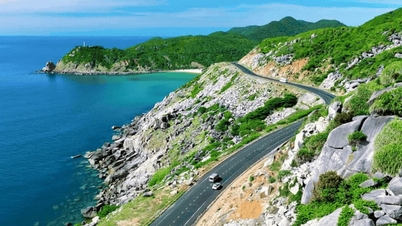
The taxi sped along, leaving Tuy Hoa City and following the coastal road. The driver looked at me and said, "It'll take about 50 minutes to get to Mui Dien." I anxiously asked, "Will we make it to Mui Dien before sunrise?" Hoa laughed, "You'll have plenty of time to choose a spot to take photos. The best place is the lighthouse, as it's a very convenient location for watching the sea and the sunrise."
I remember yesterday evening, when we decided to go to Mũi Điện early this morning, I told everyone about my visit to Mũi Ngọc in Móng Cái City, Quảng Ninh Province. That time, we went to Móng Cái to make a documentary. Our friends in the city at the northernmost point of the country suggested that the film we were starting to shoot should include a scene of the sunrise at Mũi Ngọc. Because Mũi Ngọc is the furthest point of land jutting out into the sea in Móng Cái. The sunrise scene there is valuable because it's the northeasternmost point of the country.
That time, we arrived at Mui Ngoc, Binh Ngoc ward, Mong Cai city, at 4 a.m. The Mui Ngoc beach was still dreamily shrouded in mist. The pristine beauty of the ancient rock formations captivated us with its stunning tranquility. After half an hour of preparing our camera positions, we managed to capture the scene of the sun gradually rising from the sea. The sea at Mui Ngoc that day was quite calm, so calm that we felt as if the sun was rising from the land itself.
“Watching the sunrise at Mui Dien is different from watching it at Mui Ngoc,” my classmate quickly said, describing it, “The sun, round like a copper platter, slowly rises above the sea, so close you can almost touch it with your outstretched hand. Then you let your soul drift along with the cool, refreshing ocean breeze. It feels like you’re enjoying the melodious music of the sea. And it seems like all your worries and fatigue are washed away.”
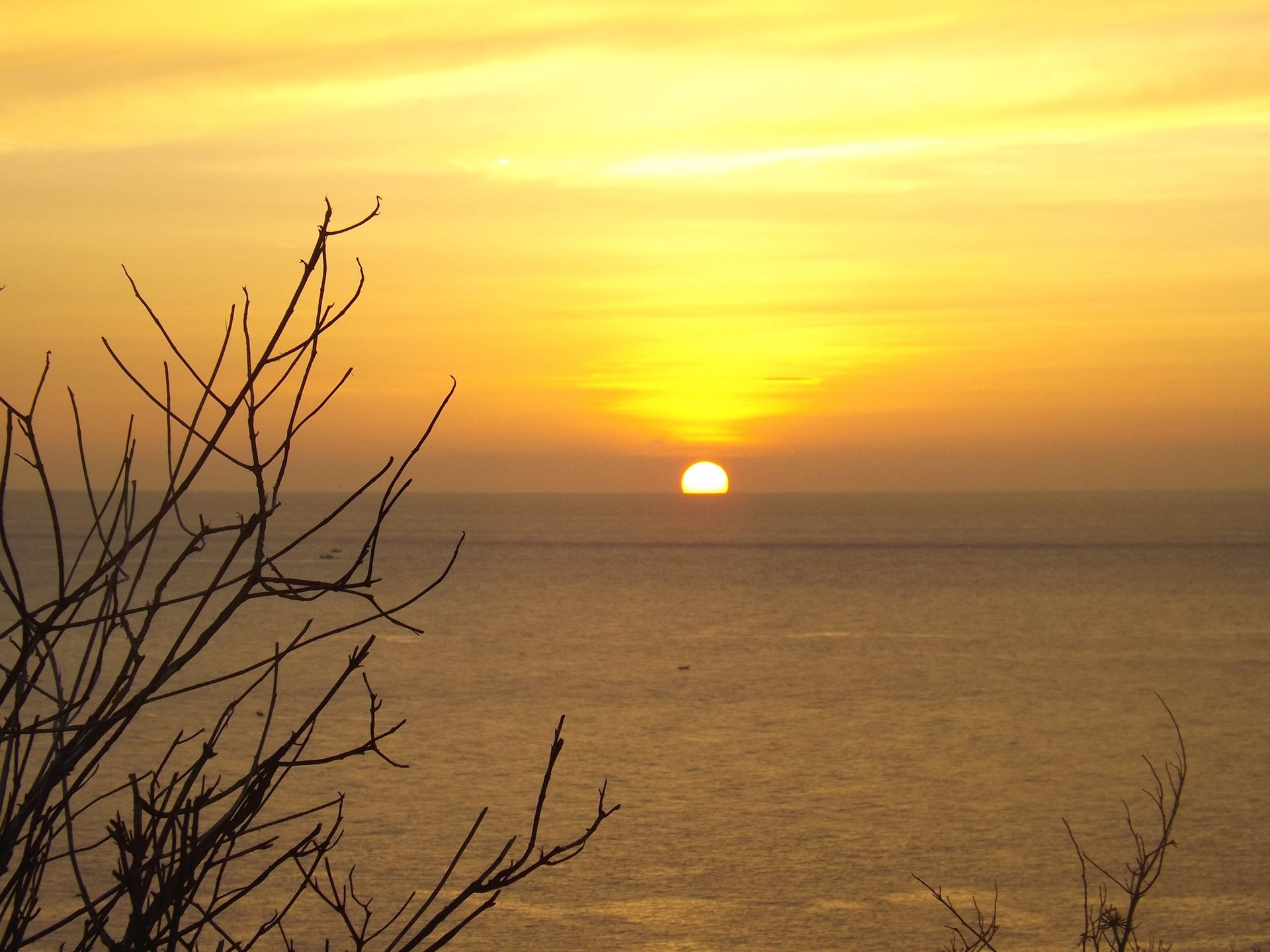
I truly believed my friend's words. I learned that Mũi Điện, also known as Mũi Đại Lãnh, is located in Phước Tân village, Hòa Tâm commune, Đông Hòa town, Phú Yên province. Mũi Điện lies on the easternmost point of Vietnam. My friend from Tuy Hòa told me that Mũi Điện is a headland jutting out into the sea from a branch of the Trường Sơn mountain range, facing directly towards Bãi Môn beach. It boasts not only stunning natural scenery but also a lighthouse built by the French in 1890 in a European architectural style. For over 100 years, the Mũi Điện lighthouse has silently shone its light far out at sea, guiding ships. Just as Hòa, the taxi driver, said: "The location of the lighthouse not only offers a pleasant, fresh atmosphere but also provides a breathtaking view of the fiery red sun rising from the sea."
Mui Dien became the first place in Vietnam to witness the sunrise because it is located at an altitude of 110 meters above sea level. From this high vantage point, one can easily see the vast expanse of the blue ocean. This advantage is quite different from Mui Ngoc in Mong Cai, which is only a few meters above sea level. I remember the time I filmed the sunrise at Mui Ngoc. While filming, a ship passed by, emitting a cloud of smoke. The passing ship had its charm, but unfortunately, it obscured part of the sun. By the time the ship left the frame, the sun had already risen above the sea.
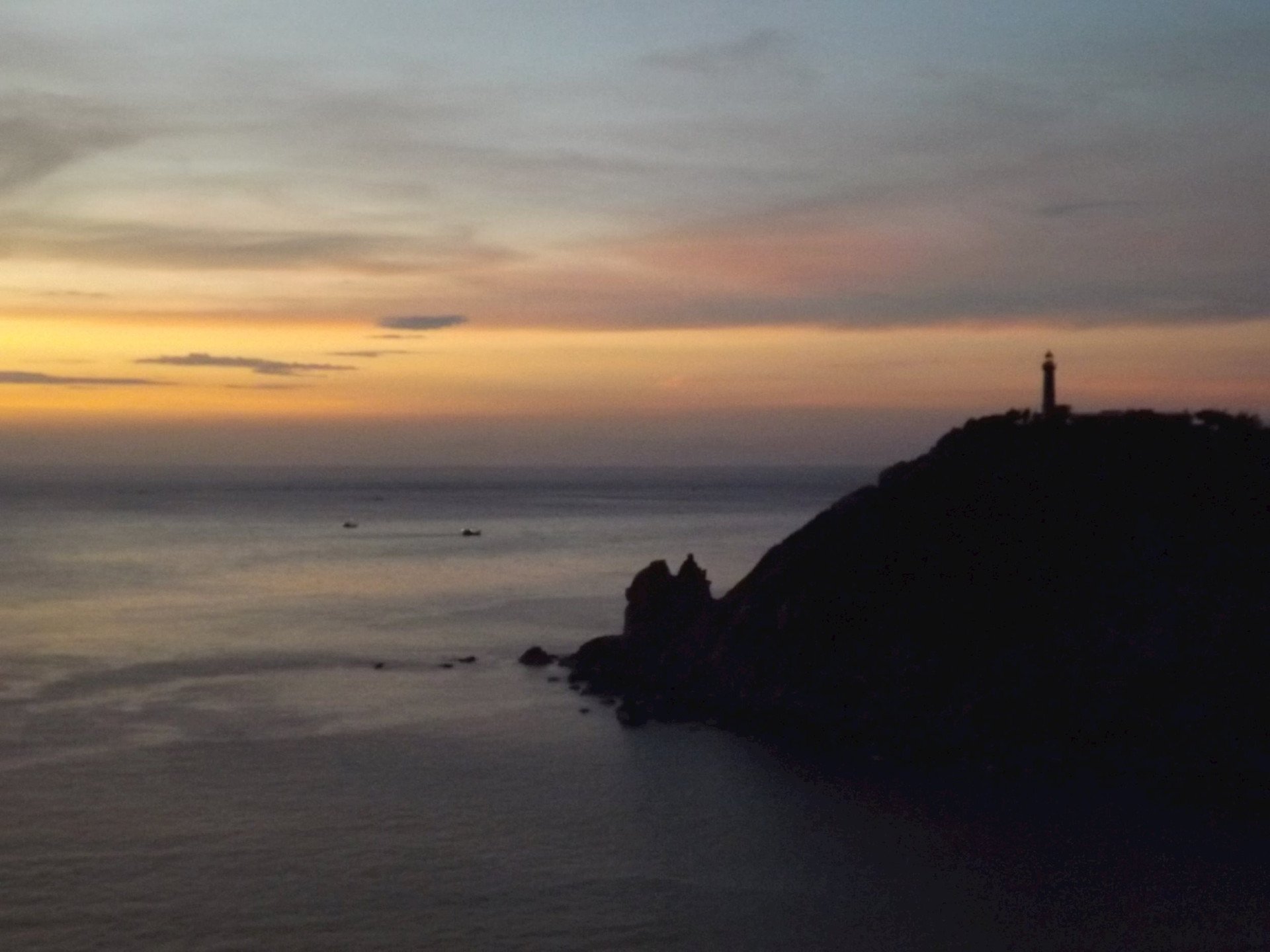
2. The car arrived at Mui Dien area. According to the driver, Hoa, to reach the lighthouse, we had to arrive the evening before, or at least between 2 and 3 a.m. By the time we arrived at Mui Dien, we wouldn't have enough time. Therefore, we decided to stop right by the roadside, opposite the lighthouse, to "watch" the sunrise. Hoa reassured us, "This spot isn't directly in front of the sun, but you'll get a picture of the sunrise next to the lighthouse. It's quite picturesque."
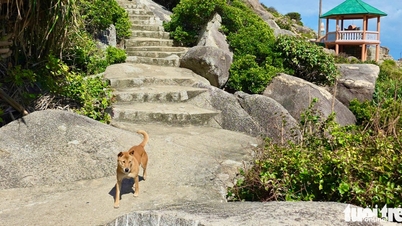
Then, Hoa introduced, "The path to the lighthouse requires a further stretch to reach the mountain range jutting out into the sea. Once there, you'll have to climb 100 wooden steps. These 100 steps will lead you to the top of the lighthouse. I'm afraid that at your age, climbing 100 steps will be very tiring. Let's just stay here to watch the sunrise and take pictures; it'll be beautiful too."
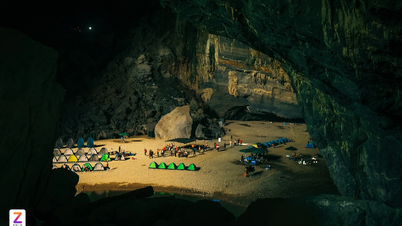
Of course. I gazed down into the small valley at the foot of the lighthouse. Barely visible in the dim light amidst the desolate landscape were a few tents. It turned out that not only were we excited, but the most excited were the young people. They had slept in makeshift tents all night to avoid moving and to watch the sunrise. Hoa added, “I know this place. They don’t just come here once to watch the sunrise; they come many times. Each time they choose a different spot. That’s how we get photos from so many different angles. It seems that artistic work is quite expensive, doesn’t it?”
Those young people must have climbed to the top of the lighthouse last time to "hunt" for the sunrise. Watching the sunrise from a high vantage point has its advantages, but it still felt somewhat unsatisfying. This time, the young people chose the beach as their vantage point, to get an angle almost level with the rising sun. That frame would surely make the sun appear larger and closer.
Finally, the moment arrived. Everyone—because I could see many more people around where we were standing, all with cameras and phones ready—seemed excited and eager to capture the moment. In the distance, the large, reddish sun, like a copper platter, was slowly rising above the sea at Mũi Điện.
Source: https://daidoanket.vn/toi-mui-dien-don-mat-troi-len-10288031.html
![[Photo] General Secretary and President To Lam presides over a working session with the Central Policy and Strategy Committee on the development of the materials industry.](https://vphoto.vietnam.vn/thumb/1200x675/vietnam/resource/IMAGE/2026/05/21/1779359935432_a3-bnd-3129-1412-jpg.webp)













































































Comment (0)