

South Korean President Yoon Suk Yeol's visit to the UK marks a new turning point in bilateral relations in the coming period.
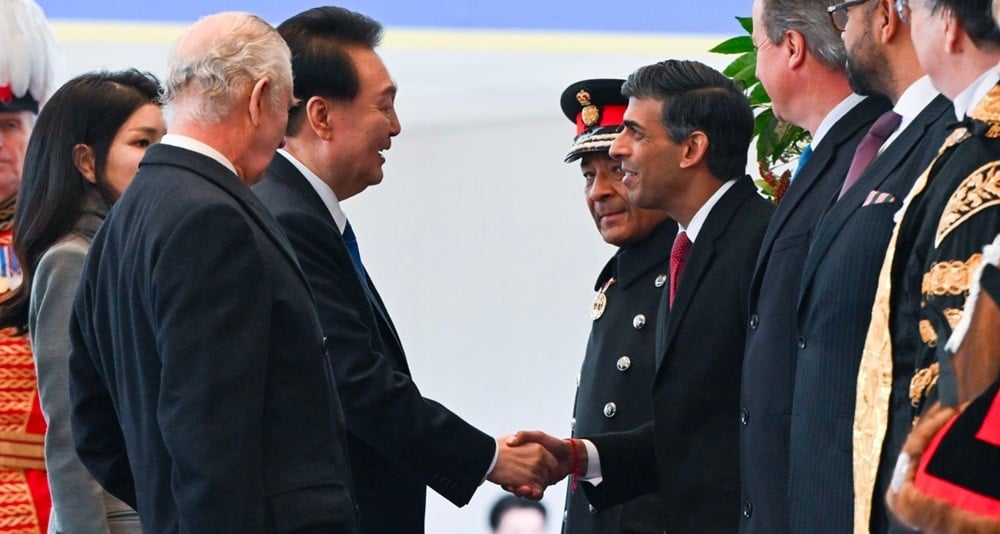 |
| Prime Minister Rishi Sunak welcomed South Korean President Yoon Suk Yeol at the airport in London on November 21. (Source: Office of the President of South Korea) |
This assessment is well-founded, considering the results of the four-day visit (November 20-23) to the European country by South Korean President Yoon Suk Yeol and First Lady Kim Keon Hee.
Special ceremony
First and foremost, the visit demonstrates the mutual respect between the leaders of the two countries. This is the first visit by a South Korean leader to the UK in the past decade, coinciding with the 140th anniversary of diplomatic relations between the two countries (1883-2023).
Speaking before his trip to London, President Yoon affirmed that this visit was a "stepping stone" to deepen bilateral economic cooperation. His office emphasized that the visit demonstrated that "London considers Seoul a key partner in global cooperation in general and in the Indo- Pacific in particular."
Conversely, President Yoon Suk Yeol was the first leader King Charles III received since his coronation in May. London welcomed the South Korean leader with special ceremonies.
On the morning of November 21st, King Charles III and Queen Camilla personally presided over the welcoming ceremony, attended by Prince William and Princess Catherine, Prime Minister Rishi Sunak, and the new Foreign Secretary David Cameron. The guest from South Korea rode in a royal carriage with the King to Buckingham Palace. Mr. Yoon attended a reception hosted by the Royal Family. Notably, in his speech, King Charles III praised the influence of South Korean popular culture, especially through K-pop groups and singers like BlackPink and PSY.
On the same day, President Yoon Suk Yeol delivered a speech to the British Parliament on bilateral cooperation, from the past to the present and the future. The leader made a strong impression when he quoted Shakespeare's famous play Romeo and Juliet to speak about bilateral relations: "This friendship is a testament to happiness, when we turn challenges into pure opportunities."
Get to the point.
Amidst a world marked by complex and unpredictable changes, the bond between South Korea and the United Kingdom is stronger than ever.
This was clearly demonstrated in the "Downing Street Agreement" signed between President Yoon Suk Yeol and Prime Minister Rishi Sunak on November 22, elevating the relationship from a broad and innovative partnership to a global strategic partnership. South Korean presidential spokesperson Kim Eun Hye stated: "The Digital Services Act (DSA) will represent the highest level of cooperation between the two countries. We will continue to explore new horizons in this partnership."
In this landmark document, the focus is on economic, technological, and energy cooperation. The two countries have launched negotiations to review and upgrade their Free Trade Agreement (FTA). London's deeper involvement in economic frameworks in the Asia-Pacific, clearly demonstrated by its signing of the agreement to join the Comprehensive and Progressive Trans-Pacific Partnership (CPTPP), presents an opportunity for it to expand cooperation with the Seoul government in the future.
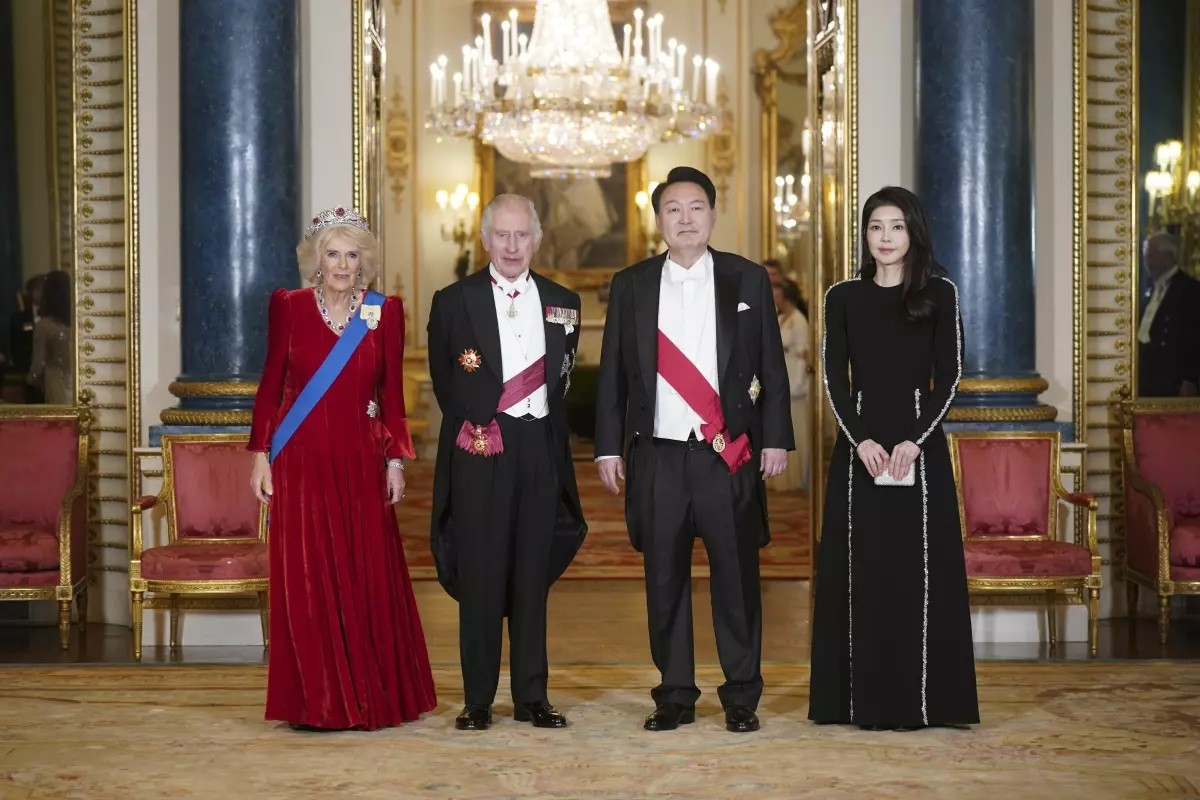 |
| South Korean President Yoon Suk Yeol and First Lady Kim Keon Hee received a warm welcome from King Charles III and Queen Camilla at Buckingham Palace on November 21. (Source: AP) |
The reciprocal relationship was demonstrated at the Korea-UK Economic Forum on November 22nd, with the participation of leaders and business representatives from both countries. On the Korean side, attendees included Chairman Lee Jae Yong of Samsung Electronics, along with leaders from Hyundai Motors, LG Electronics, Lotte, and Hanwha. Representatives from major UK companies, including ARM, Rolls-Royce, Standard Chartered, Ocado, and Rio Tinto, were also present. Korean companies Hanwha Aerospace, Hyosung Heavy Industries, and Kyung Dong Navien signed major contracts with British businesses.
The leaders also agreed to strengthen cooperation in the field of atomic energy. The two sides signed nine Memoranda of Understanding (MoUs) on related projects. The trade ministers of both sides discussed in more detail comprehensive cooperation in the construction of new nuclear power plants, from planning and construction to operation and decommissioning when necessary.
This is a particularly important area for London. The UK was the first country in the world to commercialize nuclear power in 1956. Currently, London is pursuing eight nuclear power plant projects, aiming to meet 25% of its electricity needs by 2050. In this context, Seoul is becoming increasingly important, with the state-owned Korea Electric Power Corporation (KEPCO) being a notable candidate for the UK project. Furthermore, the two countries are committed to strengthening cooperation in defense and security; and collaboration in semiconductors, artificial intelligence (AI), and digital technologies.
On regional and international issues, London and Seoul stated their positions on the Korean Peninsula, including joint military exercises and maritime patrols based on United Nations Security Council resolutions. South Korea and the UK will cooperate closely in addressing global issues such as the conflicts in Ukraine and the Middle East.
It's not an exaggeration to say that the visit of the South Korean President to the UK, and the DSA in particular, is a crucial "stepping stone" for bilateral relations to "take off," continuing to explore new horizons of cooperation for the benefit of both countries.
Source
![[Photo] Prime Minister Pham Minh Chinh presides over the conference announcing the establishment of the International Finance Centre in Vietnam.](/_next/image?url=https%3A%2F%2Fvphoto.vietnam.vn%2Fthumb%2F1200x675%2Fvietnam%2Fresource%2FIMAGE%2F2025%2F12%2F21%2F1766309817714_ndo_br_dsc-3400-jpg.webp&w=3840&q=75)


![[Photo] Prime Minister Pham Minh Chinh presides over a meeting on private sector economic development.](/_next/image?url=https%3A%2F%2Fvphoto.vietnam.vn%2Fthumb%2F1200x675%2Fvietnam%2Fresource%2FIMAGE%2F2025%2F12%2F20%2F1766237501876_thiet-ke-chua-co-ten-40-png.webp&w=3840&q=75)










































Comment (0)