Ho Chi Minh City urgently needs to 'exchange land for infrastructure'.
Utilizing long-abandoned public land in Ho Chi Minh City to finance large-scale Build-Transfer (BT) projects will pave the way for private capital to flow in and improve infrastructure bottlenecks.
Báo Sài Gòn Giải phóng•22/04/2026
UNLOCKING "PRIME LAND"
Recently, the Ho Chi Minh City People's Council approved a resolution on the list of land plots intended to be used to compensate investors implementing projects under the public-private partnership (PPP) and BT (build-transfer) contract methods, totaling 33 land areas. This is seen as a step to concretize the policy of mobilizing non-budgetary resources in the context of the city's very large infrastructure investment needs.
According to the Department of Construction, Ho Chi Minh City needs more than 3 trillion VND for the period 2026-2030, but has only managed to secure over 1 trillion VND so far. With the new, more flexible regulations, Ho Chi Minh City has the opportunity to mobilize land resources through the Build-Transfer (BT) model to accelerate infrastructure projects.
Not long ago, the Ho Chi Minh City People's Council also approved the investment plan for three BT (Build-Transfer) projects: Can Gio Bridge, Phu My 2 Bridge, and Rach Chiec National Sports Complex, with a total investment of over 182,000 billion VND. Simultaneously, a series of other projects are also being proposed by investors under the BT model, with a total estimated investment of over 366,000 billion VND.
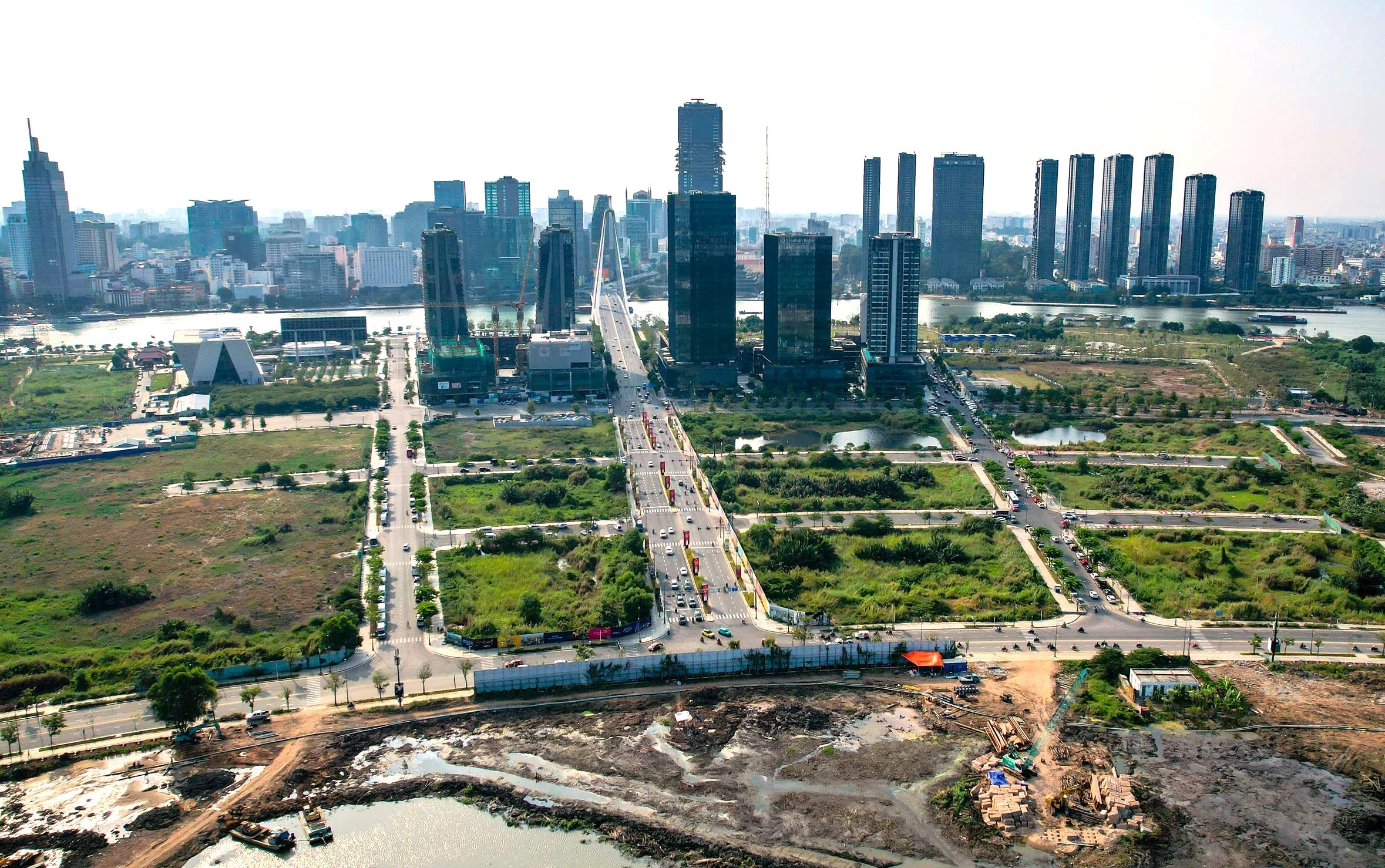
Many land plots in the Thu Thiem New Urban Area (An Khanh Ward, Ho Chi Minh City) will be used to pay for BT (Build-Transfer) contracts.
PHOTO: NHAT THINH
Mr. Le Hoang Chau, Chairman of the Ho Chi Minh City Real Estate Association, assessed that this is the first time Ho Chi Minh City has established a large-scale land fund to prepare for BT (Build-Transfer) projects. This shows a high level of consensus from the City Party Committee's policy to the institutionalization by the Ho Chi Minh City People's Council, creating conditions for the Ho Chi Minh City People's Committee to implement the next steps. This also signals that Ho Chi Minh City is ready to invite investors to address urgent infrastructure projects.
Previously, the Standing Committee of the Ho Chi Minh City Party Committee directed the implementation of several urgent infrastructure projects under Build-Transfer (BT) contracts to address environmental pollution, wastewater treatment, flooding, and traffic congestion. The Ho Chi Minh City People's Committee stated that these are all large-scale projects requiring significant matching resources to ensure the financial feasibility of the plan. Therefore, the land plots must not only be of sufficient size but also have high commercial potential to ensure the principle of equal value payment, minimize budgetary obligations, and attract capable investors.
BUILDING CONFIDENCE FOR INVESTORS
According to Ho Chi Minh City's plan, land will be used to pay for Build-Transfer (BT) projects in various technical infrastructure sectors, addressing major bottlenecks. In the transportation sector, projects such as the Can Gio Bridge, Phu My 2 Bridge, and inter-regional connecting routes are expected to reduce traffic pressure in the southern and eastern parts of the city, while expanding urban development space.
In the environmental sector, wastewater treatment plants in West Saigon and North Saigon play a crucial role in reducing canal pollution, improving quality of life, and enhancing flood control. Additionally, public space projects such as Ben Nha Rong - Khanh Hoi Park, the central square, and the administrative center will contribute to improving urban quality and creating distinctive landmarks.
A notable point in this list is that many land plots were previously involved in inspection reports, audits, or court rulings. In fact, many land plots have completed land clearance but still face legal obstacles, causing delays in their development. For example, the "prime land" plots at 2-4-6 Hai Ba Trung Street, 8-12 Le Duan Street, 33 Nguyen Du Street, and 34-36-42 Chu Manh Trinh Street (Saigon Ward) were handed over to the Ho Chi Minh City Land Fund Development Center for management after legal issues were resolved.
Despite its prime location, most of this unit's land is vacant or only partially used, resulting in wasted security costs and inefficient land use.
The Ho Chi Minh City People's Council's approval of the land fund list is seen as establishing the official legal basis for relevant agencies to proceed with subsequent steps such as valuation, investor selection, and payment under the BT (Build-Transfer) contract. A financial expert commented that the biggest risk for investors lies not in the land value itself, but in the stability and transparency of the legal framework. When land plots are included in the official list, it means they have undergone a review, processing, and legal agreement, significantly reducing risk and improving the ability to raise capital.
THE KEY IS IN THE LAND VALUATION PROCESS
While supporting the use of land funds to pay for BT projects, many experts believe that land valuation will be a crucial step, determining the effectiveness of the entire "land for infrastructure" policy.
From a business perspective, Mr. Le Hoang Chau believes this mechanism is suitable for the actual conditions of Ho Chi Minh City, where budget resources are limited while the need for infrastructure investment is very large. Payment with land funds not only helps reduce the capital pressure on the state but also creates an incentive for investors to participate. "Businesses are the direct entities that assess the potential and effectiveness of the land. They can see values that the management agencies have not fully quantified, and that is precisely the expectation when participating in BT projects," he said.
The auction may yield a lower value.
According to the Ho Chi Minh City People's Committee, most of the land plots in the list have not yet received comprehensive infrastructure investment, their development potential is limited, and organizing auctions under the current conditions would be difficult.
In terms of value, if auctioned at the present time, the value of the land fund is likely to be significantly lower than the market value at the time of land allocation for payment. This is because, once BT projects are completed and infrastructure is fully developed, land values usually increase. Meanwhile, the method of payment using land funds after infrastructure investment allows for establishing a value closer to the market value, ensuring the principle of equivalence.
Mr. Chau stated that after the land fund list is published, investors can propose and select land plots suitable to their development strategies. However, the final decision rests with the state agency, ensuring the principle of managing public assets and selecting capable investors. For new BT projects, land prices will be calculated at the time of land allocation or lease, while for previous projects, prices will be determined according to resolutions of the National Assembly and the Government.
Dr. Vo Kim Cuong, former Deputy Chief Architect of Ho Chi Minh City, argues that, in principle, public land should be auctioned when put on the market. However, in the case of BT project payments, applying a land valuation mechanism to "exchange" for infrastructure projects is a unique form of transaction.
Mr. Cuong views the relationship between the state and the investor in this case as commercial in nature, based on the principle of "barter." The state has the land, the investor has the infrastructure project, and the two sides exchange based on agreement and consensus through a contract to ensure a balance of interests. From a technical perspective, Dr. Vo Kim Cuong emphasizes that valuation must be carried out through a valuation council with full professional expertise, while also requiring transparency of information from both sides.
Accordingly, the state needs to clearly define the legal status and value of the land, while investors must commit to the project's implementation schedule. "We cannot allow a situation where land is allocated first but infrastructure projects are delayed and prolonged. If the schedule is violated, there must be clear sanctions," recommended Dr. Vo Kim Cuong.





![[Photo] National Assembly Chairman Tran Thanh Man working with the Standing Committee of the National Assembly's Ethnic Council](https://vphoto.vietnam.vn/thumb/1200x675/vietnam/resource/IMAGE/2026/05/21/1779337435930_ndo_br_1-jpg.webp)












![[Image] "Journey of Hope" promotes the organ and tissue donation movement in Vietnam.](https://vphoto.vietnam.vn/thumb/1200x675/vietnam/resource/IMAGE/2026/05/20/1779294400833_1-8910-jpg.webp)


















































Comment (0)