|
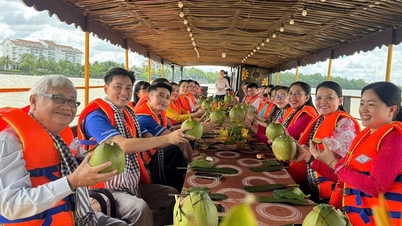
| Experience it once to understand and love it (Photo: Lu Vu Travel Agency) |
A revival from footprints on saline soil.
Few people know that before becoming the "green gem" of the Seven Mountains region, Tra Su was once a barren land heavily contaminated with alum. Its transformation began in 1983, when the first melaleuca seeds were sown in the heart of the saline, alum-contaminated basin. And since then, a new symbol has emerged, proving the success of human creation of nature.
 |
| Sunlight filters through the layers of melaleuca leaves, casting shadows onto the water's surface covered with duckweed – a mesmerizing visual spectacle. |
Spanning an area of 845 hectares, life has surged forth with remarkable vigor. The numbers speak for themselves: from a barren land, Tra Su is now home to 140 plant species and shelters 70 species of birds (including rare individuals such as the Indian stork and the Oriental Darter). This biodiversity is not only valuable from a scientific perspective but also symbolizes the harmonious blend of human indomitable spirit and the boundless generosity of Mother Earth.
The cultural undercurrent in the sound of oars.
The beauty of Tra Su lies not only in sight but also in hearing and feeling. Sitting in a traditional three-leaf boat, a symbol of the "reclaiming land" culture, visitors will feel the pulse of this land. The gentle sound of oars stirring the tiny water hyacinths, the chirping of birds calling to each other in the leafy canopy, or the simple stories of the boatman about the history of this border region… these are all pieces of knowledge beyond traditional books, incredibly vivid and real.
 |
| The small boat glides gently through the mangrove forest, a bridge connecting people and the spirit of the vast southern wilderness. |
Architecture of respect and sustainability


Furthermore, one cannot overlook the modern yet distinctly local highlight: the "Thousand-Step Bamboo Bridge." With a record-breaking length of 10 km, this structure is constructed from hundreds of thousands of Vietnamese bamboo stalks. Remarkably, the bridge doesn't disrupt the landscape but gracefully curves beneath the ancient melaleuca trees, allowing visitors to walk directly into the heart of the forest without harming any roots or blades of grass.
 |
| The thousand-step bamboo bridge, a symbol of exquisite artistry. (Photo: Son Doan) |
That is the philosophy of sustainable development that the management board is pursuing: using the purest materials from Mother Earth to honor Mother Earth's beauty. Coming to Tra Su, we don't just go to admire the scenery, but also to learn to love and appreciate the core values that are gradually being eroded amidst the pace of industrial life.
Here, nature does not stand alone but is intimately intertwined with human life. Tra Su is like an open museum, preserving the authentic character of the people of the Mekong Delta: from how they rely on the forest for survival to how they protect the forest as if it were their own lives. This beauty is both proud and humble, reflecting the enduring spirit that has never faded over generations.
Tra Su is more than just a forest; it's a "green journey" from a pristine past to a sustainable future. Immerse yourself in its verdant beauty, and you'll find your heart soothed and a deeper understanding of the profound human stories being told beneath the green canopy of the melaleuca trees.
For more detailed information about our tour services, please contact: Tra Su Melaleuca Forest Tourist Area Address: Van Tra Hamlet, An Cu Commune, An Giang Province Fanpage: https://www.facebook.com/kdlrungtramtrasu?locale=vi_VN  Vietnam encourages US businesses to expand investment in high technology.On the morning of June 26th, at the Government Headquarters, Deputy Prime Minister Ho Quoc Dung received Mr. Jeff Place, Supply Chain Director of Coherent Group (USA). During the meeting, the Deputy Prime Minister affirmed that Vietnam encourages US businesses to expand investment, especially in high-tech, innovation, and semiconductor industries.  Encourage U.S. businesses to expand investment in high-tech sectors.Deputy Prime Minister Ho Quoc Dung said that Vietnam welcomes US businesses to continue expanding their operations in Vietnam, especially in high-tech industries and sectors with high added value.  Vietnam and the United States strengthen cooperation in addressing the consequences of war.VTV.vn - On June 22, General Secretary and President To Lam received Acting Secretary of the US Navy Hung Cao. Phone number: 02966 512 299 Gmail: [email protected] |
Source: https://baoquocte.vn/tra-su-hon-ca-nhung-sac-xanh-384513.html


![[Photo] Strengthening character and expertise: Intense training for artillery soldiers.](https://vphoto.vietnam.vn/thumb/1200x675/vietnam/resource/IMAGE/2026/06/30/1782815602541_lu-368-1875-4571-jpg.webp)