

Human activity is pushing Earth to the brink of danger at 7 out of 8 safety thresholds, with many factors threatening the stability of life-support systems.
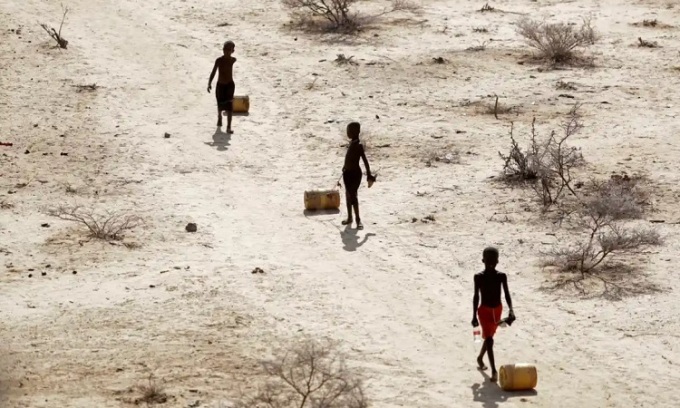
Water resources are one of the factors reflecting the health of the Earth in the analysis. Photo: AP
Beyond climate disruption, a report by a team of scientists on the Earth Commission presents alarming evidence that the planet is facing a crisis in water resources, environmental nutrients, ecosystem maintenance, and aerosol pollution. These are threats to the stability of life-support systems, leading to poorer social equality, according to an analysis published on May 31 in the journal Nature .
The current situation is very serious in almost every aspect. Aerosol pollution, caused by the accumulation of exhaust fumes from vehicles, factories, coal, and oil and gas power plants, is occurring on a global scale.
Water quality and habitat loss for freshwater species are also declining. This safety margin has been crossed in one-third of the world's land area due to hydroelectric dams, irrigation systems, and construction. A similar problem exists with groundwater systems, where the safety margin is that the aquifer cannot be depleted faster than it is replenished. However, 47% of river basins are shrinking at an alarming rate. This is a major problem in population centers like Mexico City and agricultural regions like the North China Plain.
Nutrient levels are another concern because farmers in wealthier countries are spraying more nitrogen and phosphorus than crops and soil can absorb. This temporarily increases yields but releases chemicals into river systems, leading to algal blooms and water that is no longer healthy enough for drinking. The safe limit in this case is an over-spraying of 61 million tonnes of nitrogen and 6 million tonnes of phosphorus globally.
Regarding climate, the world has set a target to keep global warming to a minimum of 1.5–2°C above pre-industrial levels. The Earth Commission emphasizes that this is a dangerous threshold because many people are already suffering the negative effects of extreme heat, droughts, and floods associated with the current temperature increase of 1.2°C. They argue that a safe target is 1°C above pre-industrial levels, requiring significant efforts to reduce atmospheric carbon dioxide.
To achieve this goal, approximately 50-60% of the world's land must contain natural ecosystems. However, in reality, only 45-50% of the planet has intact ecosystems. In areas altered by humans, such as farms, cities, and industrial zones, at least 20-25% of land needs to be reserved for semi-natural environments like parks and green spaces to maintain ecological functions such as pollination, water quality regulation, and pest management. However, about two-thirds of altered land does not meet this goal.
According to the research team, the analysis of the Earth's condition is rather bleak but not without hope. "Our doctors have diagnosed that the Earth is indeed quite sick in many areas. This affects the people living on Earth. We cannot just treat the symptoms; we must address the root causes," emphasized Joyeeta Gupta, professor of environment and development at North China Plain University and co-chair of the Earth Commission.
The new research represents the largest effort yet to integrate essential indicators of planetary health with human well-being, according to Professor Johan Rockström, the lead researcher. The Earth Commission, formed by dozens of leading research institutions worldwide, is using the analysis to establish a scientific basis for future sustainability goals, beyond the current focus on climate. The organization hopes that cities and businesses will adopt the new goals as a way to measure the impact of their activities.
An Khang (According to The Guardian )
Source link
![[Photo] National Assembly Chairman Tran Thanh Man working with the Standing Committee of the National Assembly's Delegation Affairs Committee.](https://vphoto.vietnam.vn/thumb/1200x675/vietnam/resource/IMAGE/2026/05/20/1779294340023_ndo_br_1-1691-jpg.webp)

![[Photo] General Secretary and President To Lam works with the Party Committee of the Ministry of Health on the work of Vietnamese traditional medicine.](https://vphoto.vietnam.vn/thumb/1200x675/vietnam/resource/IMAGE/2026/05/20/1779294323718_a1-bnd-2978-3319-jpg.webp)
![[Image] "Journey of Hope" promotes the organ and tissue donation movement in Vietnam.](https://vphoto.vietnam.vn/thumb/1200x675/vietnam/resource/IMAGE/2026/05/20/1779294400833_1-8910-jpg.webp)


































































Comment (0)