Phuoc Luu Pagoda
Trang Bang was the first area where migrants from Central Vietnam settled in Tay Ninh . On this land, the ancient Phuoc Luu Pagoda still stands. The pagoda's predecessor was a small, thatched-roof shrine built on the edge of the flooded Trang Bang area to worship Buddha.
The first shrine was established in the year Canh Ty 1840. Later, Mrs. Nguyen Thi Trinh, originally from Long An (formerly), followed migrants to Trang and renovated the Buddhist shrine. This woman had the ability to enter a trance and predict the future, so the people called her Mrs. Trinh "Mrs. Dong" (Mrs. Spirit Medium), and the thatched shrine also came to be called "Mrs. Dong's Shrine".
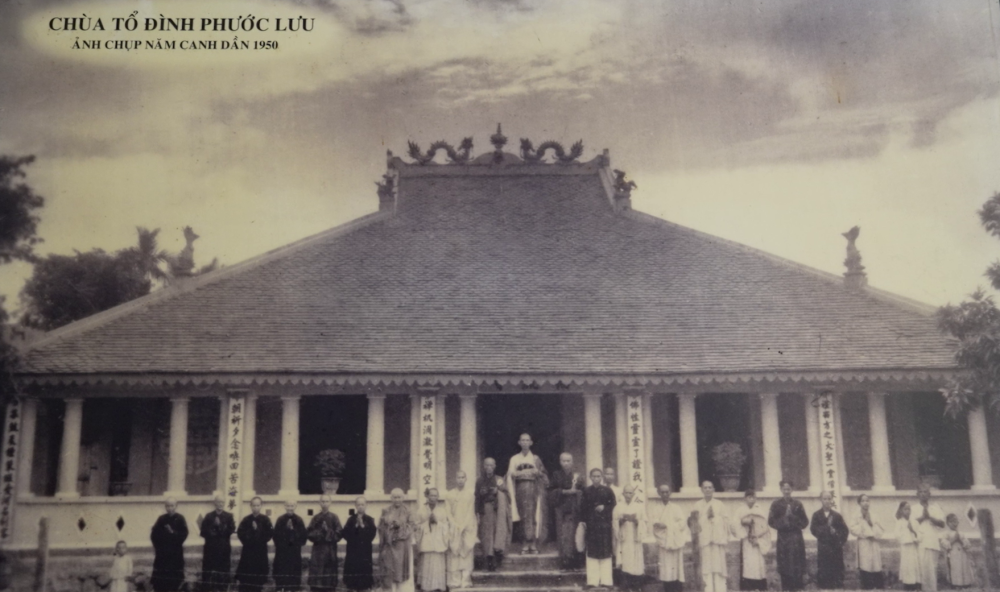
Phuoc Luu Pagoda in 1950
Many years later, a nun named Tran Thi Nen, whose Buddhist name was Chon Tang, came to the hermitage to practice Buddhism and lived with Mrs. Dong. Mrs. Nen was elderly, and the locals called her Mrs. Coc. Mrs. Dong and Mrs. Coc lived in the hermitage, performing charitable acts and helping people. Their good reputation spread far and wide, and more and more people came to worship and seek treatment. Later, the hermitage was expanded and upgraded into a temple, and it became known as Mrs. Dong's Temple.
Before becoming a monk, Mrs. Coc had three sons, all of whom became monks. Her eldest son took the Dharma name Truong Luc. After Mrs. Coc and Mrs. Dong passed away, Abbot Truong Luc became the head monk of the temple. In 1900, Abbot Truong Luc mobilized Vietnamese and Chinese people in the area to contribute manpower and resources to renovate the temple and named it Phuoc Luu. After that renovation, it became the largest temple in Trang Bang as well as in the entire southern region of Tay Ninh.
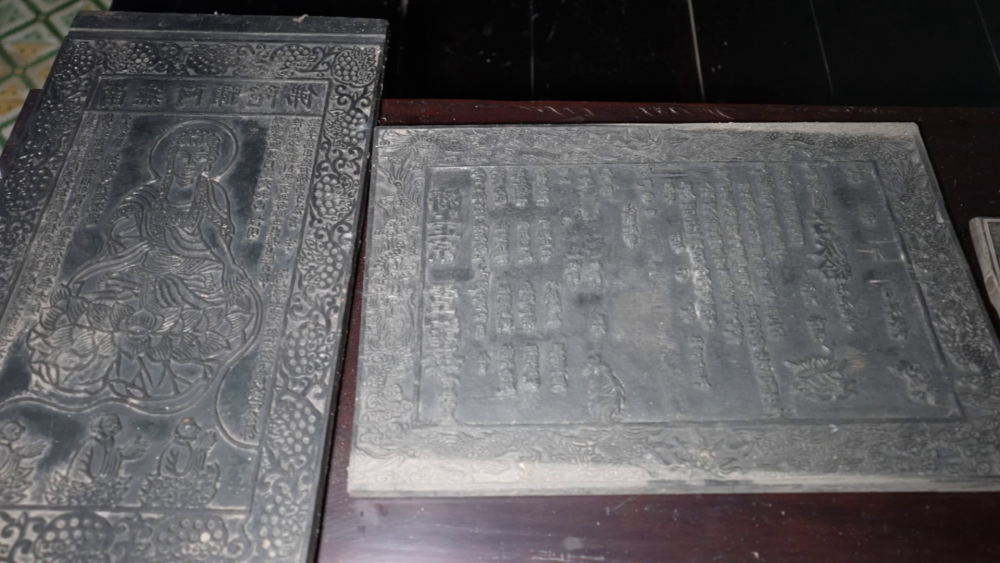
Precious artifacts in Phuoc Luu Pagoda
Currently, Phuoc Luu Pagoda preserves many precious paintings and statues, such as the set of Five Sages painting by artist Nam Kieng, from Gia Binh village (formerly Trang Bang). The pagoda also preserves many woodblock prints carved around 1898 containing Buddhist doctrines, petitions, decrees, incantations, and trigrams. The pagoda also houses hundreds of scriptures, treatises, and medical books in Han Nom script, compiled by the pagoda's founding masters.


Mr. Phi Thanh Phat, a member of the Vietnam Folk Arts Association and the Tay Ninh Literature and Arts Association, said that since the 1900s, Phuoc Luu Pagoda has been a training center for Buddhist rituals in Trang Bang. The pagoda has a "two-part" architectural style, consisting of two interconnected four-pillar buildings. Adding to its ancient charm are the exquisitely carved wooden panels, horizontal plaques, and couplets. The pagoda also preserves calligraphy by the renowned Chinese calligrapher Mac Thien Trai of the 19th century, along with the pagoda's ancestors. This ancient pagoda, possessing significant historical, cultural, and artistic value, is a typical example of Tay Ninh, classified as a provincial-level historical and cultural relic and recognized as one of the 108 famous ancient pagodas of Vietnam.
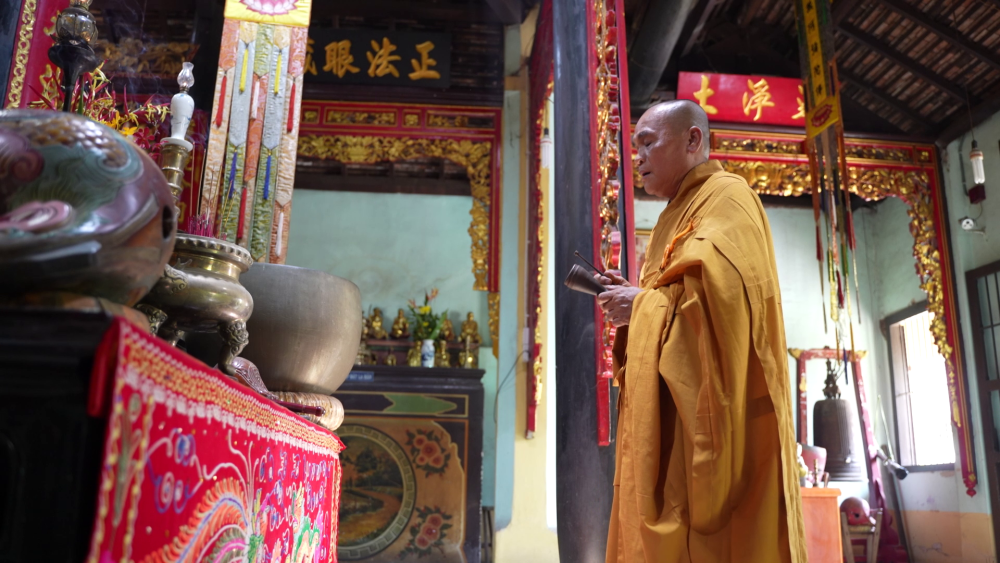
Venerable Thich Thien Nhan, abbot of Phuoc Luu Pagoda, uses bullet casings instead of bells in religious ceremonies.
Visiting Phuoc Luu Pagoda on holidays, Buddhists and tourists can see a rather special item, currently used regularly by Venerable Thich Thien Nhan - the abbot of Phuoc Luu Pagoda - during chanting: a shell casing used by the US-backed South Vietnamese army during the war. The Venerable uses this shell casing instead of a bell in the pagoda's rituals and chanting sessions. He uses a metal bolt to strike the casing, creating a resonant sound.
Abbot Thich Thien Nhan explained: "Previously, this type of weapon caused atrocities, but now the temple has renovated it to guide people towards goodness, aiming to express the spirit of the Dharma, encouraging everyone to do good and avoid evil, and to take refuge in the Three Jewels for happiness and peace."
Tinh Ly Pagoda
Besides Phuoc Luu Pagoda, Trang Bang also has the ancient Tinh Ly Pagoda, located in An Tinh ward (formerly part of Trang Bang town). The pagoda's predecessor was a small shrine built of bamboo by the village's buffalo-herding children, under a tree in the middle of Bau Dang marsh. Inside the shrine were clay Buddha statues, also molded by the buffalo-herding children from the soil of Bau Dang marsh. Many years later, as people brought offerings to worship and witnessed miraculous events, the locals named it Bau Dang Pagoda.
In 1902, during a trip to inspect road construction, District Chief Nguyen Van Buu of Trang Bang district (originally from An Tinh) saw that Bau Dang Pagoda was small and low, so he invited people from the village to help rebuild it on a larger scale and named it Tinh Ly Pagoda. The word "Tinh" means pagoda in An Tinh village, while "Ly" refers to the village headman who represented the village in building the pagoda.
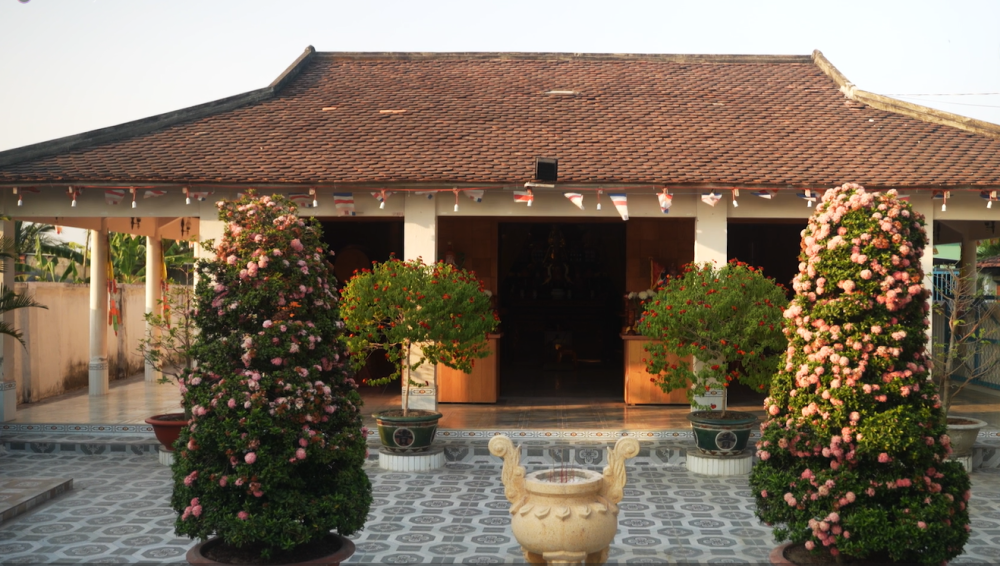
The ancient Tinh Ly Pagoda today
Currently, the temple has been rebuilt with brick walls and tiled roofs in the traditional style of Southern Vietnamese temples. From the outside, the temple resembles the traditional house of a high-ranking official from the past. In front of the temple are a statue of Bodhisattva Avalokiteshvara, a pond, a rock garden, altars dedicated to Maitreya Buddha, the Three-Headed Demon-Slaying Buddha, shrines to the Jade Emperor, Linh Son Holy Mother, Earth Mother, and the Earth God, etc.


Currently, Tinh Ly Pagoda still preserves a number of precious artifacts of historical and artistic value, such as three clay Buddha statues commissioned by District Magistrate Nguyen Van Buu, including a statue of the meditating Buddha Shakyamuni, a statue of the infant Buddha Shakyamuni, and a statue of the Three-Headed Demon-Slaying Tathagata.
This simple, rustic village temple has been closely associated with generations of people in An Tinh village from the past to the present.
Along both banks of the Vam Co Dong River are several other ancient temples, such as Cao Son (Phuoc Thanh commune), Thien Lam (Hoa Thanh ward),... These nearly 200-year-old religious sites preserve many typical historical, cultural, and artistic values of Tay Ninh. For almost 200 years, these ancient temples along the Vam Co Dong River have accompanied the settlers during the land reclamation period and contributed to the prosperous development of Tay Ninh today.
Ocean
Source: https://baolongan.vn/tram-nam-chua-co-a202494.html