

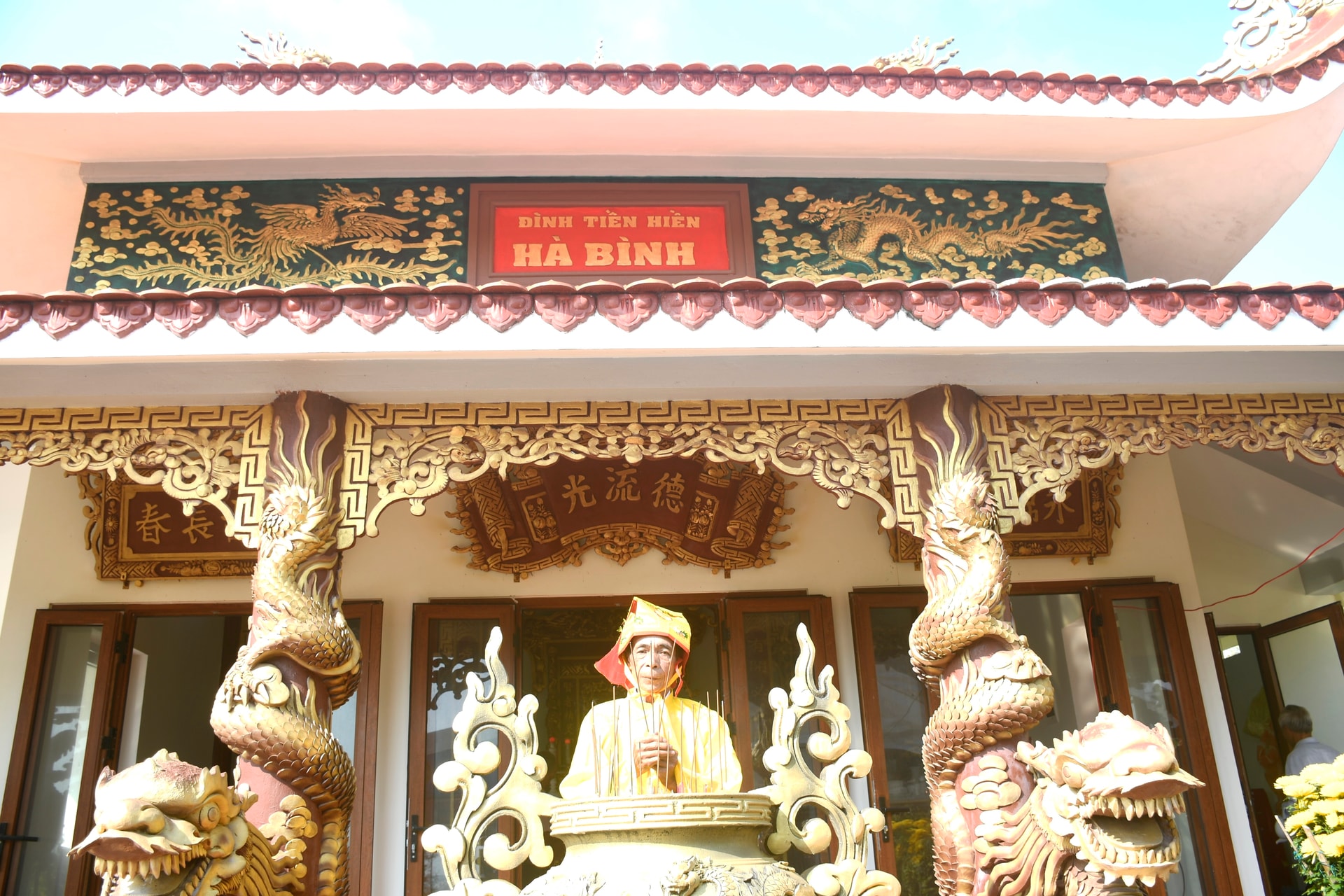
The fishing festival is rich in folk culture. It is an indispensable spiritual value in the customs, cultural life, and spiritual beliefs of fishermen whose lives are closely tied to the sea.
Preserving cultural beauty
On the 6th day of the Lunar New Year of the Year of the Horse (Bính Ngọ), thousands of people gathered around the ancestral temple of Hà Bình village (Thăng An commune) to respectfully perform a prayer for a bountiful fishing season, marking the beginning of a new year of seafood harvesting.
Amidst the resounding gongs and drums, the occasional sound of waves echoed. Mr. Nguyen Duc Thanh, the chief officiant of the Ha Binh fishing festival, adjusted his long robe and carefully examined each offering on the altar. He had retired from seafaring a few years ago due to old age, but from his eyes to his every action, he exuded the resolute spirit of a man deeply connected to the sea.
Mr. Thanh said that the fishing festival is a prayer for calm seas and favorable weather, ensuring safe voyages and abundant catches for fishermen. The most important ritual is the solemn and dignified offering to the Whale God – the guardian deity of fishermen. “The fishing festival has existed since ancient times, intertwined with the customs, beliefs, and spiritual life of coastal residents who depend on the abundant fish, shrimp, and squid resources of the vast ocean,” Mr. Thanh said.
According to Mr. Nguyen Duc Thanh, the coastal village of Ha Binh was formed when Vietnamese people from the North migrated here in waves. This process of cohabitation gradually created a community of people who make their living from seafaring. Therefore, closely linked to their livelihood, the residents of Ha Binh have shaped distinctive maritime cultural characteristics, from daily life and beliefs to customs and lifestyles.
The fishing festival of the people of Ha Binh includes the procession of the Whale God, the ritual of offering sacrifices to the spirits, and the ritual of praying for a bountiful catch. The ceremonial part is followed by festivities such as boat races or fishing net weaving, reflecting the community life of the people in this coastal area. Because the people of Ha Binh live off the sea, they consider the fishing festival a way to show respect to the Whale God, the god of the South Sea, helping them to feel secure in their work at sea, believing in good fortune, safety, and abundant catches of shrimp and fish.
The fishing festival is taking place vibrantly throughout Da Nang's coastal villages, as the local communities place great importance on spirituality and religious beliefs. In these coastal villages, it seems that no place lacks temples, pagodas, and shrines. The residents have been closely connected to the sea for generations, resulting in Da Nang having many ancient fishing villages with a rich and diverse system of tangible and intangible cultural heritage. These coastal cultural heritage sites not only beautify the coastal cultural landscape but also contribute to the city's diverse cultural values.
The unique art of the "ba trao" dance.
During the fishing festival, the "ba trao" performance (ba means to hold, trao means oar) is a mandatory form of performance, mainly consisting of dancing and singing. Each "ba trao" team usually consists of 3 main dancers (total of the bow, total of the spear, total of the stern) and about 12 oarsmen.
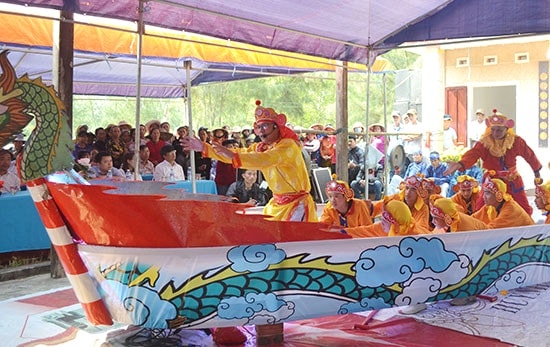
According to Mr. Tran Van Tam, who holds the position of chief conductor in the Ba Trao folk dance troupe of Thang An commune, the main formation of the Ba Trao performance is usually arranged in three vertical rows, with two groups of "trao" standing in two side rows, and the middle row consisting of three chief conductors: the chief helmsman, the chief bowman, and the chief merchant. The Ba Trao singing and dancing performance is a reenactment of the activities of fishermen during their work at sea.
Previously, many coastal villages in the city had shrines dedicated to the Whale God, whale cemeteries, and maintained a traditional folk dance troupe to perform rituals praying for a bountiful fishing season at the beginning and end of the fishing season. Nowadays, due to the passage of time, some coastal villages no longer maintain these troupes. Therefore, finding ways to ensure the stable and continuous operation of these folk dance troupes is crucial.
Mr. Nguyen Thanh Phong, Chairman of the People's Committee of Thang An commune, said that the local government always calls for and promotes the role of the three main groups (head, middle, and left) to act as leaders, maintaining and guiding the activities of the traditional boat dance troupes in the area, especially creating favorable conditions for young generations and students to participate. The locality hopes that the Department of Culture and Education will advise the City People's Committee to have mechanisms and policies to support the development of traditional boat dance troupes, and to introduce traditional boat dance performances into schools to spread cultural and spiritual values.
According to Mr. Pham Phu Ngoc, Director of the Hoi An World Cultural Heritage Conservation Center, the Ba Trao folk singing and dancing performance is usually performed on boats at the Whale God shrine. In addition, in thematic art programs on folk culture, the cultural heritage conservation sector, in coordination with Hoi An, Hoi An Dong, Hoi An Tay wards and Tan Hiep island commune, subtly integrates Ba Trao folk singing and dancing into the overall art program with excerpts, novel forms of expression, cheerful and optimistic dance movements and lyrics; especially mobilizing Ba Trao art to serve tourism. Hoi An has joined UNESCO's Creative Cities Network in the field of crafts and folk arts, so folk art forms in general, and Ba Trao singing in particular, have even more opportunities for preservation and promotion.
Source: https://baodanang.vn/tram-tich-van-hoa-tu-khong-gian-lang-bien-3326095.html




















































































Comment (0)