

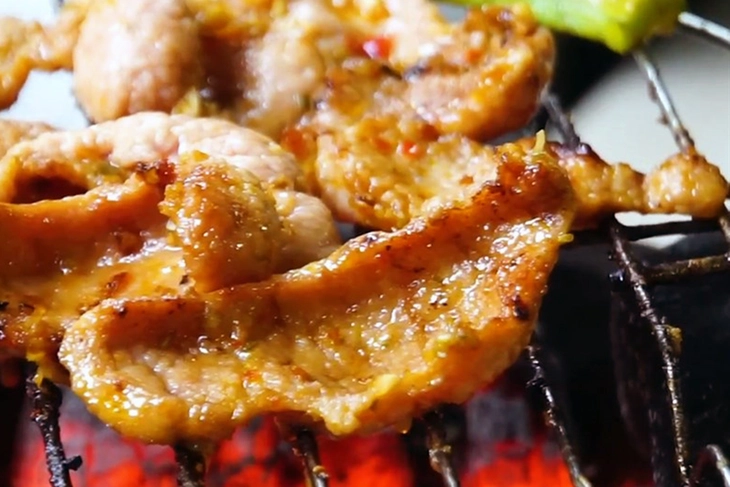
Grilled goat udder is a favorite snack for many diners. However, many people believe that goat udder is not actually goat udder and is "magically" replaced with pig udder - Photo: CTV.
Goat udder (also known as goat breast) has a rich, subtly fragrant, and crunchy texture, making it a favorite dish for many, especially those who enjoy drinking alcohol.
However, many people are skeptical: Where do all those goat udders come from?
Pig's udder but calling it goat's udder.
According to Tuoi Tre Online , many restaurants in Dong Nai sell goat meat. Quite a few of them list grilled goat udder on their menus. However, many people are skeptical, wondering, "Where do they get so much goat udder from?"
Because female goats are always kept by farm owners for breeding and profit. They are only culled if they become sick or experience problems that prevent them from continuing to be raised. Therefore, the supply of female goat meat to slaughterhouses is very limited, making it impossible to provide a plentiful supply of goat udders for restaurants and food stalls.
Mr. Quynh, owner of the well-known Quynh Kha goat meat restaurant in Bien Hoa, shared: "Goat udders are scarce; most are pig udders. Many restaurants list goat udders on their menu, but in reality, they're marinated and grilled sow's breast pads for customers."
According to Mr. Quynh, his restaurant specializes in goat meat, but the menu clearly states "pork udder" to make it clear and to serve customers who request it.
"Many restaurants label pig udders as goat udders. In reality, many goat meat restaurants buy pig udders from wholesale markets, marinate them, and sell them to customers who want to eat them."
"I think menus should be transparent. Selling pig's udder and claiming it's goat's udder is deceiving customers," Quỳnh confided.
Similarly, Mr. Loc, owner of Loc Goat Restaurant by the river in Bien Hoa City, shared: "The restaurant has been around for almost 10 years. When I opened the restaurant, I clearly stated that it was pig udder, not goat udder like other restaurants. To do business long-term, you have to be upfront with your customers."
Mr. Loc said that the situation of small eateries labeling their products as "goat udders" to sell to customers is real. However, these udders are actually pig udders sold at a price of about 230,000 VND/kg. "Frozen ones are even cheaper, only around 170,000-180,000 VND/kg," Mr. Loc said.
Goats are bred for raising, and only sold when they are old and weak.
Regarding this issue, Mr. Nguyen Truong Giang, head of the Dong Nai Department of Animal Husbandry and Fisheries, stated that animal udders, whether domestically sourced or imported, are usually from female animals. Identifying whether they are goat or pig udders requires inspection and verification. If the product has already been processed, it is very difficult to distinguish between them.
In the market, pig udders are more abundant than goat udders because sows are of higher quality, with each sow normally having 5-7kg of udders. Meanwhile, each female goat only has about 0.5-1kg of udders.
Currently, most eateries and restaurants buy live goats and slaughter them themselves. In the province, there are only 1-2 centralized slaughterhouses that butcher goats, and their output is only about 20-30 goats per day. With a total goat and sheep population of approximately 200,000 in Dong Nai, the market demand is basically met.
Regarding the control of goat slaughter, Mr. Giang stated that the veterinary sector only controls slaughtering at registered, centralized slaughterhouses. For illegal slaughterhouses, according to the law, local authorities at the district and commune levels supervise, with the veterinary sector only participating as a partner.
"The government agencies handle this. The district has an inter-agency inspection team including veterinarians, police, market management, economic department, agricultural department… to inspect illegal slaughtering and food safety," Mr. Giang added.
Regarding the control of the origin of goat meat, Mr. Giang said there are two sources: within the province and outside the province. For within the province, only the information of the place of purchase is required to be recorded for traceability when needed.
For goats from other provinces, the veterinary department of the province from which the goats enter Dong Nai will register and issue an export quarantine certificate. Only upon arrival at a specific local slaughterhouse will the Dong Nai veterinary department conduct inspections according to established procedures and affix a quarantine stamp if the food meets hygiene standards.
According to statistics, the total goat population in Dong Nai is approximately 200,000, equivalent to about 10.5% of the total pig population (1.92 million). The entire province has only one goat slaughterhouse, while there are more than 40 centralized pig slaughterhouses. Each goat weighs only about 20-30kg, while pigs can weigh up to 90-100kg (3-5 times heavier).
Read more Back to Homepage
Back to the topic
HA MI - A LOC
Source: https://tuoitre.vn/treo-vu-de-ban-vu-heo-20250507131245772.htm



































































































Comment (0)