

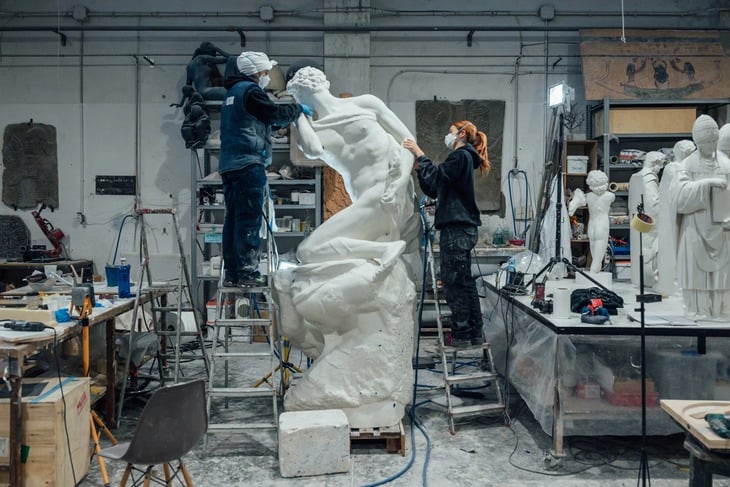
Technology was used to bring together almost all of Michelangelo's sculptures in a single location - Photo: Oak Taylor-Smith/Factum Foundation
This is considered the "most comprehensive" exhibition of Michelangelo's sculptures in the past 150 years.
Using 3D technology to recreate Michelangelo 's works.
To hold the exhibition, the museum did not need to transport the 5-meter-tall statue of David from the Galleria dell'Accademia in Florence, or the statue of The Genius of Victory located nearby in the Palazzo Vecchio.
Instead, the "Michelangelo Imperfect" exhibition, organized by SMK (Statens Museum for Kunst), featured around 40 replicas, including new 3D-printed copies, made specifically for the exhibition by the Madrid-based Factum Arte studio.
This isn't the first time a Michelangelo sculpture has been 3D-printed. The University of Florence previously unveiled an acrylic replica of David at the Dubai Expo 2020. However, this time, the technology was used to bring together almost the entirety of his sculpture in a single location.
The exhibition also includes original works by the Italian artist, comprising 20 drawings and a group of wax and clay models.
Matthias Wildel, the exhibition curator, said in a call with CNN: "This is an exhibition that is primarily made up of replicas – an experiment. This is not common these days."
Michelangelo Buonarroti, a sculptor who lived in the 15th and 16th centuries, remains known as one of the most celebrated artists of all time, thanks to the vibrancy and emotional depth in his classical sculptures.
Michelangelo's works bend and twist in space, maintaining seemingly precarious postures despite being carved from solid white Carrara marble.
At Factum Arte's workshop, the team not only 3D prints each piece but also combines new and traditional techniques. The in-depth process includes recording each piece using photometric and Lidar scanning methods to create a digital replica.
They printed the first few copies using resin, similar to the replica of the David statue displayed in Dubai. Then, they created silicone molds from the prints and cast them using a marble composite to get closer to the original material, before finishing the artwork by hand.
"Our goal is to make the pieces visually identical to the originals when displayed," Adam Lowe, founder of Factum Arte, told CNN. "You can only tell the difference by touching or tapping them, because the temperature of the marble isn't exactly the same."
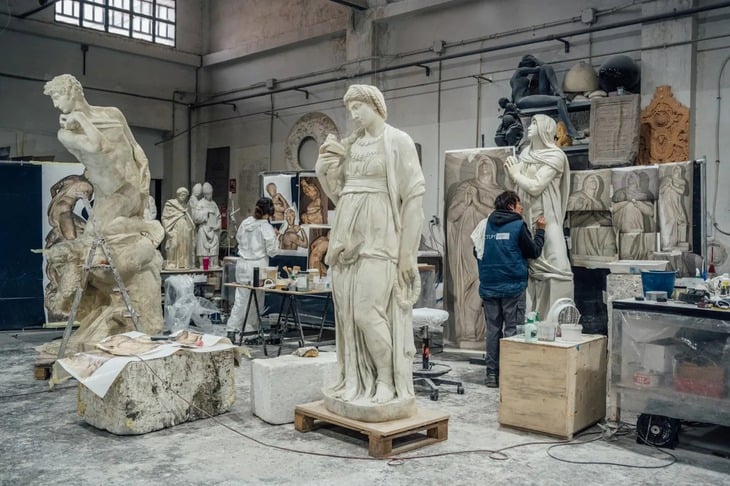
At Factum Arte's workshop, the team not only 3D prints each piece but also combines new and traditional techniques. - Photo: Oak Taylor-Smith/Factum Foundation
Creating " twin copies "
Today, people may not appreciate replicas. But in the 19th century, plaster casts of famous statues were the "stars" of many museums. Institutions like the Art Institute of Chicago began their collections with plaster casts. The Louvre Museum's foundry, established in 1794, is still in operation today.
Tourists who have visited Florence may have seen a plaster replica of the statue of David in its original location in Piazza della Signoria. These replicas have also been erected in London and Moscow, while bronze replicas have been found worldwide.
Many of these were cast shortly after Michelangelo's largest exhibition at the time, in Florence in 1875, marking the 400th anniversary of his birth.
However, the copies gradually lost their prestige and eventually became damaged, locked away in archives, or destroyed.
In 2004, the Metropolitan Museum of Art donated its once-cherished collection. Prior to that, it had been neglected in a "dilapidated storage room," according to The New York Times in 1987.
"This used to be a way to bring together and make accessible to the public works of art they couldn't otherwise access, perhaps because they were too far away or couldn't be seen together," Wivel explains. "From the 20th century onwards, something called 'originality cult' began to emerge regarding original artifacts."
In fact, he added, the entire foundation of Western art might have been overturned without the copies, since very few original statues from ancient Greece remain. Much of our knowledge of that period comes from Roman copies.
Source: https://tuoitre.vn/trien-lam-lon-nhat-ve-tac-pham-cua-michelangelo-phuc-dung-bang-3d-20250405155253984.htm





![[Image] A brilliant symphony and explosive power in the skies of Da Nang.](https://vphoto.vietnam.vn/thumb/1200x675/vietnam/resource/IMAGE/2026/05/31/1780196945787_anh-man-hinh-2026-05-31-luc-10-08-51.png)












![[Video] Sunset at Lap An Lagoon – Where the sun sets over the fishing nets](https://vphoto.vietnam.vn/thumb/340x192/vietnam/resource/IMAGE/2026/05/31/1780192137701_beach-landscape-sea-water-nature-grass-745871-pxhere-com.jpeg)












































































Comment (0)