

In the flow of contemporary Vietnamese music , composer Ngoc Khue is a familiar name to many generations of music lovers. His real name is Nguyen Ngoc Khue, born in 1947 in Hanoi into a family of educators with a Confucian tradition. While a student teacher, heeding the sacred call of the Fatherland, on February 18, 1965, he enlisted in the army.
At the age of 19, Ngoc Khue was an anti-aircraft gunner and radar operator, directly fighting alongside his unit to defend the Ham Rong Bridge during the fierce American bombing raids of 1965 aimed at cutting off the vital transportation route from North to South Vietnam. With a spirit of determination to fight and win, our army and people shot down 47 American aircraft.
The joy of victory and the emotions of youth inspired the young soldier to write "The Song by the Ma River" in the autumn of 1966. The song has pure lyrics and a lively melody, praising the beauty of the Ma River, the courageous fighting spirit, and love for the homeland amidst the flames of war. Two years later, the work won a Gold Medal at the Military Region III Festival. It can be said that from that milestone, music truly chose Ngoc Khue.
After serving as an artillery soldier, he was invited to teach mathematics at the 228th Regiment Ham Rong Cultural School. Soon after, he became an actor in the Air Defense - Air Force Performing Arts Troupe. Growing up in the military art environment, Ngoc Khue successively held many important positions: Head and Artistic Director of the Air Force Performing Arts Troupe; Director of the Air Force Cultural Center; Director of the Air Defense - Air Force Cultural Center until his retirement in 2007 with the rank of Colonel.
He is known as the "Rice Village, Flower Village".
Born and raised in the rural area of Kẻ Giá, where lush green rice and corn fields stretched along the gentle Đáy River, and with a close friend living in the picturesque Nghi Tàm by West Lake, Ngọc Khuê frequently visited him. A lover of flowers, he composed many emotionally rich poems and songs about various flowers such as lotus, grapefruit blossom, a glimpse of jasmine, marigold, kapok, bougainvillea, lotus… along with images of purple crape myrtle, lemon blossom, white frangipani, honeysuckle, and betel nut…
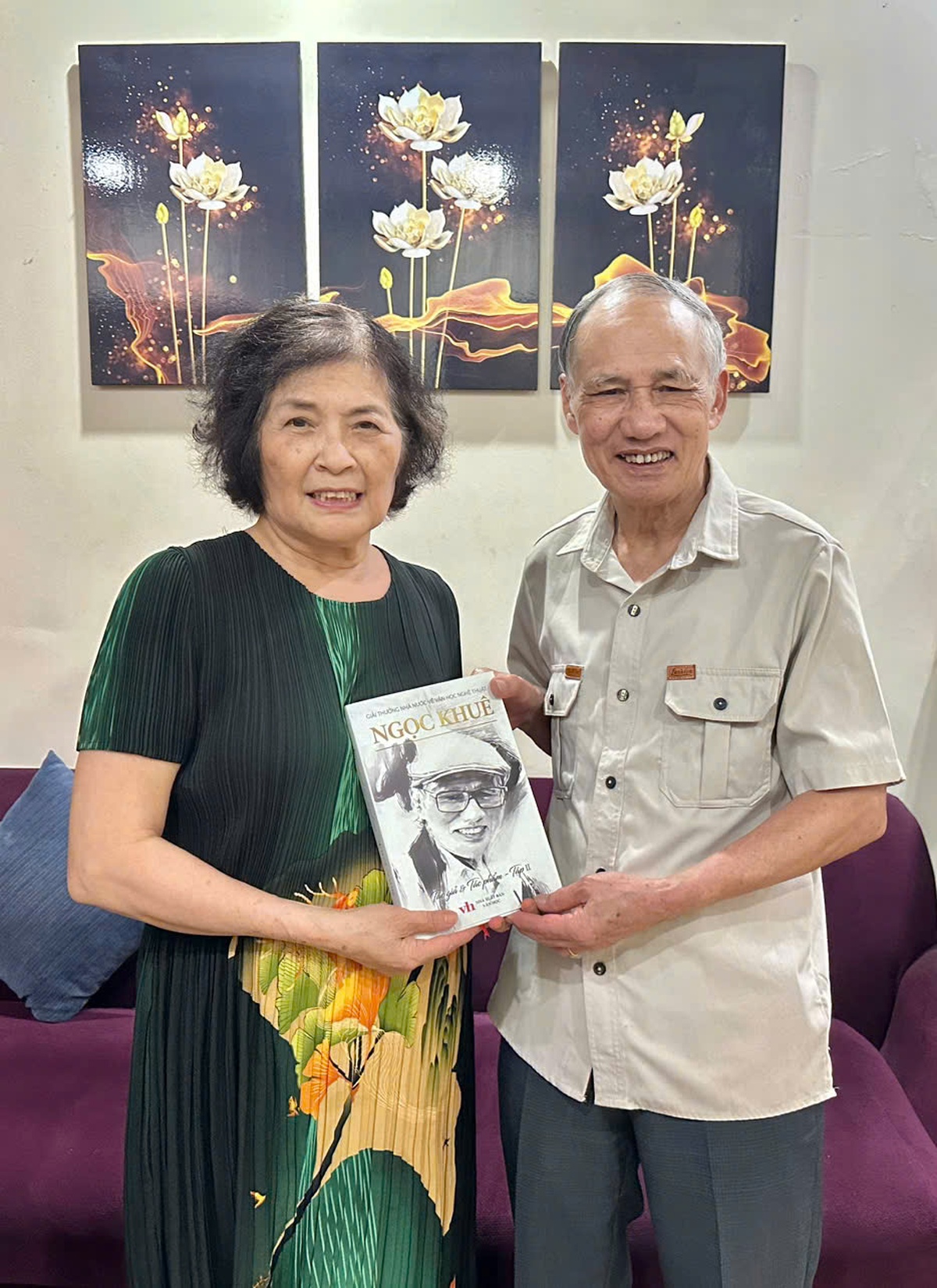
The author of this article and musician Ngoc Khue
From that love of nature and homeland, the musician always longed to write a work that could recreate the beauty of his own hometown; to celebrate rice and flowers - "bread and roses" - as Westerners say about the essential needs of human beings: material life and spiritual beauty. And then that opportunity came.
One spring morning, on his way home from visiting a friend by bicycle, passing through rice fields swaying in the wind like a song, amidst the fragrant scent of spring, beautiful melodies suddenly resonated in the musician's soul. Upon arriving home, he immediately sat down at his desk, letting his mind wander with the musical notes in a moment of heightened emotion. From that moment, the song " Village of Rice, Village of Flowers" was born.
Immediately after completing the song, Ngoc Khue took it to the Voice of Vietnam Radio . After listening to the song, many people praised it. A leader of the station suggested adding the word "Spring" to the title because the song strongly evoked the atmosphere of spring. The composer happily agreed, and the song officially became titled "Spring in the Rice and Flower Village ."
In 1981, singer Thanh Hoa performed the song for the first time on Vietnam National Radio, moving millions of listeners. The work is deeply romantic, praising the peaceful and prosperous beauty of the homeland. The images of "rice villages" and "flower villages"—symbols of abundance and spiritual beauty—captivated listeners with its gentle and pure melody. The song not only evokes love for the homeland but also reminds everyone to cherish and preserve national cultural values.
"Springtime in the Rice and Flower Village" has been selected among the Top 10 best songs about Hanoi by the Ministry of Information and Communications ; and among the Top 20 best songs about agriculture by the Ministry of Agriculture and Rural Development, receiving a Gold Cup. Recently, the work was further honored in the Top 50 representative songs of the 50 years after the liberation of the South and the reunification of the country (2025).
When the song is mentioned, the public immediately thinks of composer Ngoc Khue. And because of that affection and respect, many people affectionately call him by the endearing name: "The man of the rice and flower village."
Source: https://phunuvietnam.vn/triet-ly-banh-mi-hoa-hong-tu-ca-khuc-ve-lang-lua-lang-hoa-238260528181639688.htm

![[Photo] General Secretary and President To Lam and the President of the Philippines hold talks.](https://vphoto.vietnam.vn/thumb/1200x675/vietnam/resource/IMAGE/2026/06/01/1780283481955_vna-potal-tong-bi-thu-chu-tich-nuoc-to-lam-va-tong-thong-philippines-hoi-dam-8797519-1429-jpg.webp)






































































Comment (0)