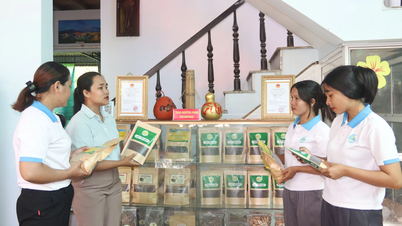
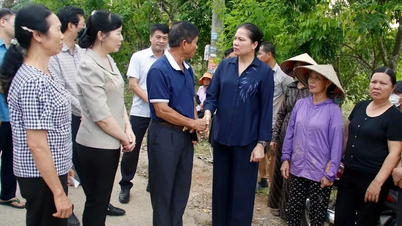
Mr. Pham Van Kien (second from the left) introduces his garden of two-branched red Siamese coconut trees to visitors. Photo: AN LAM
Originally from Rach Gia ward, Kien came to Hoa Dien to start his business when he realized that there was still a large area of undeveloped land. Initially, he planted rice and melaleuca trees. However, the economic results were not as expected, leaving him constantly pondering and searching for a new direction.
About six years ago, after accidentally encountering coconut trees with two branches, Kien came up with the idea of building a unique coconut garden. Initially, many people thought the idea difficult to implement because two-branched coconut trees are very rare. "I spent nearly three months researching, learning from experience, and finding seedlings," Kien recounted.
According to Mr. Kien, collecting two-branched coconut trees is not easy. Each nursery only has a few trees, and in some places, you can search for a whole week without finding one. He asked nursery owners and traders in many places to keep an eye out for them, and to report any two-branched coconut trees they spot so he could buy them. One by one, hundreds, then thousands of trees were brought back and planted on the reclaimed acidic soil. To prepare for this model, he invested heavily in preparing the land, treating the acidity, buying seedlings, installing an automatic irrigation system, and hiring workers to care for the trees.
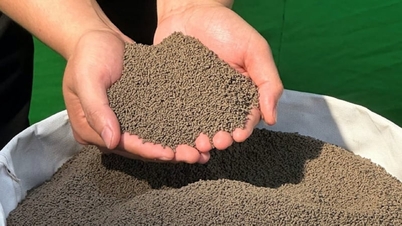
To date, the garden has expanded to about 20 hectares with more than 6,000 red Siamese coconut trees with two branches. According to Mr. Kien, the advantage of the two-branch coconut is that each tree produces two canopies of leaves, yielding twice the productivity of regular coconuts. On average, each bunch yields 6-8 fruits. Thanks to the application of an automatic irrigation system covering the entire garden, he has reduced the amount of labor required for care. "For coconuts to grow well, they need a suitable nutritional regime. I fertilize regularly to make the trees strong, and at the same time, I frequently spray pesticides to prevent and treat coconut beetles because they are a dangerous pest," Mr. Kien said.
Currently, the coconut plantation yields a continuous harvest year-round. Coconuts are available for sale every week, with an estimated production of approximately 40,000 coconuts per month, equivalent to nearly 480,000 coconuts per year. With the current selling price of around 8,000 VND per coconut, revenue from coconuts is expected to continue increasing as market demand grows.
After years of investment, Mr. Kien said that the initial costs were high, from land improvement, irrigation systems, seedlings, to labor and maintenance expenses over many years. Even so, he believes in the path he has chosen. Besides the economic value of the coconuts, he hopes his two-branched coconut garden will become a tourist attraction in the future. “Two-branched coconuts are rare, so many people like to come and see them. If combined with ecotourism later, this will be a unique highlight of the locality,” Mr. Kien said. Not only does he hope his model will develop sustainably, but Mr. Kien also hopes that relevant authorities will pay attention to connecting him with a market and finding stable buyers so that he can invest confidently in the long term.
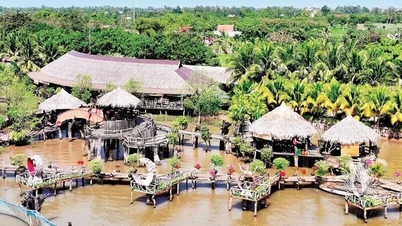
In the midst of land once affected by acidity, rows of lush, two-branched coconut trees bearing fruit year-round are the result of persistent research, investment, and bold innovation by Mr. Pham Van Kien. This model contributes to affirming the potential for agricultural development in a distinctive direction, adding a highlight to the rural area of Hoa Dien.
Source: https://baoangiang.com.vn/trong-dua-2-ngon-บน-dat-phen-a489094.html

![[Photo] General Secretary and President To Lam attends the Central Public Security Party Committee Conference](https://vphoto.vietnam.vn/thumb/1200x675/vietnam/resource/IMAGE/2026/06/24/1782302063612_a1-bnd-9302-9166-jpg.webp)
![[Photo] The 13th National Congress of the Youth Union conducts personnel work.](https://vphoto.vietnam.vn/thumb/1200x675/vietnam/resource/IMAGE/2026/06/24/1782299943080_ndo_br_1-6868-jpg.webp)