

China is attracting global attention in the energy sector thanks to the successful development of CHSN01, a super-strong steel. This material is capable of withstanding the harsh conditions inside a fusion reactor, something many international experts had previously considered impossible.
Nuclear fusion, considered the "holy grail" of the energy industry, mimics the Sun's energy generation process to provide a clean, virtually inexhaustible source of electricity. However, the biggest hurdle currently lies in finding structural materials that can withstand extreme operating environments.

Inside the reactor core, the plasma reaches temperatures of millions of degrees Celsius, while the surrounding superconducting magnets must be cooled to near absolute zero, approximately -269 degrees Celsius. The combination of ultra-high temperatures, ultra-low temperatures, and massive mechanical stress places stringent demands on material strength. The new CHSN01 alloy developed by China has paved the way for the BEST reactor, a project aimed directly at commercial power generation.
Overcoming material limitations in international projects.
Nuclear fusion reactions require extremely strong magnetic fields to confine the plasma stably. These magnets, which generate the magnetic field, use superconducting materials and must operate in a liquid helium environment at approximately -269°C. The stronger the magnetic field, the more effective the plasma confinement, but the structural materials must withstand high stress without becoming brittle.

Traditional stainless steels like 316LN have reached their limits when working under a magnetic field of 11.8 Tesla. During tests in the international ITER project in 2011, loss of ductility at low temperatures occurred, causing significant delays. Recognizing this as a major obstacle, Chinese scientists have been researching a new type of steel with the goal of meeting the design magnetic field of up to 20 Tesla for the BEST reactor.
The 10-Year Journey of CHSN01 Steel Development
The development of CHSN01 spanned over a decade, involving leading experts. In the initial phase, the research team focused on adjusting the steel composition, adding vanadium, carbon, and nitrogen to improve properties at sub-zero temperatures.
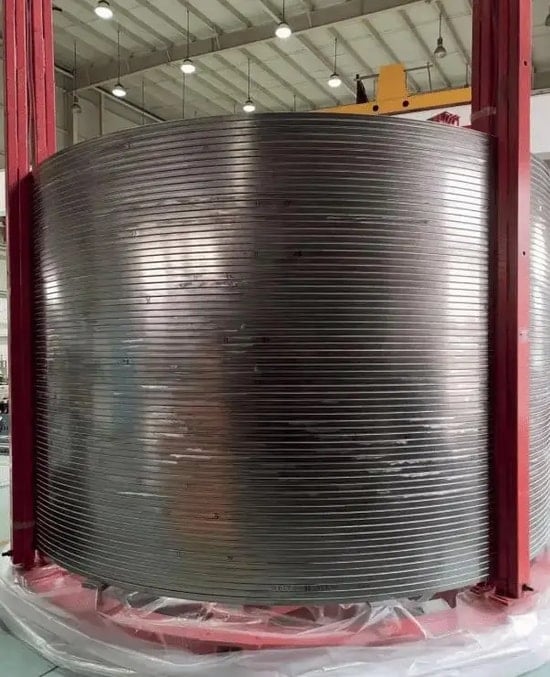
The turning point came in 2020 when Academician Zhao Zhongxian, a leading expert in low-temperature physics, joined the team. By 2023, tests showed that CHSN01 maintained its integrity under a 20 Tesla magnetic field and a stress of 1,300 MPa. The material achieved a tensile strength of 1,500 MPa and elongation of over 25% at low temperatures, solving the "impossible triangle" problem in materials science.
Impact on the global energy race
Currently, 500 tons of CHSN01 steel have been used for the conductive cladding of BEST, with installation starting in May 2023. BEST is a tokamak device aiming to increase energy output by more than five times and is expected to be completed in 2027. Compared to ITER, the BEST project is directly aimed at demonstrating the feasibility of commercial electricity production.

CHSN01 steel allows for the design of more compact reactors, about one-third the size of conventional ones, thus reducing construction costs. Beyond fusion, this material also has potential applications in particle accelerators, magnetic levitation trains, and quantum computing systems. This breakthrough affirms China's advantage in the clean energy supply chain and propels the global fusion race into a new phase.
Source: https://baonghean.vn/trung-quoc-dot-pha-thep-chsn01-cho-lo-phan-ung-nhiet-hach-10317808.html




























































































Comment (0)