

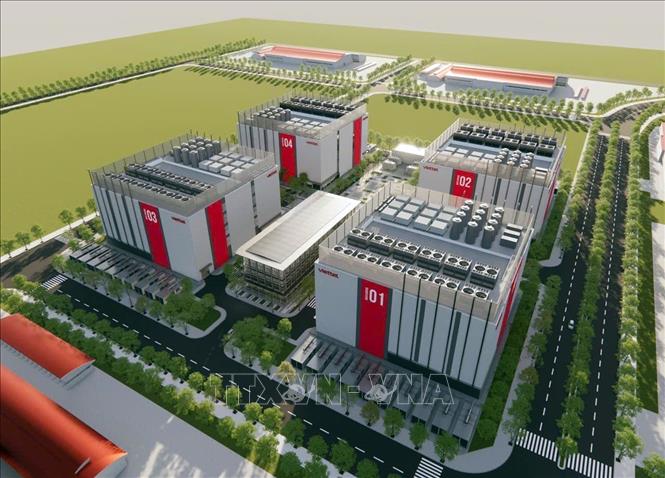
Minister of Science and Technology Nguyen Manh Hung emphasized that Vietnam's digital infrastructure must ensure ultra-broadband, universal accessibility, sustainability, intelligence, openness, greenness, and security. Establishing new data centers that meet international green standards is one of the goals of the Digital Infrastructure Strategy to 2025 and the orientation to 2030.
A data center is a physical location designed to store an organization's critical applications and data, comprising components such as servers, storage systems, routers, switches, networks, cooling systems, security systems, and application delivery controllers. Considered the "heart" of the internet and the "backbone" of the digital economy , data centers play a crucial role in storing, processing, and managing massive amounts of data, facilitating a smooth and successful digital transformation.
Building a dedicated data center is a safer option compared to traditional storage methods due to its outstanding advantages in secure storage and management, enhanced operational efficiency, guaranteed service continuity, flexible scalability, cost savings, and its crucial role in digital transformation.
Vietnam currently has 33 data centers belonging to domestic telecommunications companies such as VNPT, Viettel IDC, FPT Telecom, and CMC Telecom, with the participation of foreign companies such as Gaw Capital and Worldwide DC Solution (Singapore). According to a recent report by the Ministry of Science and Technology, four companies are planning to invest in large-scale data centers with a total capacity of 220 MW. The Ministry of Science and Technology also assessed that Vietnam's data center infrastructure has made significant progress, however, the total capacity only reaches 182 MW, far from the target of 870 MW by 2030. Currently, only one ultra-large-scale data center with a capacity of 30 MW has been put into operation by the Military Telecommunications and Industry Corporation (Viettel) in April 2024 at the Hoa Lac High-Tech Park (Hanoi).
Forecasts indicate a boom in data centers in Vietnam in the coming years, reaching a scale of US$1.27 billion by 2030, with an average compound annual growth rate of 10.8%. One of Vietnam's advantages is that the cost of building and operating data centers is significantly lower than in other countries in the region, resulting in lower service rental prices. This presents a great opportunity for Vietnam amidst the strong wave of data and technology infrastructure migration from developed economies to Southeast Asia.
To meet the growing market demand, data centers in Vietnam are continuously being put into operation. Recently, Viettel commenced construction of a super-large-scale data center in Tan Phu Trung Industrial Park, Ho Chi Minh City. The project covers an area of nearly 4 hectares, with a total designed power capacity of 140 MW, allowing for the installation of approximately 10,000 racks. The initial phase is expected to be operational from Q1 2026 and fully completed before 2030. Upon completion, this will be Vietnam's first data center with a capacity exceeding 100 MW, also known as a super-large-scale center, comparable to major data centers worldwide .
The Tan Phu Trung Data Center is designed and operated according to international Uptime Tier III standards; it has an average power density of 10kW/rack, 2.5 times higher than the average in Vietnam. The highest rack capacity reaches 60 kW, meeting the high-performance computing needs of large-scale artificial intelligence (AI) models and applications. To achieve this high power density, the Tan Phu Trung Data Center applies advanced cooling technologies and an intelligent management system based on artificial intelligence.
The Chairman and CEO of the Military Telecommunications and Industry Group (Viettel), Major General Tao Duc Thang, stated: “Data centers are not simply technical facilities for storing resources, but rather the foundation of digital sovereignty , the digital infrastructure – the basis for the digital economy, digital society, and digital government. All security, monitoring, and digital security coordination solutions are developed in-house by Viettel, ensuring absolute technological sovereignty – without dependence on third parties.”
The scale, technology, and sustainability of the project are consistent with the directions set forth in Resolution 57-NQ/TW of the Politburo on breakthroughs in the development of science, technology, innovation, and national digital transformation, and Decision No. 36/QD-TTg of the Prime Minister on the Planning of Information and Communication Infrastructure.
Source: https://doanhnghiepvn.vn/chuyen-doi-so/trung-tam-du-lieu-nen-tang-day-nhanh-qua-trinh-chuyen-doi-so/20250428093911030

![[Photo] Prime Minister Pham Minh Chinh presides over the conference announcing the establishment of the International Finance Centre in Vietnam.](/_next/image?url=https%3A%2F%2Fvphoto.vietnam.vn%2Fthumb%2F1200x675%2Fvietnam%2Fresource%2FIMAGE%2F2025%2F12%2F21%2F1766309817714_ndo_br_dsc-3400-jpg.webp&w=3840&q=75)


![[Photo] Prime Minister Pham Minh Chinh presides over a meeting on private sector economic development.](/_next/image?url=https%3A%2F%2Fvphoto.vietnam.vn%2Fthumb%2F1200x675%2Fvietnam%2Fresource%2FIMAGE%2F2025%2F12%2F20%2F1766237501876_thiet-ke-chua-co-ten-40-png.webp&w=3840&q=75)












































































Comment (0)