

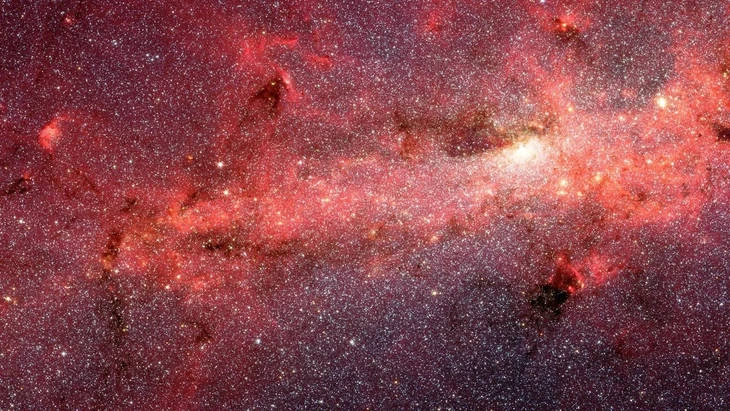
In space, there are four dimensions: length, width, height, and time - Photo: NASA
More than a century ago, scientist Albert Einstein believed that the universe was static and introduced the "cosmological constant." But then astronomical discoveries changed everything: the universe is not static, but is constantly expanding over time.
Even more surprising is that the universe doesn't have a single "center." And to understand this, we need to look at the world from a completely new perspective.
The theory of a stationary universe
In 1915, Albert Einstein published his theory of general relativity, a theory that completely changed how humanity understands space and time. At that time, Einstein assumed that the universe was static: its size and shape remained constant over time. Galaxies remained stationary in an infinite and eternal space.
However, some time later, astronomers began observing distant galaxies with more powerful telescopes and discovered that the light from these galaxies was "redshifted," a physical phenomenon that indicated the galaxies were moving away from Earth.
Specifically, astronomer Edwin Hubble made two revolutionary discoveries.
In the early 1920s, Hubble demonstrated that the "island universes" that scientists had been talking about were actually galaxies, and that they were located very far from our Milky Way.
Later that decade, he made another groundbreaking discovery: that, on average, all galaxies are moving away from us.
This meant a truth that seemed unbelievable at the time: the universe is not stationary. Hubble's discovery ushered in a new era in cosmology, laying the foundation for the concept of the expanding universe as we know it today.
This was a historic turning point: the universe is not static, but constantly expanding. Einstein later had to admit that his initial assumption was wrong, and he called it "the biggest mistake of my life."
The universe is expanding but has no "center".

The universe holds countless mysteries that humanity has yet to fully understand - Photo: AI
It sounds strange: if the universe is expanding, where is its center? Is Earth the center?
The answer is no.
Imagine this: when we use a telescope to observe galaxies in every direction, they all seem to be moving away from us. In fact, the farther away the galaxies are, the faster they move away. This doesn't mean Earth is the center, but rather that all of space is expanding simultaneously.
In other words: It's not the galaxies themselves that are "flying away," but rather the space between galaxies that is expanding over time.
A familiar example is the image of a balloon. Imagine you stick small dots on the surface of a balloon. When you inflate the balloon, the dots will be further apart, even though they are not moving on the surface. The increased distance is not because the dots are moving, but because the balloon's surface is expanding.
The same is true in the universe. Galaxies are like dots on the surface, and space is the shell of the ball. As the universe expands, all galaxies simultaneously move away from each other without a fixed center.
Space, time, and the "fourth dimension"
One of the reasons we find it difficult to visualize the universe is that human intuition is accustomed to seeing the world in three dimensions: length, width, and height. But our universe is not just three-dimensional; it also has a fourth dimension: time.
In general relativity, space and time combine into a single concept called "spacetime". As the universe expands, not only do the distances between galaxies change, but time is also part of that change.
Therefore, the question "where is the center of the universe?" essentially has no answer. It's like asking "where is the center of the surface of a ball?" There is no single point. Every point in the universe is the same, and from any galaxy, you will see other galaxies moving away from you.
Scientists are currently researching what is causing the universe to expand at an ever-increasing rate. Many theories suggest it is due to an ununderstood form of energy called dark energy. But no matter how advanced our technology becomes, the universe will always hold mysteries far beyond human imagination.
Understanding the expansion of the universe not only helps us explore the history of the cosmos, but also opens up a new perspective on the place of Earth and humanity within the grand scheme of space and time.
Source: https://tuoitre.vn/trung-tam-vu-tru-nam-o-dau-2025090814153114.htm



![[Image] National Assembly discusses the implementation of the socio-economic development plan.](https://vphoto.vietnam.vn/thumb/1200x675/vietnam/resource/IMAGE/2026/04/20/1776696707422_ndo_br_img-20260420-185419-jpg.webp)

![[Photo] General Secretary and President To Lam meets with National Assembly delegates from ethnic minorities.](https://vphoto.vietnam.vn/thumb/1200x675/vietnam/resource/IMAGE/2026/04/20/1776696701056_a1-bnd-8331-3342-jpg.webp)




























































































Comment (0)