

In the overall economic picture of the province, some key indicators still show some less than ideal results. To achieve the growth target of over 8% in 2025, Dak Lak has set a plan for the gross regional product (GRDP at 2010 constant prices) to reach VND 68,425 billion.
By the end of the first quarter of 2025, the entire province had achieved over 12,706 billion VND, an increase of 6.5% compared to the same period in 2024, but only reaching 18.57% of the plan.
Thus, in the remaining nine months of this year, the entire province must achieve a total product value of over 55,718 billion VND. Several pillars of growth and key indicators of the economy are facing difficulties, which has affected the province's total product value in the early months of the year.
Despite implementing numerous measures to support businesses in the province, the number of businesses dissolving or temporarily suspending operations in the first three months of 2025 still exceeded the number of newly established businesses. Specifically, in the first quarter of 2025, the province saw the establishment of 382 new businesses (a 9.1% increase compared to the same period last year, but only 12% of the 2025 plan), with a total registered capital of VND 11,600 billion, a 259% increase compared to the same period last year. However, the province also saw 60 businesses dissolve and 545 businesses temporarily suspend operations (a 14.8% increase compared to the same period last year). These figures speak volumes, clearly demonstrating the difficulties that businesses are facing.
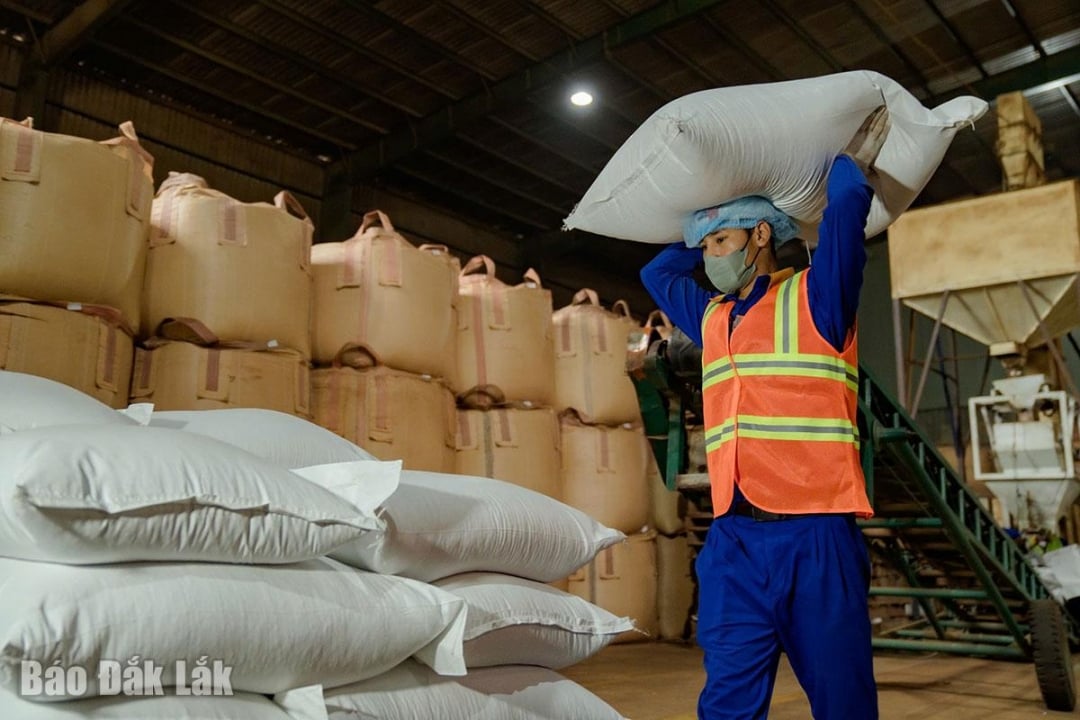 |
| Coffee production and processing for export at Simexco DakLak's factory. |
Analyzing the causes of this situation, the Provincial Business Association believes that the production and business activities of enterprises in the province have faced many difficulties in recent times, especially regarding access to capital. Currently, most enterprises in the province are small and micro-sized, making it difficult to provide collateral for credit loans. In addition, current state mechanisms and policies still have bottlenecks, including a "request-and-grant" system and cumbersome administrative procedures. This has significantly hindered businesses. Furthermore, the lingering effects of the COVID-19 pandemic, as well as economic and political fluctuations worldwide, have also significantly impacted the "health" of businesses.
To achieve a growth target of over 8% in 2025, our province has set a target of total export turnover reaching US$1,860 million. However, in the first quarter, the province's total export turnover only reached US$510 million, equivalent to 27.4% of the plan, a decrease of 2.7% compared to the same period last year. According to the analysis of the Department of Industry and Trade, the reason for the decrease in the province's export turnover is due to the recent difficulties in the global economy, reduced consumer demand, and the fact that major commodities such as green coffee beans and pepper have lower inventory levels than in the same period last year, affecting export volumes. Specifically, green coffee bean exports decreased by over 24,000 tons, cashew nuts by 1,134 tons, pepper by 937 tons, and rubber by 42 tons…
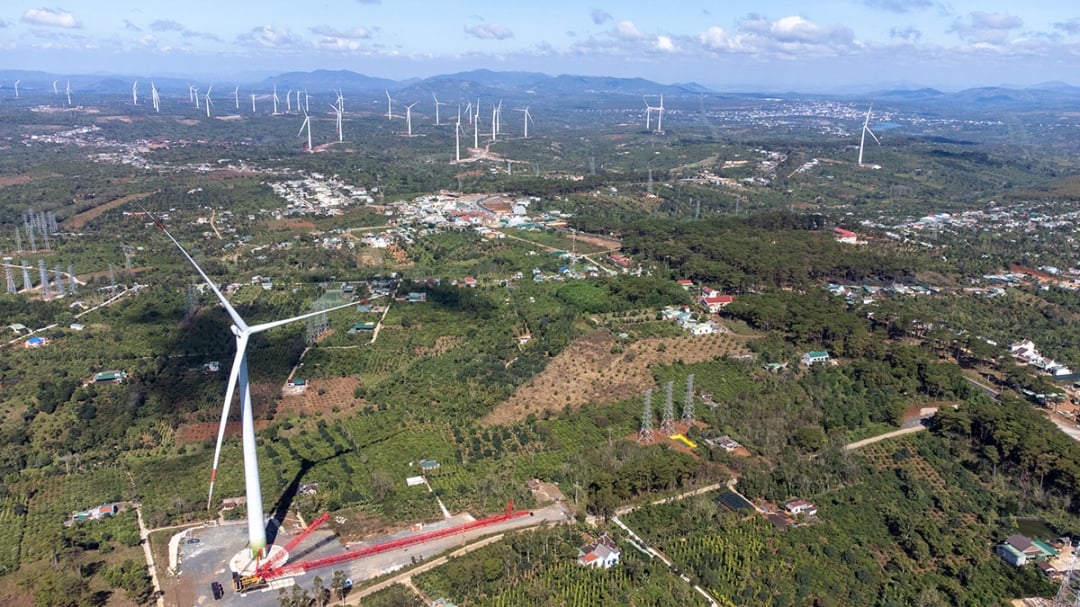 |
| Wind power project in Ea Nam commune, Ea H'leo district. Photo: Nguyen Gia |
Simexco DakLak, a subsidiary of 2-9 Dak Lak Import-Export Company Limited, is one of Vietnam's leading coffee exporters. However, in the first quarter of 2025, the company's coffee exports totaled just over 33,000 tons, a 44% decrease compared to the same period last year. Mr. Le Thanh Son, Business Director of Simexco DakLak, stated that in addition to difficulties caused by economic fluctuations, the US policy of imposing retaliatory tariffs on other countries is posing significant challenges for the business community. The US is a major consumer market for Vietnamese goods, primarily key products with high added value. Therefore, the tariff increase not only affects specific industries but also the entire economy.
Investment promotion and attraction activities, business operations, and project implementation in the province have not achieved the desired results, partly due to the slow progress in preparing and adjusting land use plans up to 2030 and land use plans for 2025 in districts, towns, and cities compared to the regulations and requirements of the Provincial People's Committee.
According to the 2024 Land Law, the annual land use plan at the district level is one of the bases for carrying out procedures related to land allocation, land leasing, land use conversion, and land reclamation for the implementation of socio-economic development, national defense, and security projects. The delay in approving the 2025 land use plan affects the resolution of land procedures for investment projects under the approval authority of the Provincial People's Committee as stipulated by investment law, and for public investment projects under the authority of the District People's Council and the Commune People's Council to approve investment policies.
According to Nguyen Minh Huan, Director of the Department of Agriculture and Environment, although the Provincial People's Committee had promptly issued guiding documents, the timing of the preparation and adjustment of the land use plan until 2030 and the land use plan for 2025 coincided with the transitional period between the 2013 Land Law and the 2024 Land Law; the effective date of the 2024 Land Law was brought forward by 4 months compared to the regulations, while the guiding documents for the implementation of the law were issued hastily and slowly, leading to confusion among localities in implementation. Furthermore, the units were not truly proactive, lacked decisiveness, and still had a wait-and-see attitude, waiting for the Provincial People's Committee to issue economic and technical norms, even though guiding documents had already been issued.
Source: https://baodaklak.vn/kinh-te/202504/truc-nhung-gam-mau-chua-sang-b6219c1/























































































Comment (0)