

Our nation's great resistance war against the US has crystallized into many powerful cultural symbols, as the poet Che Lan Vien said, "a thousand years from now, they will still have the power to light the way." One such symbol is the Truong Son mountain range.
It's easy to understand why the majestic Truong Son mountain range is so closely linked to war: "Cutting through the Truong Son mountains to save the country / With hearts overflowing with hope for the future" (To Huu). This could be attributed to the direct inspiration of soldiers who lived and fought in Truong Son. After 1975, most soldiers from the anti-American war era had memories of Truong Son. The inspiration from a bygone era of fighting the enemy, combined with the atmosphere of literary renewal and socio- economic achievements, has given authors new perspectives and fresh insights into the imagery.
In many poems about the resistance against the American war, the Trường Sơn mountain range, as a focal point for artistic expression, has flowed forth streams of meaning reflecting the times. Naturally, this focal point is also a fundamental image in poetry. Beyond the majestic Trường Sơn of physical space and the historical Trường Sơn of communal consciousness, there is another Trường Sơn in the individual's mind. Poets often borrow the image of Trường Sơn to anchor their feelings and emotions. It's the love between a man and a woman in longing: “He gets on the bus as the rain pours / The windshield wipers chase away the longing / She comes down the mountain as the sun shines brightly / A branch of a tree brushes away her private thoughts” (Trường Sơn Đông, Trường Sơn Tây - Phạm Tiến Duật). It's the yearning for giving: “Trường Sơn Đông / Trường Sơn Tây / One side scorched by the sun / The other surrounded by rain / She stretches out her arms / She spreads her hands / She cannot / Dispel the clouds / She cannot / Hide him...” (Threads of Memory, Threads of Affection - Thúy Bắc). It's a test of character: "The Trường Sơn mountains are sunny in the east and rainy in the west / Whoever hasn't been there doesn't truly know themselves" (A Thousand Miles of Mountains and Rivers - Tố Hữu)...
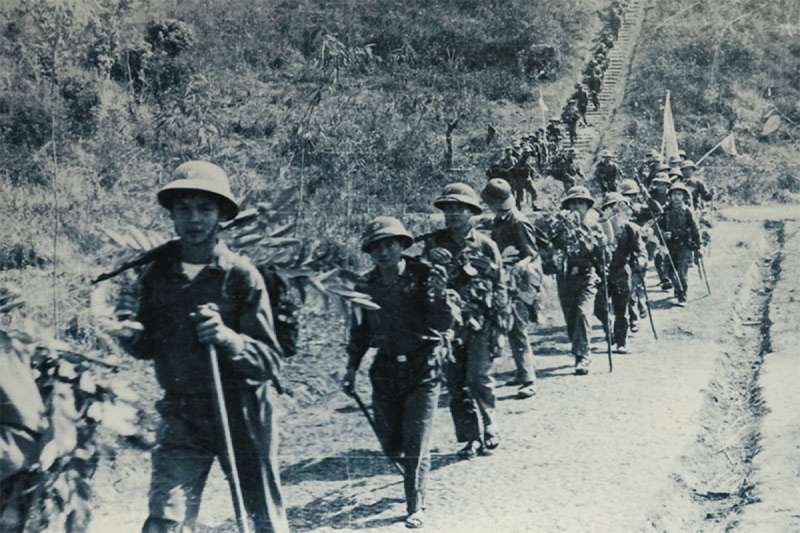
It's not just poetry, it's also music. Like birds, from the peaks of the Truong Son Mountains, many musical works spread their wings and soar high into the sky of freedom, singing of aspirations. These timeless songs were born as a matter of course. "Footsteps on the Truong Son mountain peaks" (music by Vu Trong Hoi, lyrics by Dang Thuc) powerfully expresses a belief: "We cross the high slopes of Truong Son / The rocks wear down, but our heels do not." Huy Du's "On the Truong Son peaks, we sing" soars optimistically to victory: "Oh Truong Son! /... Every day, every month / Is a song / The singing accompanies us / Overcoming hardship." The "Truong Son Song" (music by Tran Chung, lyrics by Gia Dung) radiates joy: "Tonight we go to the windy Truong Son / The sky is moonless and starless, but our hearts are ablaze / Let us go, spreading our eagle wings"... Using their strong, healthy bodies to lead tens of thousands, even millions, of outstanding sons and daughters from the North to the South to fight for independence, Truong Son produced a team of artists and writers, including: Pham Tien Duat, Le Luu, Le Minh Khue, Khuat Quang Thuy, Pham Hoa, Nguyen Thuy Kha... (prose, poetry); Huy Du, Huy Thuc, Vu Trong Hoi, Trong Loan, Tan Huyen, Hoang Hiep, Tran Chung, Nguyen Nhung... ( music )... Truong Son has become a symbol of willpower, resilience, and love, giving those who live and are connected to Truong Son even more opportunities to create great works.
In late 1974, poet Nguyen Dinh Thi went on a field trip to the battlefield and met young female volunteers waving to the troops marching to the front lines. Deeply moved, he wrote the poem "Red Leaves" in one go. After its publication, composer Hoang Hiep set it to music, making only minor changes to the lyrics. With the music giving wings to the poem, it soared into the hearts of readers and listeners, leaving behind a profound love for the country, homeland, camaraderie, and unwavering faith in victory. The rhythm of the poem mimics the marching steps of soldiers on their way to victory. Of the nine lines, eight are in the six-syllable meter, creating a rapid, strong, resonant, and lingering rhythm. The line "You stand by the roadside like homeland," serves as an "artistic highlight," with seven words structured in a comparative style, encapsulating the soul of the poem: "You" is the embodiment of homeland going to battle alongside it. This single line of poetry alone partly reveals that this was a war of the entire nation, a comprehensive war, combining the strength of the nation, of history, of the homeland and the country. It was a just war, destined for victory!
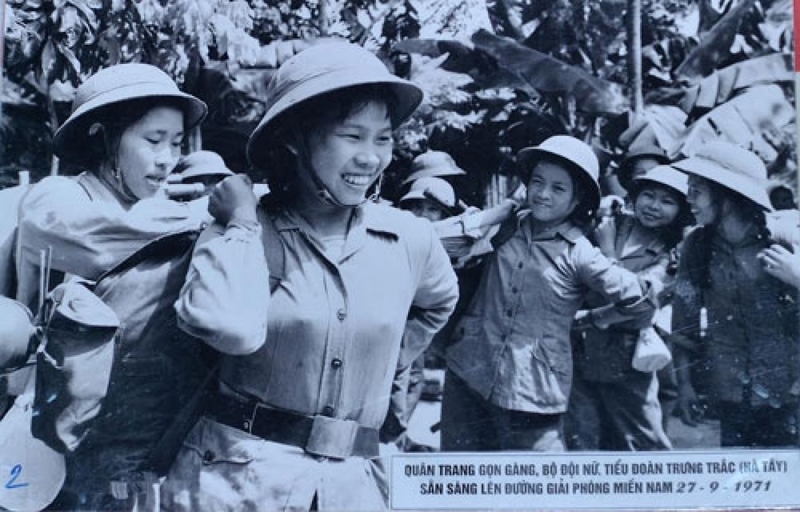
The poem creates a contrast between humanity and brutality, highlighting the image of the "frontline girl" rising above the vast, fiery battlefield. It's not just optimism; it also reflects the Vietnamese people's defiance against the bombs and bullets of the world's wealthiest and most ruthless enemy at that time. With the image of "She waves a smile, her eyes bright," the poet carves into the space a symbol of Vietnamese culture: Vietnamese faith, morality, and righteousness! This image not only illuminates the entire poem but also shines throughout the era, highlighting the truth: Vietnam will win!
When literary works reach a high level of refinement, they become the voice of their time and history. Reading such poems, readers sense a great victory is imminent!
Historical, national, and community inspiration, specifically the inspiration from the great wars of national defense against France and the United States, with their glorious victories and devastating losses, dominated the entire tone of epic poems after 1975. It is evident that historical place names were a focus for many authors, with the Trường Sơn mountain range appearing in almost all of their works. Many epic poems focused solely on this image, such as Nguyễn Anh Nông's Trường Sơn Epic, Nguyễn Hữu Quý's Vạn Lý Trường Sơn, and Nguyễn Minh Khang's Hành Quân Trường Sơn...
Epic poems about the Truong Son Mountains after 1975 are characterized by using the Truong Son Mountains of the past to analyze and explore the people of today. For example, in Thanh Thao's "Metro": "Mother, people are so small / Three months on Truong Son before we could enjoy a bowl of water spinach soup / Mother, / needs are usually simple / Now sometimes / I wonder what I crave / Happiness is sometimes / being able to crave many trivial things." Or, using this imagery as a point of reference to speak of a great sacrifice - another Truong Son: "There is another Truong Son / that you didn't know then / a fierce Truong Son / lonely nights / a Truong Son immersed in the memory of sweat that has faded / a melancholic Truong Son / stark white of youth" (Metro - Thanh Thao). This is the immense sacrifice of a woman, who may have dedicated the most beautiful years of her youth to Truong Son, and now, in her twilight years, she gazes back at Truong Son with a wistful longing, searching for a bygone era. It's also possible that the woman's lover or husband fell in battle on the Truong Son mountain range. She remained there, eventually turning to stone and becoming a "waiting wife." In legend, the waiting wife longs for her husband, comforted by her child. Many "waiting wives" today long for their husbands in lonely solitude...
The Trường Sơn mountain range is embodied in people. And people are embodied in the Trường Sơn range. Nguyễn Hữu Quý has moving verses about deaths that have become one with the nation, bringing glory to this land: “Ten thousand incense burners / Ten thousand burning stars / Ten thousand bells ringing in silence / Ten thousand hearts anchored at the source / Ten thousand Trường Sơn mountains within one Trường Sơn mountain / Ten thousand songs in a great song...” (The Red Bells). Just as there is a real Trường Sơn mountain range in the world, there is also an figurative Trường Sơn range in the epic poem.
Source: https://congthuong.vn/truong-son-mot-bieu-tuong-van-hoa-454408.html





















































































Comment (0)