

Autumn has arrived in Hanoi , and it's not difficult to spot groups of radiant tourists taking photos by the lake, on street corners... crowds of people and vehicles move busily along the capital's streets amidst flags, flowers, and banners commemorating the 78th anniversary of the August Revolution and Vietnam's National Day on September 2nd.
Time serves as a reminder for everyone to look back at history 78 years ago, when, under the leadership of the Party and President Ho Chi Minh , our nation accomplished a momentous revolution, giving birth to a new model of state on the S-shaped strip of land.
Fulfilling the oath of independence completely.
The August 1945 general uprising quickly succeeded throughout the country. President Ho Chi Minh, returning from Tan Trao to Hanoi, promptly drafted the Declaration of Independence, announcing to the Vietnamese people and the whole world the birth of a nation with a republican form of government, a new type of democratic state in Southeast Asia.
And from the moment he returned to Hanoi from Tan Trao, the world map had to be revised, revealing the first democratic republican state in Southeast Asia on the Indochina peninsula.
On September 2, 1945, President Ho Chi Minh read the Declaration of Independence in Ba Dinh Square, a moment when millions of people united as one. Everyone watched intently as the nation's leader, tall and thin, still pale after recovering from a serious illness at the revolutionary base in the liberated zone, shone with bright eyes and a deep, clear voice.
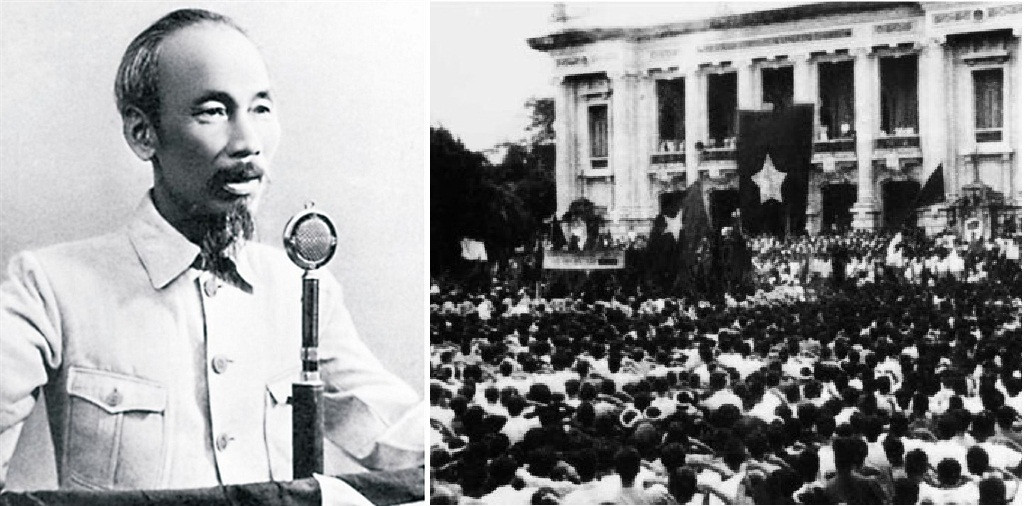
On September 2, 1945, at Ba Dinh Square in Hanoi, President Ho Chi Minh read the Declaration of Independence, giving birth to the Democratic Republic of Vietnam (now the Socialist Republic of Vietnam). Photo: Archival material
The revolutionary winds swept in like a storm, reviving the entire nation, bringing new life and vitality to countless people who had recently been enslaved; the whole country was reborn from that autumn.
The oaths of millions of people, along with the Party, the Provisional Government, and President Ho Chi Minh, to resolutely uphold national independence echoed throughout the vast Ba Dinh Square. The will to be masters of their own destiny, the spirit of mastering the country, surged with enthusiasm in the hearts of every Vietnamese citizen.
In his memoir "Unforgettable Years," General Vo Nguyen Giap quotes: "One morning, Uncle Ho and Anh Nhan called us all together. The historic Declaration of Independence had been drafted, and Uncle Ho brought it to read aloud for collective approval. As Uncle Ho later recounted, those were the most exhilarating moments of his life."
The work "Ho Chi Minh's Thousand-Mile Journey" states: "After reading the draft Declaration to many people and asking for their opinions, President Ho Chi Minh could not hide his emotion, saying that in his life, he had written many things, but only now had he been able to write such a Declaration." And Uncle Ho's article under the pseudonym CB, "Celebrating National Day 2/9/1955" (a rally commemorating the 10th anniversary of the founding of the nation), shows that "seeing Uncle Ho happy and rosy-cheeked, the leaders healthy, the people cheered even louder," revealing his hidden feelings and joy about this sacred event of nation-building.
In 1945, our country faced an extremely difficult situation with internal enemies and external aggressors (Japanese, French, Kuomintang, and British troops) plotting to sabotage the achievements of our revolution.
The famine of 1943-1944, caused by the exploitative policies of the French colonialists and Japanese fascists, resulted in the deaths of 2 million people. Illiteracy was prevalent among the majority of the population, public order and security were highly unstable, and floods caused by dike breaches on the Red River in the northern provinces submerged the rice granaries of six delta provinces…
Faced with such a difficult reality, President Ho Chi Minh and the Indochinese Communist Party, with all their courage and talent, steered the ship of revolution through the turbulent and challenging waves.
Against the backdrop of a wide-open power vacuum in the Indochinese peninsula and a chaotic state of Vietnam (major powers were rearranging the post-World War II order, and the domestic security situation was extremely turbulent), a replacement force was absolutely necessary to fill that political void.
The Vietnamese communists, led by President Ho Chi Minh, with their correct struggle strategy, legitimacy, and spirit of unity (the Viet Minh Front), were chosen by history.
That self-evident truth remains true to this day, as General Secretary Nguyen Phu Trong stated: "In Vietnam, there is no other political force besides the Communist Party of Vietnam that possesses the courage, wisdom, experience, prestige, and ability to lead the country through all difficulties and arduous challenges to bring the nation to the shores of glory."
After the establishment of the Democratic Republic of Vietnam, under the skillful leadership of President Ho Chi Minh and the Indochinese Communist Party, later renamed the Communist Party of Vietnam (which at one point disbanded and went underground), our people achieved miraculous victories, defeating French and American imperialism, fulfilling the oath of independence for the Fatherland as President Ho Chi Minh had stated in the Declaration of Independence, and completing the political responsibility and historical demands of the 20th century.
The mission was incredibly glorious but also extremely arduous.
Following the Great Victory of Spring 1975, faced with new difficulties and challenges arising from real-life situations, and alongside the process of political development, the Vietnamese Party and State spent ten years struggling to find a path to reform.
The success of the Doi Moi (Renovation) process, initiated by our Party at the 6th National Congress in 1986, demonstrates the correctness and wisdom of the Party, as well as its courage to confront and speak the truth.

Following in the footsteps of those extremely proud revolutionary achievements, the task facing future generations is both glorious and extremely challenging.
The concerted efforts of the State apparatus, the National Assembly, and the Government in developing the socio-economic system under a centralized, bureaucratic, and subsidized planned economy immediately led to a transformation and change to a socialist-oriented market economy. This broke the international blockade and embargo and enabled the country to overcome the economic crisis.
Today, based on the idea of the rule of law state as stated by President Ho Chi Minh in "Vietnam's Request Song" (1922) "Seven requests for the promulgation of the Constitution/ One hundred articles must have the divine power of law" as well as the spirit and content of our country's first Constitution in 1946, Vietnam is striving to build a socialist rule of law state.
This includes more clearly defining the functions, tasks, organization, and operation of the state apparatus; and initially restructuring it towards a more streamlined, effective, and efficient operation, coupled with a reduction in staffing levels.
The role of law in the organization and operation of the State is increasingly emphasized. The mechanisms for the division, coordination, and control of power among State agencies in the exercise of legislative, executive, and judicial powers are becoming clearer and showing positive changes.
General Secretary Nguyen Phu Trong has repeatedly affirmed, "With all humility, we can proudly say that never before has our country had such a foundation, potential, position, and international prestige as it does today."
Following in the footsteps of those extremely proud revolutionary achievements, the task of future generations is incredibly glorious but also extremely challenging. That is, to work together with the Party and the State to successfully realize the aspiration of building a prosperous and happy country, as President Ho Chi Minh always wished.
The documents of the 13th National Congress of our Party set out specific goals with three important milestones.
By 2025, marking the 50th anniversary of the complete liberation of Southern Vietnam, Vietnam aims to be a developing country with a modern industrial sector, surpassing the lower-middle income level.
By 2030, the 100th anniversary of the Party's founding, Vietnam aims to be a developing country with a modern industrial sector and a high-middle income.
By 2045, marking the 100th anniversary of the founding of the Democratic Republic of Vietnam, now the Socialist Republic of Vietnam, Vietnam will have become a developed, high-income country.
We hope that on the occasion of the 100th anniversary of the founding of the nation on September 2nd, 2045, the 21st-century generation of Vietnamese people can proudly and confidently report to Him the brilliant achievements of our beloved Vietnam.
Source: vietnamnet
Source



![[Photo] General Secretary and President To Lam meets with National Assembly delegates from ethnic minorities.](https://vphoto.vietnam.vn/thumb/1200x675/vietnam/resource/IMAGE/2026/04/20/1776696701056_a1-bnd-8331-3342-jpg.webp)
![[Image] National Assembly discusses the implementation of the socio-economic development plan.](https://vphoto.vietnam.vn/thumb/1200x675/vietnam/resource/IMAGE/2026/04/20/1776696707422_ndo_br_img-20260420-185419-jpg.webp)





















































Comment (0)