

Pages of glorious history
On March 12, 1945, the Central Committee of the Party issued the Directive "The Japanese and French are fighting each other, and our actions." This was a powerful call to action for the people, along with the slogan guiding decisive action: "Break open the granaries to solve the famine" for the people, igniting the flames of struggle and uprising among the people. Tan An province (later Long An, now Tay Ninh ) was chosen by the Regional Party Committee as the focal point, so preparations were made meticulously. On the afternoon of August 21, 1945, the uprising broke out and quickly achieved victory.

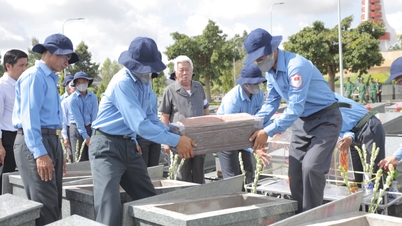
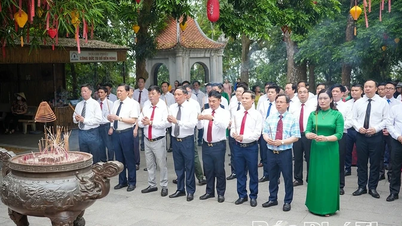
Central and Tay Ninh provincial leaders offered incense to commemorate the heroes and martyrs at the Central Committee Base of the Southern Region.
Under the guiding light of the Party, the army and people of Tay Ninh province (formerly), on August 25, 1945, rose up to regain independence and freedom, contributing to the success of the August Revolution. Following the success of the August Revolution, on September 2, 1945, at Ba Dinh Square ( Hanoi ), President Ho Chi Minh, on behalf of the Provisional Government, solemnly read the Declaration of Independence, giving birth to the Democratic Republic of Vietnam. This served as a source of encouragement and inspiration for our army and people to continue the struggle, for the reunification of North and South Vietnam, and for peace to be restored throughout the country.
In Tay Ninh, during the resistance war against the US, the Central Committee of the Southern Region, located in the North Tay Ninh war zone, became the "resistance capital" of the entire South. The Central Committee of the Southern Region was not only the residence and workplace of high-ranking leaders but also a symbol of unwavering will and creativity in the harsh conditions of war.
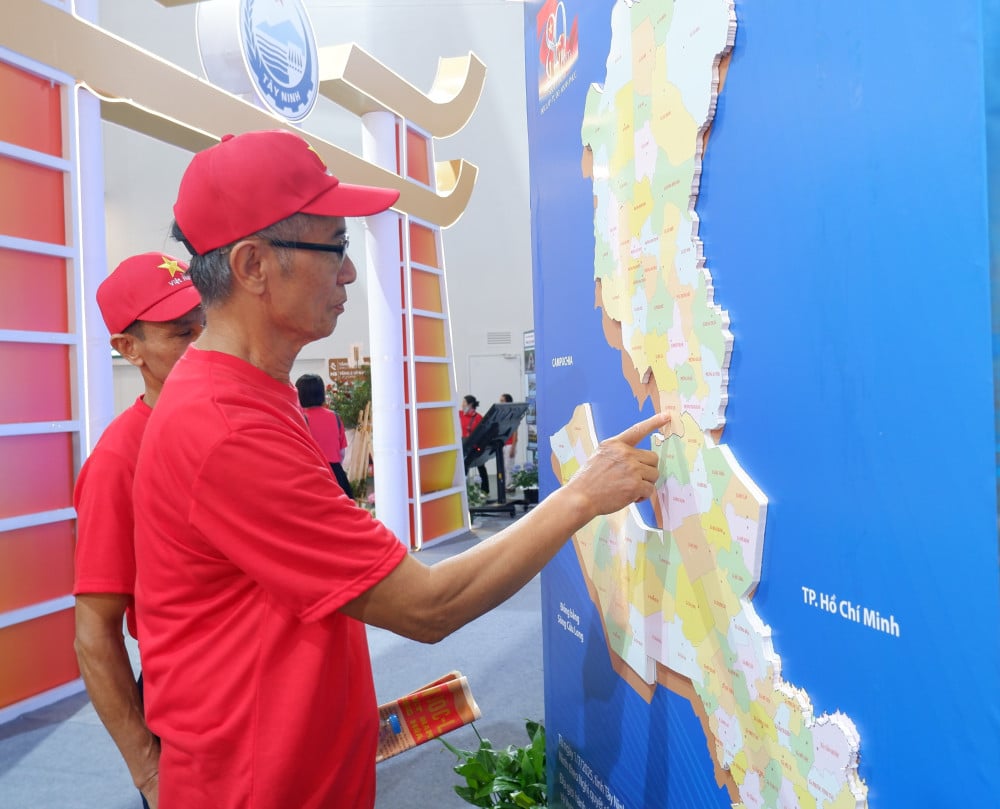
Veterans who lived and fought in Tay Ninh revisited their "old battlefield" through an exhibition celebrating 80 years of national achievements.
Meeting us in Hanoi, veteran Dam Tien Chiem (residing in Ba Dinh ward, Hanoi) - a soldier of the Special Forces Company - recalled the fierce battles in Tay Ninh. “We fought while digging tunnels and building shelters. Some nights, the jungle rain poured down, our rice mixed with potatoes was soaked, but we still encouraged each other: as long as Tay Ninh existed, the base would remain, and the revolution would continue because Tay Ninh at that time was the ‘heart’ of the resistance, carrying the belief in victory,” Mr. Chiem recounted.
Not only was Tay Ninh a "revolutionary base," it also embodied the strength of the people's will. The people of Tay Ninh, from the plains along the Vam Co River to the remote border regions, wholeheartedly sheltered cadres and protected soldiers. This people-centered solidarity created a solid "shield of the people's hearts," enabling the revolution in the South to survive and thrive even in the heart of the enemy. "During the days when the Americans bombed the Central Committee Base in the South, we were surrounded and protected by the people. The army and the people shared every bowl of rice, every piece of bread, every drop of water to live and fight together to regain independence and freedom for the nation. It was so warm and full of affection!" - Mr. Chiem said emotionally.
Simultaneously healing the wounds of war and defending the southwestern border.
After the Liberation of South Vietnam and the reunification of the country (April 30, 1975), while the entire nation was striving to heal the wounds of war and restore the economy , the Pol Pot - Ieng Sary clique (Cambodia) simultaneously attacked several areas in Ben Cau and Tan Bien districts on the southwestern border, spreading to almost all 18 communes in 4 border districts of Tay Ninh province. They burned, looted, and massacred people, causing serious damage to lives and property. Under the leadership of the Party Committee, the army and people of Tay Ninh province simultaneously healed the wounds of war and fought to protect the southwestern border of the Fatherland.
Ms. Sau, a small trader at Tan Lap market, said that every Mid-Autumn Festival, many families in the commune hold memorial services for those killed by Pol Pot and Ieng Sary's forces, calling it the "memorial festival." On the night of September 24th and the early morning of September 25th, 1977, 11 young teachers from Tan Thanh Primary School (Xa Mat, Tan Lap), all in their early twenties, were brutally murdered. Three male and five female teachers were killed and thrown into a well. The remaining two were found lying on the floor.
A memorial plaque commemorating the crimes of Pol Pot's army, located next to National Highway 22B (Tay Ninh province), clearly states: "At 0:15 AM on September 25, 1977, Pol Pot - Ieng Sary's army invaded the Vietnamese border in Tan Lap commune, Tan Bien district, Tay Ninh province. 592 people lost their lives."

Tay Ninh has become an attractive tourist destination.
Immediately after helping Cambodia escape the Pol Pot-Ieng Sary genocide, under the direction of the Central Committee, the Party Committee, army and people of Tay Ninh continued to provide manpower and resources to help Kampong Cham province (Cambodia) for 10 years (1979-1989).
Regarding the task of restoring the local economy, from 1975 to 1985, the military and people of Tay Ninh focused on the main task of reforming, building, and developing the economy according to the resolutions of the 4th and 5th Party Congresses, primarily taking food production as the top priority.
From relying on central government support, Tay Ninh has strived to become not only self-sufficient in food but also to fulfill its obligations to the central government, gradually overcoming difficulties and guiding the economy onto a socialist path, creating large-scale specialized farming areas: sugarcane, peanuts, rubber, and rice. The Party, government, and mass organization systems have been strengthened and consolidated, democracy has been expanded, and politics have been stable, creating the foundation for new development.
From a starting point where agriculture accounted for almost 90% of the economy, industry only 2%, and trade and services about 9%, Tay Ninh has now risen to assert its position as a growth engine, a new tourism center, and a bright spot of integration at the southern gateway of the country.
Mr. Pham Van Trai (residing in Tan Dong 2 hamlet, Tan Lap commune) happily stated: “From a land that suffered greatly after the wars, today, with the construction of new rural areas, people are enjoying a prosperous and happy life. Roads have been concreted and asphalted, making travel convenient. The health station has been invested in, meeting the basic healthcare needs of the people.”
Eighty years into that historic autumn, the land and people of Tay Ninh, having endured immense suffering and loss during wartime, are now "reviving," steadily progressing on the path of development in peacetime, and joining the rest of the country in entering an era of strength, prosperity, and flourishing.
Vu Nguyet
Source: https://baolongan.vn/tu-mua-thu-doc-lap-den-khat-vong-hung-cuong-a203206.html














![[BMHP Episode 32]: Dung sets a trap to shake off the detective, Minh secretly sacrifices himself but is still misunderstood by his wife.](https://vphoto.vietnam.vn/thumb/402x226/vietnam/resource/IMAGE/2026/04/18/1776490183743_bvl_2_20260418111705.jpeg)































































Comment (0)