

Nearly half a century ago, while studying journalism, I first encountered a very new concept: syllogism. This is a fundamental concept in logic. It's a form of deductive reasoning, consisting of two premises (a major premise and a minor premise) and a conclusion, where the conclusion is derived from the two premises. I still remember the example my professor gave: "The unknown causes fear. The future is unknown. Therefore, the future causes fear."
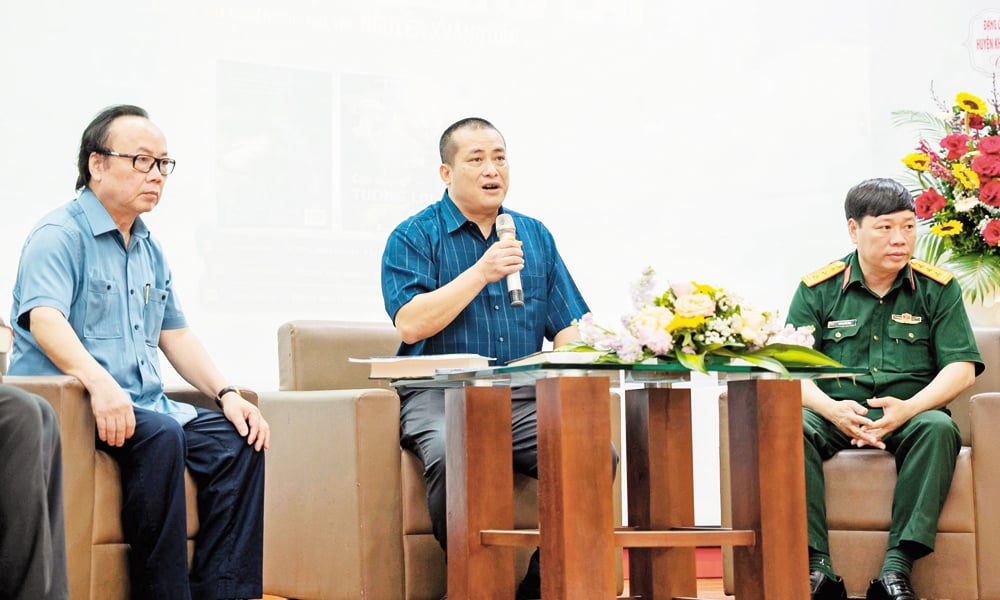 |
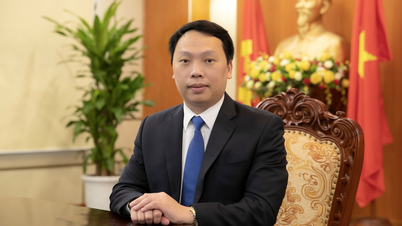
Author Nguyen Xuan Tuan at the launch of his book "The Path to the Future". |
The major and minor premises are easy to accept, but the conclusion that "the future causes panic" seems somewhat far-fetched. And so, endless debates continued throughout the course, and naturally, they followed us throughout our decades of journalism. The future cannot cause panic if, instead of merely predicting, people actively create it; that is true historical materialism. That's when we remembered the words of US President Abraham Lincoln (1809-1865): "The best way to predict the future is to create it."
It was very interesting that one summer day in 2025 we had the opportunity to read a large book, "The Path to the Future," by a research group, authored by researcher and writer Nguyen Xuan Tuan. This work, as its title suggests, does not merely predict and shape the future based on a few arguments, but is a comprehensive system of viewpoints discussing the future of the Vietnamese nation.
| I recall the story of the great intellectuals who modernized the country at the end of the 19th century; they all shared a common concern for the nation's destiny and sought every means to revitalize the country. Today, we "modernize the country" through innovative thinking and integration, driven by the aspiration for independence and sustainable development. As the work suggests: Absorbing the best of humanity while preserving our identity is crucial. The golden key we must grasp is knowledge and talent, for the country to develop prosperously and happily. |
The research work of Nguyen Xuan Tuan and the team of authors from the Study Society and Reading Project is a treasure trove of rich documentation containing valuable human knowledge. This knowledge encompasses all fields: politics , economics, culture, history, diplomacy, etc.; integrating knowledge from East and West, ancient and modern, to the present. It is both a solid foundation of knowledge and up-to-date information, based on the research conducted by the authors across dozens of countries on all continents. Theory and practice, past and present, what has happened and is happening, and predictions of opportunities and challenges for our country on the threshold of a new era of progress, beginning with the 14th National Congress of the Party to be held in early 2026.
According to the research compiled, summarized, and predicted by the authors, it can be said that we can basically know what the future will look like through scientific forecasting and by participating in practical reforms and shaping the future. This is clearly discussed in the chapters and sections of the book: "What will the future of humanity look like in 500 to 5,000 years?"; "Models for sustainable economic development and economic risk management in the new era"; "The 'universal' key to unlocking God-given treasures"...
When publishing the research work "The Path to the Future," with nearly 1,000 pages, based on our monitoring and comprehensive analysis, although it did not predict a specific date for the completion of any major undertaking or event, the authors' predictions and proposals preceded even the strategic policies of our Party and State. These included the policy of establishing a two-tiered local government system and the National Governance Strategy in the New Era, in which the authors aspired to compile a comprehensive electronic encyclopedia. For successful national governance, "society is not only a subject in governance, but also a source of essential resources for development." This involved ensuring harmonious social development, maintaining internal stability and preventing financial, cultural, and social risks.
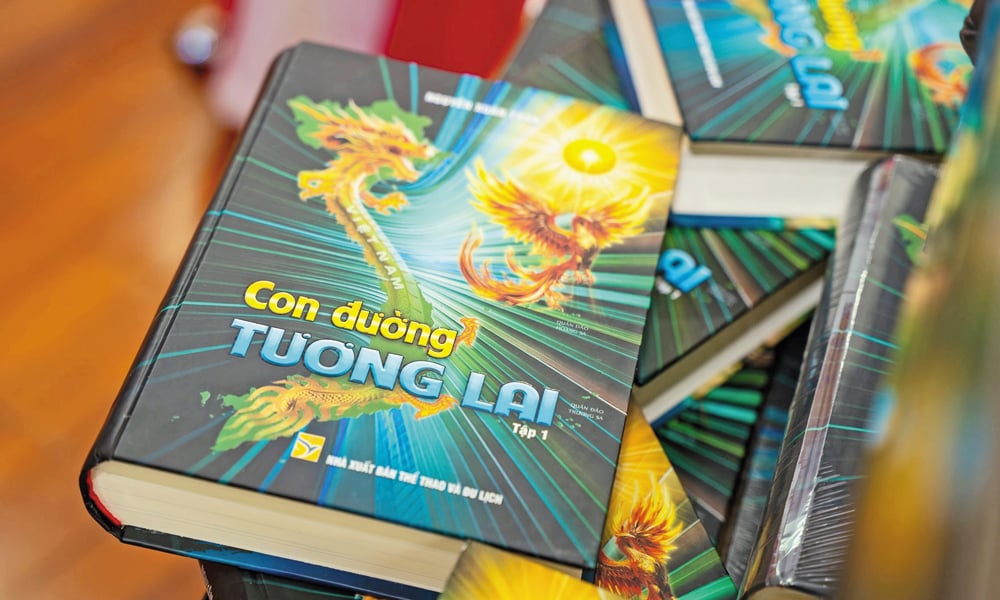 |
The work "The Path to the Future" by Nguyen Xuan Tuan and a group of authors. |
I am particularly interested in the "complete clearance" solution when implementing projects, which requires reclaiming road strips with houses along them at "bargain prices," thus creating injustice. There are many ways to do this, such as completely clearing parallel roads while keeping the old ones; auctioning off land plots to create new strips on either side of the road, avoiding creating lucrative frontages for homeowners on the inside while those on the outside suffer losses. This is about how to awaken the intellect and national spirit in the new era, from the "Dien Hong Conference" to the "National Sustainable Council." This is a huge issue, building a socialist society with Vietnamese characteristics, unlike China, unlike the Western democratic model... So what kind of political system should this unique model have to overcome all bottlenecks? The authors asserted that there can be no binary answer here, only a relative answer, an answer that depends on the specific circumstances and the specific stage. This is how the researchers explain it: “On a major road, there are always many smaller roads. Every road must have a solid foundation, be continuously reinforced and improved... The major road is built on the foundation laid by the Party and the State; the smaller roads are built by the people, including intellectuals, entrepreneurs, workers, and various economic, social, and cultural sectors who contribute to its construction” (page 967).
***
Reading "The Path to the Future," as many readers have noted, is a monumental work, encompassing a vast amount of knowledge, with much new information from the past to the present and predictions for the future. Reading the text and the writing, reading to discover bright spots and new perspectives, helping us to define ourselves, reflect, and change our views – that is the true fascination and beauty of reading. This book, heavy in both literal and figurative senses, captivates us, leaving us feeling energized, like climbing a skyscraper with occasional "resting areas." These resting areas are fascinating stories ranging from culture, religion, and spirituality to tales from behind the bamboo hedges, street life, and the humble beginnings of the author's group of friends (Tuan, Bac, and Nam) with all their ups and downs. These resting areas are the narrative style, the storytelling, and the characters' "expressions of opinion" through everyday details.
The old saying goes, "A wise person knows how to ask, a knowledgeable person knows how to answer." Here, readers are drawn into the story through such questions and answers, small thoughts with big ideas, a major issue beginning with the confessions of motorbike taxi drivers with university degrees. Nguyen Xuan Tuan poses a question that is quite startling: Should universities be renamed vocational schools, for example, journalism training instead of the University of Journalism, information technology training instead of the Polytechnic University, similarly for teacher training and medical training? The fact that 12% of motorbike taxi drivers currently have university degrees, some even with master's degrees, and 26% have college degrees or higher, needs further investigation. Of course, every profession in society is valuable; "no one is boring in this world," don't judge a fish by a cat's ability to climb a tree. However, it's clear that we need to seriously consider changing our educational philosophy. This is a process of adjusting our perspective and ideas regarding educational goals, methods, and content to meet the new demands of society and human development. This change could include shifting from traditional to modern education, focusing on developing personal competencies, soft skills, and critical thinking, rather than simply transmitting knowledge. Without this, we will forever lag behind the world.
A monumental research project, a book that serves as the prelude to the next installment, "The Path to the Future - A New Era," is being actively prepared and could certainly be written in an academic style. However, Nguyen Xuan Tuan and his colleagues chose a more "intimate" approach, allowing everyone, from high-ranking officials to village schoolteachers and locksmiths, to visit this place, because everyone has something to read. New content naturally finds its way to a new form. And fortunately, this new form suits the temperament of writer Nguyen Xuan Tuan perfectly. It's not just a resting place in a building; visitors have the opportunity to board a luxurious ship, crossing the ocean to new horizons, carrying with them an unwavering belief: The future belongs to us!
"The Path to the Future" is a very valuable research work as we stand on the threshold of a new era. It can be considered a very precious book, especially for managers, strategists, and public officials. I recall the stories of the great intellectuals who modernized the country in the late 19th century, notably Pham Phu Thu, Dang Huy Tru, Nguyen Truong To... They all shared a common concern for the fate of the nation, seeking every way to revitalize the country. Although their approaches differed, they all aimed for a more independent, strong, and civilized Vietnam.
Today, we are "renewing the country" through innovative thinking and integration, driven by the aspiration for independence and sustainable development. As the work suggests: Absorbing the best of humanity while preserving national identity is crucial. The golden key we must grasp is knowledge and talent, for the country to develop prosperously and happily.
Source: https://baobacninhtv.vn/tuong-lai-thuoc-ve-chung-ta-postid424622.bbg

































































Comment (0)