

Appointment reminders with precise timekeeping, down to the minute.
Having been managed for diabetes for the past 8 years at Duc Giang General Hospital, Mr. Nguyen Tru (65 years old, Long Bien, Hanoi ) said: "My underlying condition requires regular check-ups."
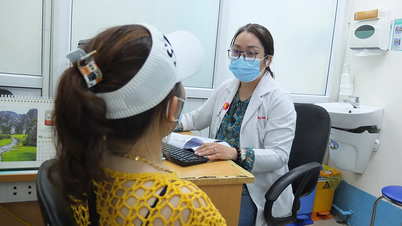
"I arrived on time, inserted my chip-embedded ID card and health insurance card into the registration machine, and in less than 30 seconds I was ready for my examination. After the blood test, the results were sent to my phone via text message, and the doctor called me in to read the results and prescribe medication."
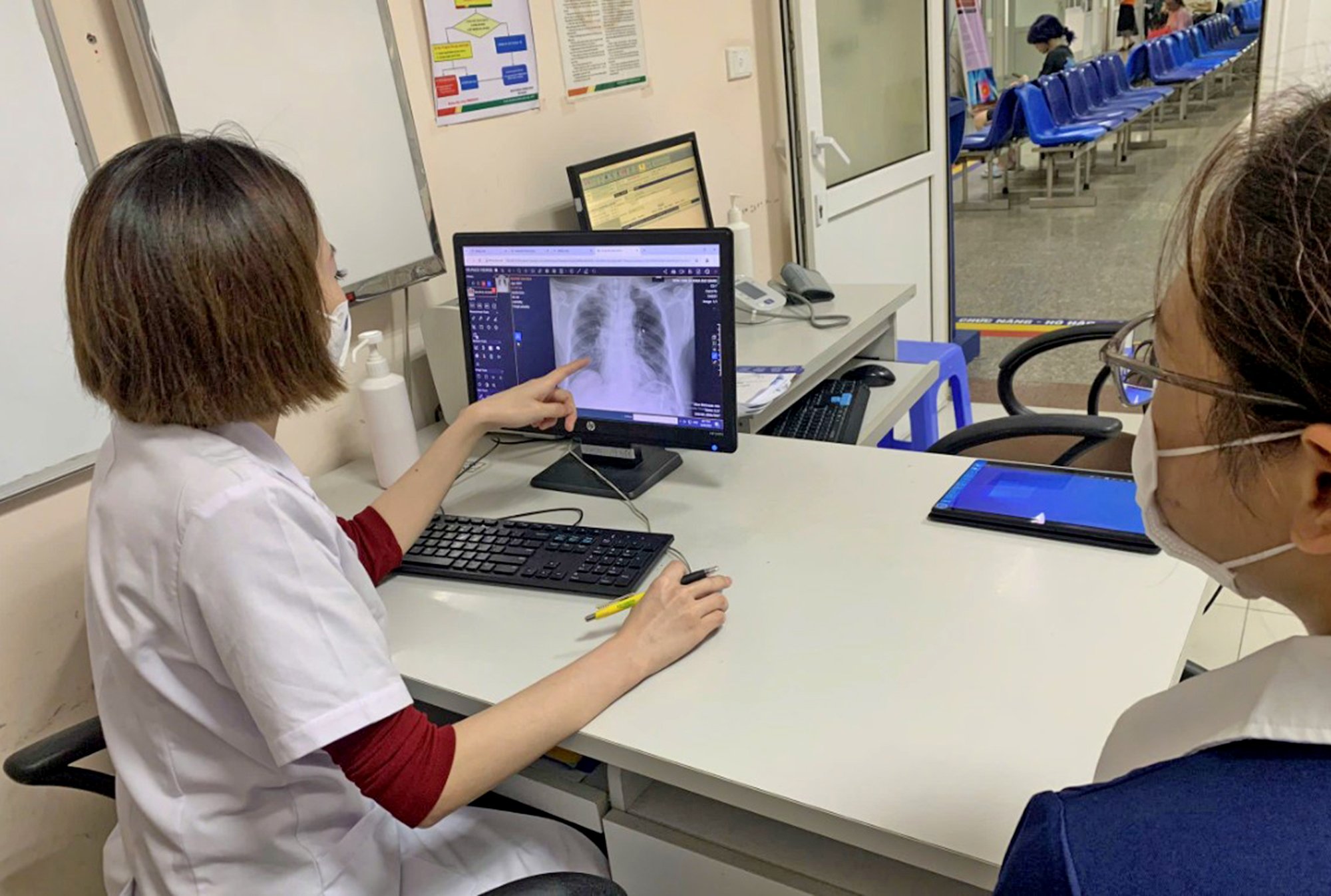
The doctor reads the X-ray results on the computer for the patient.
When he left, Mr. Tru only had the prescription in his hand, not the numerous patient files he used to carry.
According to Dr. Nguyen Van Thuong, Director of Duc Giang General Hospital, in recent years, the application of digital transformation has created a breakthrough in management and simultaneously improved the quality of medical examination and treatment at the hospital.
Since 2020, the hospital has been using a PACS (Picture Archiving and Communication System) for X-ray imaging. Once an X-ray is taken and the results are available, the system transmits them to clinics and treatment departments, facilitating early diagnosis and intervention.
PACS also helps improve the quality of medical examinations and treatment, as it provides clearer images, allows for clearer visualization of lesions, more accurate measurement of lesion size, and determination of lesion density.
The results are stored on the system with better image quality, so even after several years, the hospital can still use them for consultations.
The hospital also has a ward-visit app for doctors and nurses to monitor inpatients. In addition, online appointment scheduling helps reduce workload and manage patient flow, and cashless payment options have been implemented at the hospital for many years.
Currently, 40% of the hospital's daily patients receive appointments and appointment reminders that are accurate to the minute.
At Bach Mai Hospital, although it is a newly implemented system, according to Associate Professor Dr. Vu Van Giap, Deputy Director of the hospital, in 2024, the hospital will strive with many effective projects, especially in digital transformation and the application of artificial intelligence (AI) in examination and treatment.
According to Mr. Giap, currently, ward doctors only need a tablet containing all the data, from examination and imaging results to patient medical records and medications used.
In particular, the application of digital signatures throughout the system has contributed to convenience in patient record keeping, freeing up time spent on administrative procedures during medical examinations and treatments.
AI applications for early cancer detection.
Mr. Giap further shared that, in addition to implementing digital transformation in all business processes, the application of AI in examination and treatment has proven effective, as many pathological signs cannot be detected through conventional examination procedures.
Mr. Giap cited an example: recently, a 49-year-old male patient came to Bach Mai Hospital for a comprehensive check-up on underlying conditions of hypertension and myocardial infarction, and had three stents implanted.
The patient showed no symptoms, and X-rays only revealed a cloudy area in the lungs. Even with additional paraclinical tests such as bronchoscopy and throat endoscopy, nothing noteworthy was found.
However, when the patient's parameters were entered into the software and analyzed by AI, it was determined that the patient had a lesion in the right lung lobe and was at risk of malignant cancer.
The chest CT scan results confirmed that the patient showed early signs of lung cancer.
Thanks to early detection, this patient underwent surgery to remove the entire lung tumor, followed by histopathology, and skipped the lung biopsy (an invasive biopsy that can cause bleeding and pneumothorax).
According to Associate Professor Dr. Dao Viet Hang, from the Endoscopy Center, Hanoi Medical University Hospital, and Head of the Global Network of Young Vietnamese Intellectuals, artificial intelligence is increasingly being applied in healthcare, making disease screening easier.
In addition to X-ray images, many hospitals now have software integrated with artificial intelligence algorithms to help detect and diagnose liver cancer using CT scans or MRI (similar to the staging of colorectal cancer). In the fields of endoscopy and pathology, there are also many products that help improve diagnosis and minimize errors in lesions.
Currently, there are several applications available for patients with diabetes, hypertension, hepatitis B, etc.
Or in the field of gastroenterology, AI has helped remind patients to take their medication, provide questionnaires to stratify patient risk, and identify warning signs when patients are at risk of complications.
This creates a channel for patients to reach medical facilities or doctors sooner.
Source: https://www.baogiaothong.vn/ung-dung-ai-phat-hien-som-ung-thu-192241217142354958.htm

![[Photo] General Secretary and President To Lam meets with National Assembly delegates from ethnic minorities.](https://vphoto.vietnam.vn/thumb/1200x675/vietnam/resource/IMAGE/2026/04/20/1776696701056_a1-bnd-8331-3342-jpg.webp)

![[Image] National Assembly discusses the implementation of the socio-economic development plan.](https://vphoto.vietnam.vn/thumb/1200x675/vietnam/resource/IMAGE/2026/04/20/1776696707422_ndo_br_img-20260420-185419-jpg.webp)




























































































Comment (0)