

Fraud or assistance?
In the US, AI technology is increasingly infiltrating schools, but a paradox is gradually emerging. Speaking to the New York Times, Jennifer Carolan, a former history teacher and founder of Reach Capital, an investment fund specializing in AI learning tools, noted that "AI technology is already being used by a large proportion of teachers and students." However, some teachers worry that tech companies are focusing their efforts on developing applications like chatbot tutoring, disrupting human relationships—the core of education —instead of creating tools to reduce administrative burdens.
Meanwhile, many middle school students in this country are already quite familiar with using AI in their studies. In fact, on some social media platforms, students have been sharing "tricks" for solving difficult problems, such as "taking a picture of the math problem and putting it into one of the free AI apps, and the result is instantly there with the answer and step-by-step solution." Many educators in this country have criticized students using math apps like PhotoMath or Google Lens (both Google products) as a form of cheating. However, they cannot deny that AI is very useful in their work, such as analyzing student learning data and behavior to form support groups, saving time on repetitive tasks, and even "outsourcing" important tasks like grading essays or supporting struggling students.
Not only in the US, but many other countries around the world are also increasingly applying AI to education. Numerous examples show that dry subjects like history can become engaging journeys of discovery if AI is used correctly. In the UK, the Natural History Museum in London uses AI to analyze millions of ancient artifacts and recreate the behavior of ancient organisms through vivid 3D images, supporting students in experiencing history visually instead of just reading textbooks. In South Korea and Japan, teachers are using AI to create interactive lessons where students are "placed in the context" of a historical event – such as the San Francisco Conference or the Meiji Revolution – and must make decisions as if they were characters in that era. This role-playing method helps history move beyond a series of events to be memorized, becoming an environment where students can practice critical thinking, understand the socio- political context, and gain a better understanding of ethical choices in the past.
Back in the US, many high schools have adopted platforms like Chronicle AI – a tool that allows students to “converse” with historical figures like Abraham Lincoln or Martin Luther King Jr., using AI to simulate their language and personalities, thereby enhancing memory and critical thinking. Similarly, in Providence, Rhode Island, a middle school history teacher trained ChatGPT using dozens of pages of self-written textbooks to shorten text, create sample assignments, and produce flawed essays to teach students how to analyze. He also openly shared his use of AI with his students – a way to educate them about digital ethics.
The billion-dollar business in education
Leveraging the potential of AI to address challenges for both learners and the education system, many technology companies in the US have rapidly developed related tools. For example, MagicSchool and Brisk Teaching provide automated feedback tools for writing assignments, assisting teachers in grading student essays.
AI technology is even being used in the grading of important exams. For example, the state of Texas (USA) signed a $391 million contract with Cambium Assessment for automated grading. While this isn't AI that generates new content, it's still an AI tool trained on thousands of graded papers. These tools still have a margin of error and must be supervised by humans. However, the Texas Department of Education Director believes the margin of error is still smaller than the probability of error caused by human grading; in some cases, AI can provide higher accuracy.
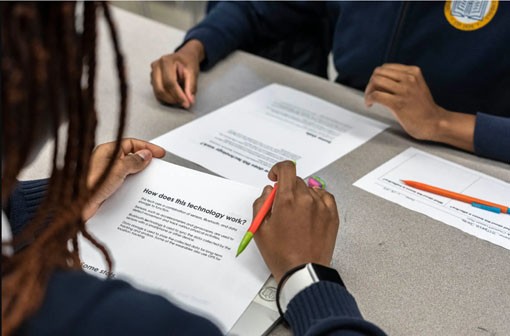 |
All technological tools used in the classroom must be rigorously evaluated. |
Over the past two years, companies combining AI and education have raised $1.5 billion in funding. Large corporations like Google, Microsoft, and Khan Academy are also actively promoting the integration of AI into research, tutoring, and educational content design. However, this wave of applications also comes with challenges. Some localities have experienced failures when collaborating with fledgling startups in developing educational chatbots, subsequently suffering financial and reputational consequences due to poor-quality products or serious violations, and facing legal repercussions from fraud allegations.
All technological tools in the classroom must be rigorously evaluated.
Technology in general, and AI in particular, in education today is becoming a "thorny issue" in many countries around the world , not only because of its complexity in operation, but also because of its multifaceted nature, constant change, and difficulty in defining clear boundaries. Therefore, solutions to this problem need to be comprehensive, flexible, and appropriate for each educational level and locality. A tool that is effective for urban students may not necessarily be suitable for rural students, and vice versa.
Many experts and educators agree that technology, while useful, is developing too rapidly for schools to adapt to and control. Many tools are introduced into the classroom not because of actual needs, but because they are offered for free or cheaply by technology companies. This order needs to be reversed: schools need to start from real needs, clearly identify what truly serves students well, and then choose the appropriate tools. Much of the existing technology is not specifically developed for education, but rather commercial products that have been adapted. Therefore, its actual effectiveness, if any, is often unproven. Even the most heavily promoted AI applications can have fundamental problems, such as failing to solve simple math problems.
Against this backdrop, it is crucial that each tool addresses two key questions: “Is it truly necessary?” and “Is this the best way to accomplish the educational task?” Clearly, this is not just a technological issue, but also a question of professional ethics and pedagogical effectiveness.
According to recommendations from American education experts, at the policy level, an independent agency should periodically evaluate and re-evaluate educational technology products, while establishing strict regulations on student data security. All collected data should be destroyed after its purpose is fulfilled and should not be reused or used for AI training. At the local level, concrete actions are needed, such as hiring an information security director to review and control all educational software within the system. Furthermore, requiring vendors to provide both paper and digital versions of the same teaching content is an effective way to ensure flexibility and avoid over-reliance on technology. At the classroom level, teachers can start with simple things like testing the tools they are using before widespread implementation: does the tool offer anything new, or does it simply repeat what already exists? Sometimes, a solution that doesn't require software, such as asking students to turn their screens towards the teacher, can be just as effective without the cost.
Ultimately, the most valuable aspect of education lies not in technology, but in human connection. Schools are not just places for imparting knowledge, but also spaces for students to learn how to live, feel, and connect with profound values. Technology can support, but it cannot replace, the role of genuine presence and companionship. In a world saturated with data and algorithms, what students need most are sincere, humane, and inspiring relationships.
Source: https://baophapluat.vn/ung-dung-cong-nghe-ai-trong-giao-duc-coi-mo-nhung-than-trong-post546652.html

![[Photo] Prime Minister Pham Minh Chinh attends the Conference on the Implementation of Tasks for 2026 of the Industry and Trade Sector](/_next/image?url=https%3A%2F%2Fvphoto.vietnam.vn%2Fthumb%2F1200x675%2Fvietnam%2Fresource%2FIMAGE%2F2025%2F12%2F19%2F1766159500458_ndo_br_shared31-jpg.webp&w=3840&q=75)



















































































Comment (0)